
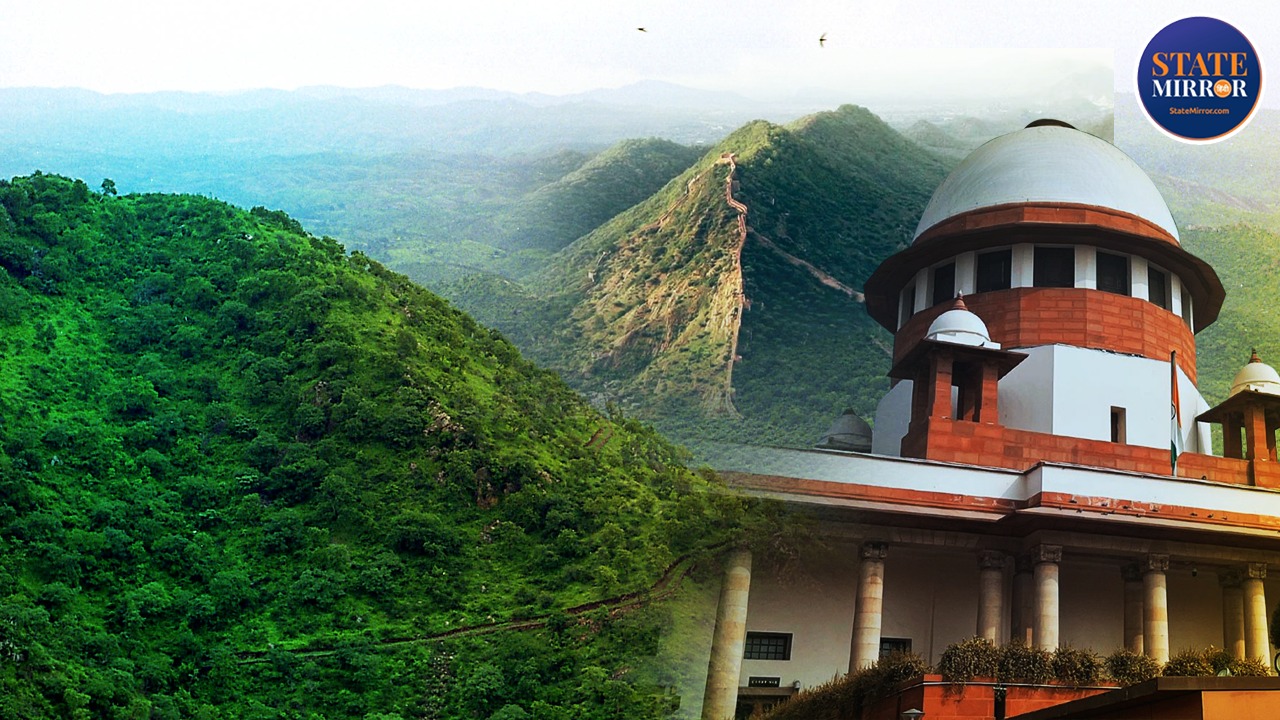
Big question on Aravali! Supreme Court accepted the government’s 100 meter rule, ignoring the warning of its own committee

aravalli hills The recent decision of the Supreme Court regarding the safety of water has raised a big constitutional and environmental question. The Supreme Court accepted the 100 meter height-based definition of Aravali proposed by the Central Government, whereas the Central Empowered Committee (CEC) constituted by the same court had clearly opposed this definition. This has been revealed in a detailed report of Indian Express.
Read now on WhatsApp also, click to subscribe
On October 13, the Ministry of Environment, Forest and Climate Change (MoEF&CC) proposed a new definition of the Aravalli Hills before the Supreme Court. According to this proposal, only structures 100 meters or higher will be considered Aravali. But the very next day, i.e. on October 14, the Central Empowered Committee of the Supreme Court appointed Amicus Curiae K. By writing a letter to Parameshwara, he clearly said that CEC has neither examined nor approved this recommendation. Despite this, on November 20, the Supreme Court accepted the ministry’s 100 meter definition.
What is Central Empowered Committee (CEC)?
CEC was formed by the Supreme Court in the year 2002. Its function is to monitor compliance with the environment and forest related orders of the court and to provide expert opinion to the court in matters related to conservation. CEC also underlined in its letter that for the definition of Aravali, only the standards set by the Forest Survey of India (FSI) should be adopted, so that the ecology of this ancient mountain range can be protected.
What does the definition of FSI say?
FSI had prepared a detailed map of Aravali under the order of the Supreme Court in 2010. According to this mapping, 40,481 square kilometer area in 15 districts of Rajasthan was considered as Aravalli. A slope of at least 3 degrees along with a minimum elevation was made the basis for identifying Aravali. Under this definition, low hills and small hillocks also come under protected areas. That is, the definition of FSI sees Aravali as a continuous and geographical unit, and not just on the basis of height.
Amicus Curiae also opposed the 100 meter rule
According to the Indian Express, in a PowerPoint presentation presented in the court, Amicus Curiae K. Parameshwara, citing FSI data, rejected the ministry’s 100 meter definition. It was said in the presentation that the imposition of a limit of 100 meters will destroy the geographical integrity of Aravali, it will lead to fragmentation of the hills and Aravali will not be able to survive as a protected mountain range. Parmeshwar concluded that MoEF&CC’s proposal is vague and should not be accepted.
Committee meeting, but CEC’s opinion not included?
In May 2024, the Supreme Court had directed the ministry to form a committee under the chairmanship of the Environment Secretary to decide on a uniform definition of Aravali so that illegal mining can be stopped. In this committee, Dr. J.R. was present on behalf of CEC. Bhatt was made the representative. But on October 14, CEC chairman and former DG (Forests) Siddhant Das wrote a letter saying that the draft minutes of the committee’s meeting on October 3 were never given to the CEC, and the report prepared by the ministry was not investigated by the CEC. Whereas the views presented in the Ministry’s affidavit in the name of CEC are actually the personal views of Dr. Bhatt and not of the CEC. The special thing is that the report filed by the ministry was unsigned.
90% Aravali Hills in danger?
The Indian Express, citing an internal assessment on 26 November, reported that if the 100 meter definition is applied, 91.3% of the 12,081 hills 20 meters or higher will be excluded. If a total of 1,18,575 Aravali hills are considered, more than 99% will not be able to fulfill the condition of 100 meters. 20 meters height is also considered important because such high hills act as wind barriers to prevent sand storms.
Will the way for mining open?
Amicus Curie told through his map that if the 100 meter rule is implemented, then small hillocks will be out of the definition of Aravali. These could be opened up for mining and development activities and this could accelerate the eastward expansion of the Thar Desert. He termed it a “serious ecological crisis”.
Government and FSI’s response
FSI issued a statement on social media saying that it has not conducted any study which states that 90% of Aravali will become unsafe. However, The Indian Express clarified that these figures were based on FSI’s internal assessment and not on any official study. Meanwhile, Environment Minister Bhupendra Yadav said that mining is allowed in only 0.19% of the Aravalli region. This area is about 278 square kilometers. But the ministry’s own figures show that this is 278 sq km of already operational mining areas – in Rajasthan, Gujarat and Haryana.
The biggest question still unanswered
The government has not been able to clarify how much scope for mining and development will open up in future after excluding the hills below 100 meters. Unless ground demarcation is completed, how can it be said that more area will fall in Aravali under the new definition? It is this contradiction that has brought this decision of the Supreme Court to the center of the debate on environmental protection versus development.

Comments are closed.