
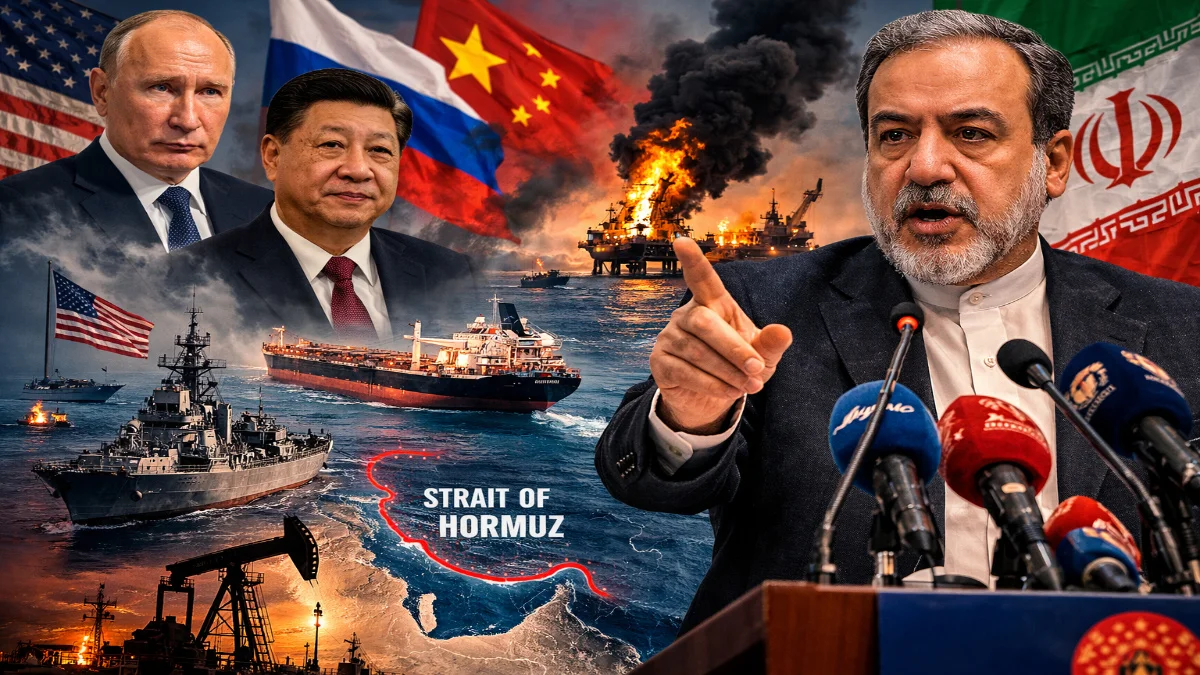

The Middle East is also on the verge of a new and more perilous geopolitical conflict since Iran is sending signals to the world that it is ready to intensify its counteractions to the United States and its supporters in case the dispute further escalates. The latest statements of an Iranian Foreign Minister Abbas Araghchi indicate that the regional conflict is no longer limited to the direct encounters between Iran and its antagonists but is progressively becoming a part of the overall global power relations between Russia and China. In his remarks, he points how the present crisis has developed into a complicated geopolitical rivalry that goes well beyond the Persian Gulf and is defining the strategic thinking of a few of the largest powers.
Araghchi disclosed in a recent interview that Iran is getting military alliance with both Russia and China, which he termed as the strategic associates of Tehran. Although he refused to mention the character or the extent of this co-operation, his word has a heavy connotation. The Iran-Russia-China relationship has been slowly rolling out over the last ten years with the economic relations, diplomatic coordination, and increasing defense relations. The comments made by Araghchi seem to affirm the fact that this relationship is growing increasingly further with the increasing tension with the United States and Israel. These alliances are of great significance to Iran as they become a key counter measure to the pressure of the west, especially when Iran is confronted with military pressures, as well as economic sanctions. To Russia, and China, a stronger relationship with Iran will give them the chance to increase their influence in an area that has been long dominated by the western security systems.
The remarks of the Iranian foreign minister were made just after Donald Trump made comments concerning reports that Russia may be supplying intelligence information to Tehran on the whereabouts of American military troops that may be within the region. In response to such reports, Trump would have been asked directly but replied with a statement of doubt that Russia was the one feeding such information but that it was not yet ascertained. There has been no concrete evidence that has been publicly tabled however with the mere mention of the suggestion it highlights the fact that the geopolitical environment that surrounds the conflict is becoming increasingly more complex. the fact that intelligence sharing between Moscow and Tehran is actually taking place would indicate a greater degree of strategic coordination between nations that are becoming more and more interested in U.S. influence as a threat to their own security and political well being.
Concurrently, Iran has also put forth threats that it is ready to retaliate against the energy infrastructure throughout the Persian Gulf in the occasion its own oil infrastructure is struck by American troops. Araghchi said that Iran armed forces would attack the energy facilities of American corporations or in which American corporations have shares in case of the United States attacking Iranian oil facilities. This reaction would considerably increase the war as the Persian Gulf is home to some of the most important oil and gas production units in the world. Large energy producers like Saudi Arabia, the United Arab Emirates, Kuwait, and Qatar depend on extensive systems of pipelines, refineries, and export terminals to feed the international markets. Any assaults against these plants would have instant effects on the prices of energy all over the world and may lead to broader economic impacts.
The fact that Iran has issued a warning shows its fundamental role in the energy infrastructure of Iran to both the economy and the national security of the country. Iranian oil exports represent a substantial source of government income and any effort to put that sector out of commission would most probably be perceived by Tehran as an existential danger. The Iranian government has thus indicated clearly that it will not sit passive as its energy industry is attacked without taking any action. Threatening to widen the battlefield to cover the energy infrastructure in the region Iran is trying to deter possible attacks by increasing the cost of escalating the battle to its opponents.
The Strait of Hormuz is one of the most dangerous hotspots in this escalating conflict, this slim but strategically important waterway between the Persian Gulf and the Gulf of Oman and the rest of the global ocean. The strait is one of the most vital shipping routes in the world, where a greater percentage of the world oil transit occurs on an everyday basis. Araghchi states that Iran has practically blocked the passage since the beginning of March. Although he underlined that vessels owned by countries that are not allied to the United States or Israel can still pass, he made it clear that Tehran has no plans of totally opening the strait as it is now.
The fact that the Strait of Hormuz is being partially closed already has had ripple effects throughout the global economy. Cargo delays have increased oil prices and put the energy-importing nations on alert over the risk of shortage of supplies. The markets in fertilizers have not been spared as most of the raw materials in the production of fertilizers are transported on the same shipping routes. In case the situation deteriorates and the strait is fully closed, the effects may be devastating to the world trade and security of energy.
The United States has also allegedly sought international collaboration in order to guard the shipping passages in the area and safeguard business ships passing through the strait as an answer to the emerging risks. Nevertheless, the officials of Iran say that the current security framework led by the U.S. in the Gulf has failed to eliminate instability and even results in the current crisis. Araghchi condemned the strategy of Washington saying that the American policy has been as holesome as ever and has promoted war instead of preventing it. In the view of Tehran, the presence of foreign military in the region has in many instances escalated tension instead of setting it aside.
The crisis has similarly resulted in acute conflict between Iran and some of the Gulf states. Araghchi claimed that the United Arabs Emirates was permitting the United States to attack Iran through positions on its land, such as Dubai and Ras Al-Khaimah. He cautioned that the use of crowded places as platforms to launch military forces might pose a threat to the lives of civilians and might widen the chances of further compounding. Emirati officials quick to dismiss these accusations termed the allegations as part of a mixed policy by Iran. UAE stressed that it reserves the right to protect itself against the threats, but still tries to find diplomatic solutions to the crisis. Authorities in other Gulf nations have also refused giving the U.S. troops permission to launch attacks using civilian territory on its soil.
In the meantime, there is a bigger conflict that has caused the current crisis that is still going on. Retaliation attacks, missile and drone attacks have been on the rise in the region since joint U.S. and Israeli attacks on Iranian facilities on February 28. Iran officials assert that the attacks took away lives of over 1300 individuals including the former Supreme Leader Ali Khamenei in Iran and this led to escalation of tension in the region. Iran, in its turn, has launched missiles and drone attacks targeting targets associated with Israel and countries that host American military resources. Such strikes have left lines of aviation flights, displaced air transport off the area, and further created new uncertainty on financial markets of the globe.
The increasingly approaching clash has already led to the speculations that the Middle East is potentially developing into a far broader conflict between various regional and world leaders. As Russia and China tighten ties with Iran and the United States continues to maintain strong ties with the countries of Israel and some of the most significant countries of the Gulf, the crisis itself becomes more indicative of greater geopolitical tensions. The fact that attacks may spread to critical energy infrastructure or major maritime chokepoints, adds further to the stakes of the international community.
With tensions still mounting, the world is keenly following to determine whether diplomatic talks can help prevent the situation to degenerate even more. The stakes are simply out of this world. The Persian Gulf is the center of the world energy networks and any long term interruption of the shipping routes or oil producing plants would transform international markets and stability of economies. Simultaneously, the fact that the large powers are involved on different sides of the crisis increases the threat of the development of a regional crisis into a significantly bigger geopolitical one.
The region is currently on its toes with governments, businesses and international organizations keeping a close watch on developments. The choice to either de-escalate or even escalate this crisis will be determined by the choices leaders will make in Washington, Tehran, and other capitals during the next weeks. The present moment is therefore a pivotal point of not just the Middle East but also the entire international system because the throwing between diplomacy and confrontation is still hanging on the balance.

Comments are closed.