

112
Kolkata:
The Trinamool Congress, already reeling from the most catastrophic electoral defeat in its history, found itself confronted on Saturday with a fresh legal and organisational crisis. The state’s Criminal Investigation Department issued a summons to Abhishek Banerjee, asking him to appear before investigators on Monday, June 1, in connection with an alleged forgery of legislators’ signatures—a development that threatens to further destabilise a party that is visibly fracturing at every level.
The CID summon relates to an ongoing investigation into allegations that signatures of several TMC MLAs were forged on a letter connected to the nomination of a Leader of Opposition in the West Bengal Legislative Assembly, which was submitted to the Assembly Speaker.
The controversy centres on a letter that reportedly nominated senior TMC leader Sobhandeb Chattopadhyay as the Leader of Opposition in the Assembly, with investigators examining claims that signatures of some legislators were affixed on the document without their consent. The CID is seeking to determine how the letter was prepared, approved and submitted. It has also visited some MLAs in connection with the probe, while party spokesperson and MLA Kunal Ghosh was also served a notice on Saturday.
The timing of the summons could hardly be more fraught.
It arrives barely three weeks after the BJP secured a historic 208 seats in the Assembly election, ending Mamata Banerjee’s 15-year rule in West Bengal.
The TMC, which had governed Bengal since 2011, was reduced to a rump of 80 seats, a drubbing that has since set off a chain reaction of resignations, recriminations and mass defections that party leaders are struggling to contain.
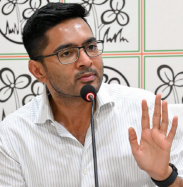
Abhishek Banerjee, the Diamond Harbour MP who is the number two in the TMC hierarchy and the principal architect of the party’s electoral strategy, received the CID notice with characteristic combativeness.
He slammed the BJP and declared that he would not be intimidated by investigative agencies after being summoned by the West Bengal CID in connection with cases registered against him. Reacting to the summons and the FIRs filed against him, Banerjee struck a defiant tone, saying, “Even if you slit my throat, you will have to take seven births to make me cower down.”
Speaking to reporters after receiving the notice in person, Banerjee said he would consult his legal team before responding. “I am yet to see the content of the notice. I will consult with my lawyers and make an appropriate response. I will surely cooperate with the probe in whatever manner possible,” he said.
Banerjee further accused the authorities of deploying multiple agencies to target him and said no amount of pressure would force him to back down. “Let them do whatever they want. They can do whatever they want. Understand it this way, earlier it was just ED, CBI and now it is Bengal Police and Kolkata Police too, along with KMC (Kolkata Municipal Corporation),” he said, referring to notices alleging illegal construction at his plush home in south Kolkata.
His response, defiant in tone but careful to signal compliance, is consistent with the posture he has maintained across a succession of legal challenges over the years—engaging with the process while contesting its legitimacy at every step.
The legal pressure on Banerjee comes at a moment when his authority within the party is itself a matter of some controversy. Several senior TMC figures have pointed to Abhishek’s centralised style of functioning as having disconnected the party from its traditional grassroots workers. One resignation letter, from Lok Sabha MP Kakoli Ghosh Dastidar, blamed political consultancy firm I-PAC—closely associated with Abhishek’s election management—for having “ruined” the party, urging party supremo Mamata Banerjee to “take charge”.
The state of the party on the ground is, by any measure, alarming.
Kakoli Ghosh Dastidar, a four-time MP from Barasat and one of the TMC’s most prominent faces in Parliament, resigned from her post as president of the All India Trinamool Mahila Congress as well as from all other organisational positions within the party.
In a blistering resignation letter, she cited her “troubled conscience” over the party’s handling of corruption in ration distribution, teacher recruitment irregularities and the alleged tampering of evidence in the RG Kar Medical College rape and murder case. Her subsequent attendance at an administrative meeting chaired by Chief Minister Suvendu Adhikari triggered speculation—which she publicly denied—about a possible political realignment.
She was not alone.
Former Rajya Sabha MP Santanu Sen resigned as TMC’s national spokesperson, also citing the RG Kar controversy, job scams and what he characterised as unethical acts and corruption within the party. TMC councillors Arup Chakraborty and Sushanta Ghosh also stepped down from their respective positions.
Around 127 TMC leaders and councillors have reportedly resigned from 15 municipalities, municipal corporations and gram panchayats, with more than 181 cases filed against TMC leaders and dozens arrested.
At the Bhatpara Municipality alone, the collapse was near-total. The Bhatpara vice-chairperson said he had “no alternative” but to resign, alleging that employees were not receiving salaries and that the TMC leadership had failed to provide any guidance.
The situation in Chandannagar Municipality was worse. In the 33-ward civic body, 30 out of 31 TMC councillors, including Mayor Ram Chakraborty, resigned on Friday.
Perhaps the most telling symptom of the party’s disarray has been the near-desertion of its legislative benches.
At a recent TMC protest against the new state government, only 36 of the party’s 80 MLAs showed up—fewer than half—indicating deep anxiety and fracturing within the party ranks.
In addition, the whereabouts of many second-rung leaders, who had built local fiefdoms over 15 years of TMC rule, remain uncertain. Several are believed to have chosen to lie low, calculating that a period of quiet invisibility is preferable to public association with a party now under intense legal scrutiny and rapid loss of civic power.
The fact that several TMC MLAs have attended meetings chaired by leaders including Suvendu Adhikari and Union Minister Nisith Pramanik has only deepened speculation about the party’s future.
BJP MP Soumitra Khan has claimed that if the central leadership in Delhi gives the green signal, as many as 20 TMC MPs are ready to switch allegiances to the BJP.
Senior TMC leaders like Sougata Roy have dismissed such claims as baseless, but the poor attendance at legislative protests has given even optimistic voices within the party reason to pause.
According to political commentator Biswanath Chakraborty, for Abhishek Banerjee, Monday’s appearance before the CID will be both a legal test and a political one.
“His ability to project confidence and command in front of investigators—and before a demoralised party watching closely—may say as much about the future of the TMC as the investigation itself,” he told Read.

Comments are closed.