
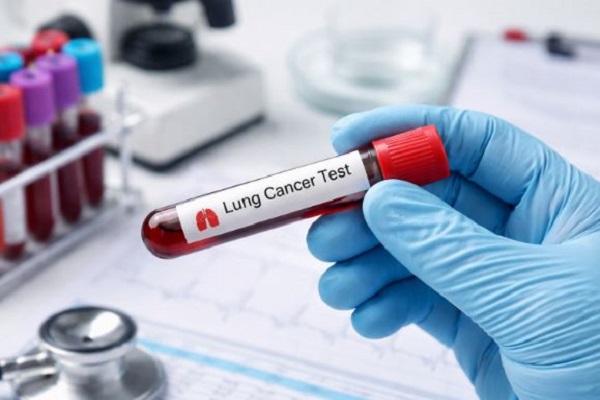
Achievement of British researchers: New blood test will help in early detection of lung cancer

New Delhi, 17 December. A team of British researchers has developed a new and advanced blood test that can detect and monitor lung cancer in real time. This will reduce the delay in diagnosis of the disease and improve the treatment outcomes of patients.
FT-IR Used microspectroscopy technique
Using Fourier transform infrared (FT-IR) microspectroscopy technique, researchers were able to identify even a single lung cancer cell present in the patient’s blood. This technology works by combining advanced infrared scanning technology and computer analysis. In this, attention is paid to the specific chemical identity (chemical fingerprint) of cancer cells. This information was given by researchers from University Hospitals of North Midlands NHS Trust (UHNM), Keele University and Loughborough University.
In future, it can also be used in the investigation of many other types of cancer.
Professor Josep Sule-Suso, lead author of the study and associate specialist in oncology at UHNM, said the method could help patients get early diagnosis, personalized treatment and less invasive procedures. In future, it can be used in many other types of cancer apart from lung cancer.
According to research, circulating tumor cells (CTCs) are cancer cells that separate from the tumor and circulate in the body through the blood. These cells help us understand how the disease is progressing and how effective the treatment is. These cells can also cause cancer to spread (metastasis).
CTCs Current methods of identifying complex, expensive and time consuming
Current methods for identifying CTCs are complex, expensive, and time-consuming. Sometimes these methods fail to identify cancer cells because these cells change their characteristics while circulating in the blood.
In the new technique, infrared rays are shone on the blood sample, which are similar to the light of a TV remote, but much more powerful. Different chemicals absorb infrared light differently and CTCs have a characteristic absorption pattern, called their chemical fingerprint. By analyzing this data through computers, it can be quickly detected whether cancer cells are present in the blood or not.
New technology simpler and less expensive than existing methods
This technique, published in the journal Applied Spectroscopy, is simpler and less expensive than existing methods. It uses ordinary glass slides already used in pathology labs, making it easy to adopt into everyday medical practice. Researchers are now planning to try this technique on larger patient groups. Their goal is to develop a rapid and automated blood test that can be easily incorporated into the cancer treatment process.

Comments are closed.