
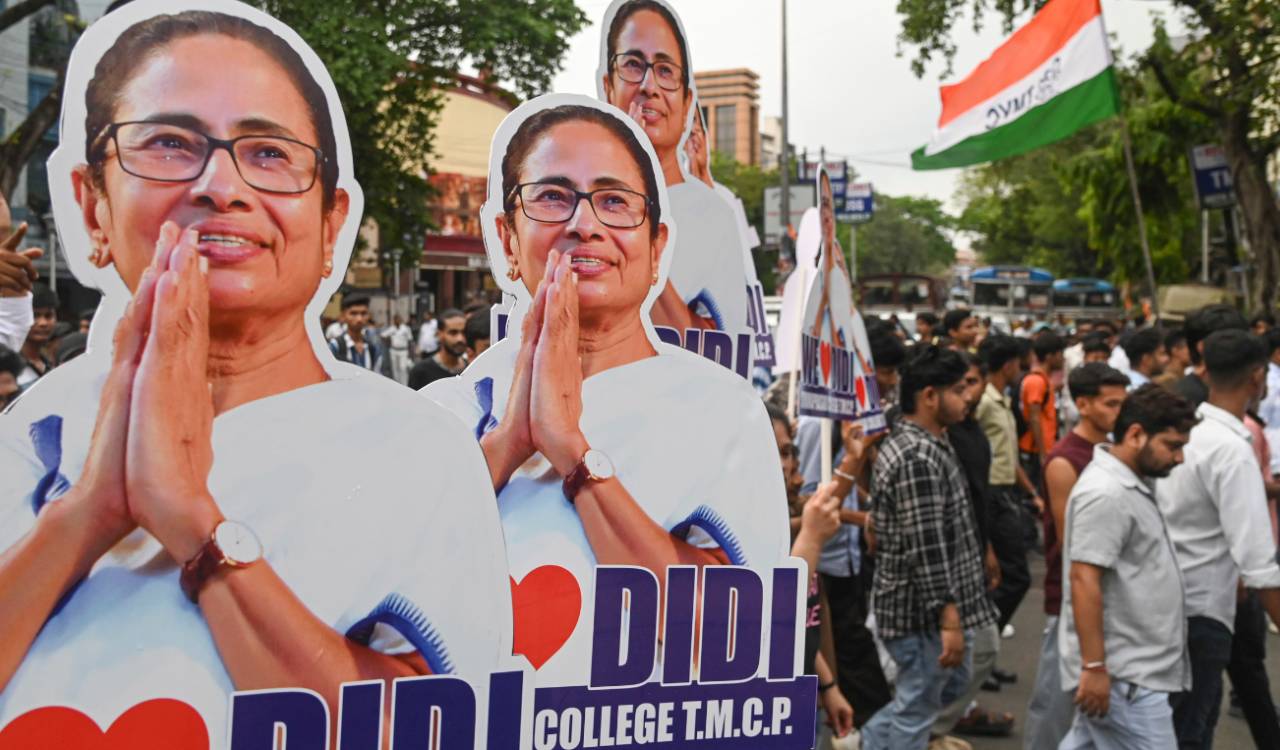

The Trinamool Congress, already shaken by a mass defection in the West Bengal Assembly, now faces the threat of rebellion spreading to its parliamentary ranks. Dissident MPs are rumoured to be preparing a challenge to Mamata Banerjee and Abhishek Banerjee’s leadership.
Published Date – 5 June 2026, 11:09 PM
Kolkata: Barely days after losing control of its legislature party in the West Bengal Assembly, the TMC is now staring at an even bigger political nightmare — the possibility of the rebellion spreading to its parliamentary ranks.
What began as a revolt by dissident MLAs under Ritabrata Banerjee has acquired a national dimension, with speculation growing that a section of party MPs in both Houses of Parliament could be preparing for a similar assertion against Mamata Banerjee and her nephew Abhishek Banerjee, the leader of the TMC Parliamentary party in the Lok Sabha.
Veteran Rajya Sabha MP Sukhendu Sekhar Roy has publicly warned that the unprecedented revolt witnessed in the Assembly could find an echo in Parliament.
“I have never seen around 60 MLAs leave in such a short span of time. A similar reaction is likely in the Lok Sabha too,” he said.
When asked by PTI whether similar developments could take place in the Rajya Sabha, Roy stopped short of making a categorical prediction but said such a possibility could not be ruled out.
Senior TMC MP Sougata Roy dismissed suggestions that the party was on the verge of collapse and accused the BJP of attempting to replicate in Parliament what had happened in the Assembly.
“The BJP may try an operation in the TMC’s Lok Sabha and Rajya Sabha wings, similar to what happened in the West Bengal Assembly. But Mamata Banerjee has fought bigger battles and will bounce back,” Sougata Roy said.
The Assembly rebellion was a political earthquake for a party that, for nearly three decades, revolved around a single organising principle — loyalty to Mamata Banerjee.
For the first time since its birth in 1998, a sizeable section of elected representatives openly challenged the authority of the founder and successfully wrested control of the legislature party, resulting in the Assembly Speaker recognising Ritabrata Banerjee as the Leader of the Opposition.
The question now being asked across Bengal’s political spectrum is whether the Assembly coup was merely the first act. Several developments suggest that the turbulence may not remain confined to the state.
Barasat MP Kakoli Ghosh Dastidar, once considered among Mamata Banerjee’s closest political associates, has repeatedly aired her dissatisfaction with the leadership since being removed as chief whip in the Lok Sabha.
Her public criticism of the leadership and growing distance from the party high command have made her one of the most closely watched figures in the unfolding crisis.
Political chatter in both Kolkata and New Delhi suggests that if a parliamentary challenge emerges, it could coalesce around a group of MPs led by leaders such as Ghosh Dastidar, though none of those concerned has publicly acknowledged any such move.
According to senior TMC leaders, Mamata Banerjee has, over the past two days, spoken to several legislators and MPs, seeking to reopen communication channels with dissidents and exploring the possibility of reconciliation before the rebellion gathers further momentum.
The outreach marks a striking reversal for a leader long accustomed to enforcing discipline rather than negotiating with rebels.
Sources said parallel damage-control exercises are underway in Parliament, with two trusted parliamentarians — one from the Lok Sabha and another from the Rajya Sabha — tasked with reaching out to colleagues amid fears that the Assembly rebellion could spill over into the parliamentary wing.
The urgency reflects growing concern within the remaining TMC leadership that if the revolt acquires momentum in the national capital, the battle for control of the party could evolve into a full-scale organisational challenge.
The TMC currently has 28 MPs in the Lok Sabha and 13 in the Rajya Sabha. Under anti-defection provisions, a group constituting two-thirds of a parliamentary party can potentially avoid disqualification if it breaks away under circumstances recognised by law.
That has given rise to two scenarios being discussed in political circles.
The first resembles what insiders describe as the “Ritabrata model” — MPs remaining under a separate “new TMC” banner while challenging the authority of the existing leadership and claiming to represent the majority within the parliamentary party.
The other is the “merger route”, under which a sufficiently large group — more than two-thirds of MPs could align with another political formation and seek protection from anti-defection provisions.
Adding to the uncertainty are persistent reports of outreach efforts by the BJP towards sections of TMC MPs.
A senior TMC parliamentarian recently claimed that several MPs had been contacted by individuals linked to the ruling party at the Centre, though the BJP has not commented on the allegation.
BJP state president Samik Bhattacharya, however, claimed that several TMC MPs and MLAs were trying to get in touch with his party and were willing to switch sides.
For the BJP, a weakening of the TMC in Parliament would carry significance beyond Bengal politics. For Mamata Banerjee, however, the stakes are existential.
The Assembly setback has already punctured the aura of invincibility that surrounded her leadership for nearly three decades. A split in Parliament would deepen questions about authority, succession and the future shape of a party that has never before faced such a challenge from within.
However, legislative strength alone does not determine ownership of a party’s symbol, organisation or finances. Any group seeking recognition as the “real” TMC would have to convince the Election Commission that it commands majority support not only among MPs and MLAs, but also within the party organisation.

Comments are closed.