
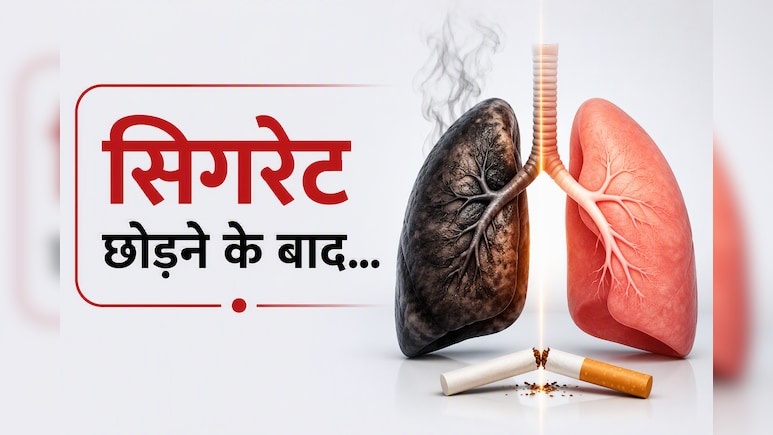
After how many days do lungs become normal after quitting smoking? As soon as you say goodbye to cigarettes, these amazing and magical changes start appearing in your body within minutes.

Addiction to smoking or cigarette smoking not only makes the lungs black and hollow from inside, but it also gradually damages the heart, brain and every organ of the body. Many times people do not quit smoking thinking that ‘Now the lungs have become very bad, what will be the benefit of quitting now?’ However, medical science and pulmonologists (lung doctors) believe that your body and lungs are adept at regenerating and healing themselves. As soon as you smoke your last cigarette and say goodbye to smoking, within just 20 minutes your body’s recovery mechanism gets activated and the healing process starts. From 20 minutes to 72 hours: The effect of nicotine wears off and breathing improves. The first few hours and days of quitting smoking are very important for the body: After 20 minutes: Heart rate and blood pressure start coming back to normal levels. After 12 hours: The level of poisonous carbon monoxide present in the blood falls to normal and the oxygen level increases. After 24 to 48 hours: The risk of heart attack starts decreasing. Nicotine is completely eliminated from the body, due to which the ability to smell and taste improves tremendously. After 72 hours: The bronchial tubes (respiratory tubes) begin to relax, making breathing much easier and the body’s energy levels increase. 2 weeks to 9 months: The ciliated cells of the lungs are regenerated. Within 2 to 12 weeks of quitting smoking, blood circulation in the body improves significantly and lung capacity increases by about 30 percent. Between 1 and 9 months, tiny hair-like structures inside the lungs called ‘cilia’ begin to grow and become active again. These cilia work to push out mucus, dust and toxins accumulated in the lungs. During this period, chronic cough, problem of breathlessness and heaviness in the chest disappear to a great extent. 1 year to 15 years: The risk of cancer and heart attack is halved. As time goes on, the healing of the lungs deepens: After 1 year: The risk of coronary heart disease is halved (50%) compared to a smoker. After 5 to 10 years: The risk of lung cancer, mouth cancer, throat cancer and stroke (paralysis) reduces to half. After 15 years: The risk of heart disease and untimely death becomes equal to that of a person who has never touched a cigarette in his life. Quitting nicotine addiction is easy with willpower and proper medical advice. Health experts say that there is no age or time that is too late to quit smoking. Whether you have been smoking for 5 years or 20 years, the day you quit, both your age and health will start increasing. Nicotine withdrawal symptoms like irritability, restlessness or cravings may occur in the first few days, but this addiction can be easily overcome with the help of deep breathing exercises, drinking enough water, chewing gum or nicotine replacement therapy (NRT).

Comments are closed.