

Human Skills Emerging as a Competitive Advantage
As Indian businesses accelerate artificial intelligence adoption, employers are placing greater emphasis on human skills such as empathy, leadership and decision-making, according to a new study by the International Workplace Group (IWG).
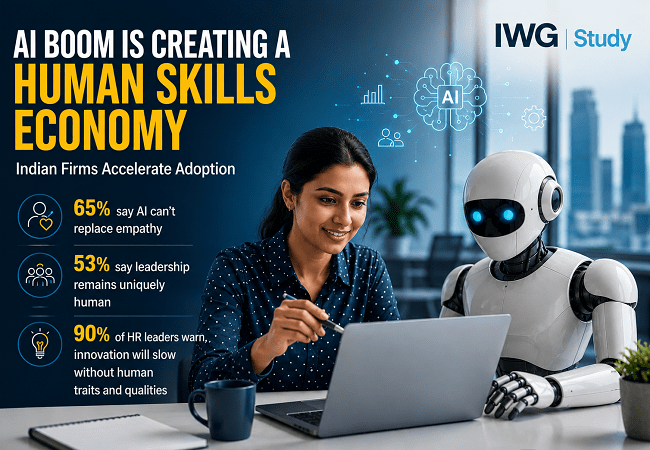
The research found that 90% of HR leaders believe innovation will suffer if organisations fail to prioritise human capabilities alongside technological skills.
The findings point to the emergence of what IWG describes as a “Human Skills Economy”, where qualities such as judgement, creativity and collaboration play a growing role in business performance.
AI Adoption Continues to Accelerate
AI tools are becoming a standard part of workplace operations.
According to the survey, 73% of hybrid teams already use AI tools such as ChatGPT. Meanwhile, 82% of organisations provide AI training programmes.
However, only 45% of HR leaders believe their organisations are effectively addressing AI-related skills gaps.
The findings carry particular significance for India, which has one of the world’s highest AI adoption rates and one of its youngest workforces.
Industry studies cited by IWG show that 73% of Indian workers use AI tools regularly, ahead of both the United States and the United Kingdom.
Human and AI Collaboration Defines the Future
As automation reshapes workplaces, employers are reassessing which skills will remain uniquely human.
The study found that 65% of HR leaders do not believe AI can replicate empathy. Another 64% said AI struggles with complex decision-making, while 53% believe leadership will remain a distinctly human capability.
At the same time, employers expect workers to combine technical knowledge with AI literacy.
The report noted that younger employees are increasingly helping older colleagues adopt AI tools and integrate them into daily workflows.
This trend reflects a broader shift towards workplaces where humans and AI operate as complementary partners.
Hiring Priorities Are Changing
Employers are also changing how they evaluate candidates.
The study found that 66% of HR leaders consider human skills more important than experience, technical qualifications or educational background during hiring decisions.
Meanwhile, 45% of employers increasingly assess career transitions and employment gaps to better understand candidates’ broader professional journeys.
The findings come as competition for entry-level jobs intensifies globally. Industry estimates suggest entry-level IT roles in India have declined by 20% to 25% as automation absorbs routine tasks.
Hybrid Work Supports Human Skill Development
The report highlighted the role of hybrid work environments in developing interpersonal skills.
More than half of HR leaders surveyed said hybrid workplaces provide an effective setting for building empathy, leadership, collaboration and judgement.
IWG believes these environments encourage mentorship, trust-building and stronger decision-making capabilities.
Industry Leaders Weigh In
“Every major technological shift has redefined how we work,” said Mark Dixon.
“AI is no different. Organisations that combine AI efficiency with uniquely human skills will be best positioned to drive innovation, leadership and growth,” he added.
Harsh Lambah said India is well placed to benefit from the trend.
“India has the world’s youngest workforce and one of the fastest rates of AI adoption. The workplaces that succeed will be those where people and AI grow together,” he said.
The New Workforce Equation
As businesses move from AI experimentation to large-scale deployment, workforce strategies are evolving.
Industry bodies expect demand for AI talent in India to grow significantly over the next few years. However, experts warn that shortages of qualified professionals could slow innovation.
The IWG report suggests that future workforce readiness will depend on more than technical expertise alone.
Companies that combine AI capabilities with strong human skills may gain a competitive advantage as workplaces become increasingly AI-driven.

Comments are closed.