
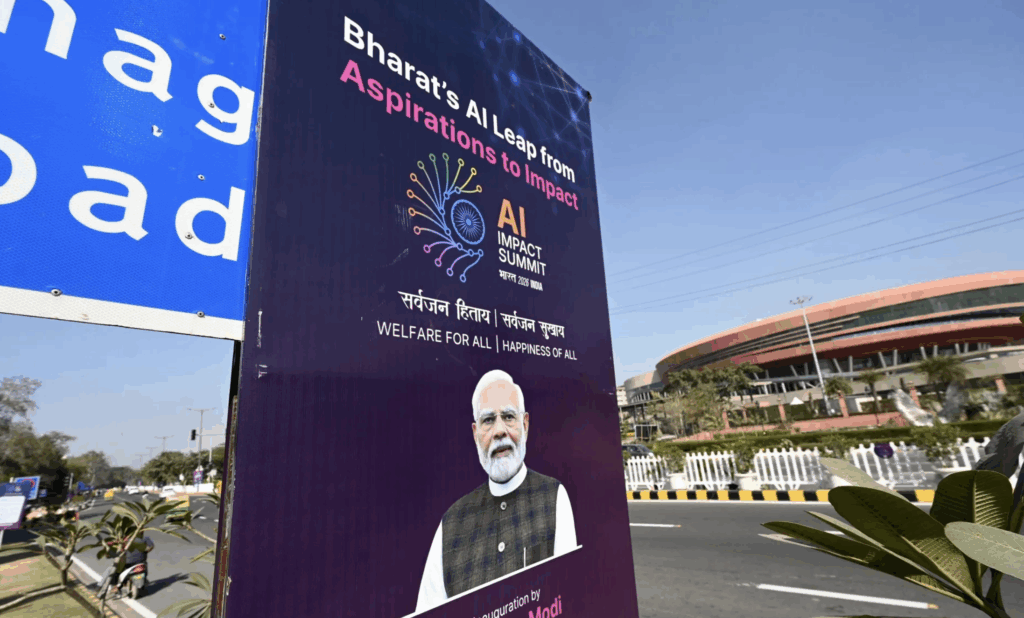

On February 17, 2026, at the India AI Impact Summit in New Delhi, Ashwini Vaishnaw announced that India will increase its AI computing capacity from 38,000 GPUs by adding 20,000 more under AI Mission 2.0.
He stated that purchase orders for these GPUs would be issued within a week, with deployment expected over the next six months.
Ashwini Vaishnaw Announces 20,000 More GPUs Under India’s AI Mission 2.0 at India AI Impact Summit 2026
The expansion is part of AI Mission 2.0, which places greater emphasis on research and development, innovation, wider AI adoption, and shared computing infrastructure.
Emphasizing accessibility, he said, “It is a constant endeavor to provide high-quality resources to our startups, researchers, and students.”
The announcement also aligns with the 2026 India–U.S. trade framework, which aims to significantly boost bilateral trade in technology products such as GPUs and data center equipment.
Under this framework, India intends to purchase $500 billion worth of U.S. energy products, aircraft, technology goods, and critical materials over five years, while deepening joint technology collaboration.
The AI expansion builds on the IndiaAI Mission approved in March 2024 with a budget of ₹10,371.92 crore (around $1.14 billion) spread across five years.
Although the original goal was 10,000 GPUs, the program has already deployed 38,000 units, available at a subsidized rate of ₹65 per hour (about 72 cents).
With 20,000 additional GPUs planned, publicly supported AI compute resources will grow further, benefiting startups and academic institutions.
Since its inception, the mission has developed seven core pillars, including subsidized compute access, foundation model creation, startup funding, and responsible AI governance.
Twelve Indian Startups Chosen to Develop Indigenous Multimodal Foundation Models
Twelve startups have been selected to build indigenous multimodal foundation models using datasets tailored to Indian contexts.
The summit itself highlights these initiatives and brings together policymakers, researchers, and industry leaders to position India as both an AI consumer and producer.
Vaishnaw indicated that earlier projections of $1 trillion in AI-related investments may be surpassed, noting that $90 billion has already been committed.
Of this, $200 billion is tied to infrastructure, while $70 million has been pledged by venture capital firms toward deep-tech and application-layer innovation.
He suggested that over $400 billion could be invested across five layers of the AI stack within two years.
Government estimates indicate India’s technology sector will exceed $280 billion in revenue this year, and AI could contribute $1.7 trillion to the economy by 2035.
Currently, around six million people are employed in India’s tech and AI ecosystem.
Aligning semiconductor policy with AI goals, he stated, “In Semicon 2.0, design will be the primary focus,” adding that at least 50 deep-tech firms are expected to emerge.
Plans are underway to begin commercial production at a major memory chip facility, with formal announcements expected soon.
Multiple companies have expressed interest in establishing memory manufacturing operations in India.
Under ISM 2.0, research initiatives are targeting intellectual property development in high-density memory technologies, and researchers have responded positively.
Stressing technological sovereignty, Vaishnaw said, “The key point is that we should be able to control our own destiny,” and affirmed that industry, government, and academia share this commitment.
This strategy spans compute infrastructure, semiconductors, and energy, with 51% of India’s power capacity now sourced from clean energy.
With expanding compute resources and a stronger focus on semiconductor design, India’s next AI phase will determine whether infrastructure growth can lead to globally competitive products and intellectual property.
Image Source

Comments are closed.