
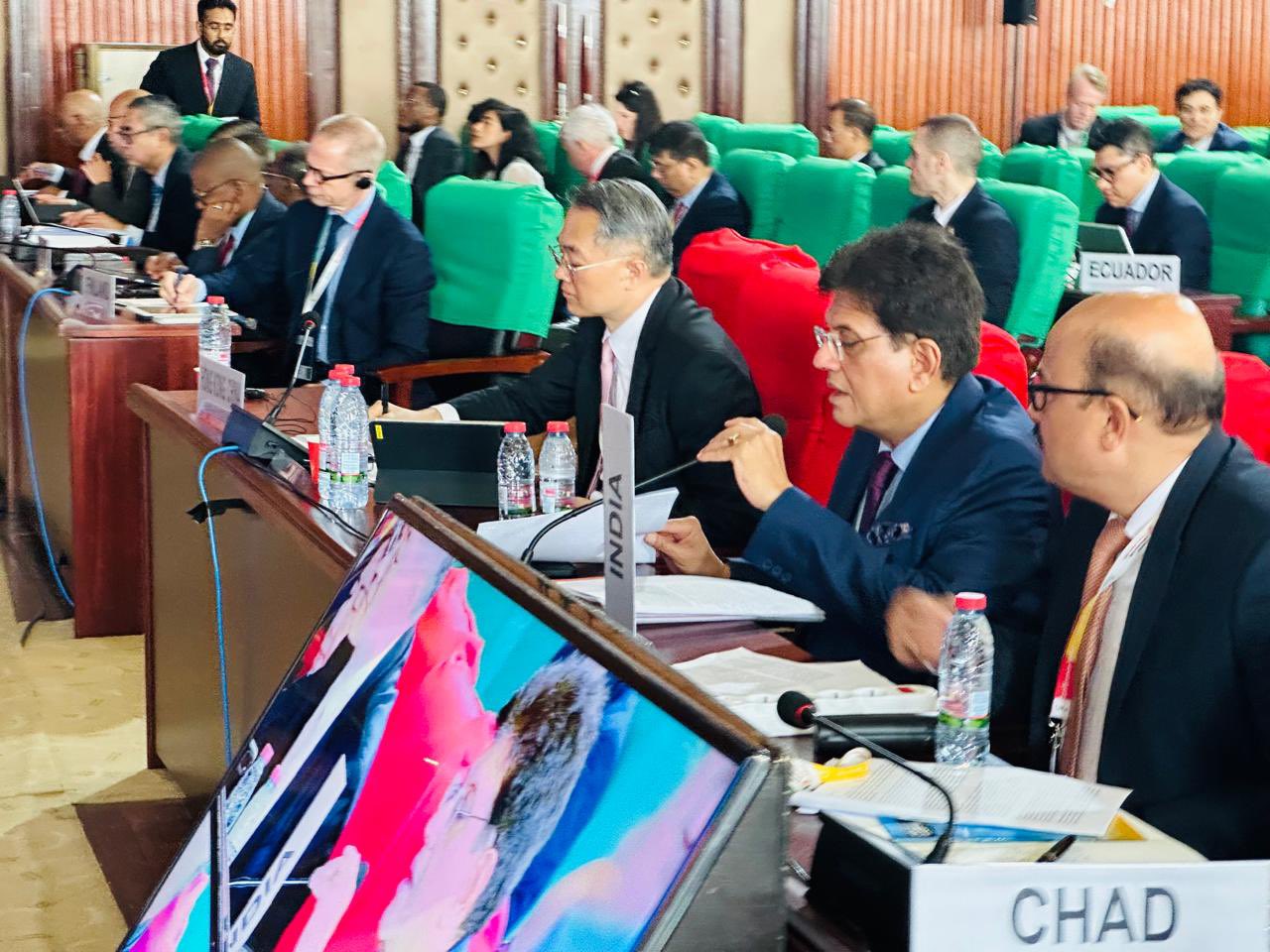

Union Commerce Minister Piyush Goyal returned from the WTO Ministerial Conference in Cameroon recently after defending India’s position on key issues, including WTO reforms and fisheries subsidies. He also blocked the China-led Investment Facilitation for Development (IFD), stood firm on public stockholding for food security, and signalled some flexibility on e-commerce duties.
India could perhaps have taken a more pragmatic view—perhaps even joined—the EU-led Multi-Party Interim Appeal Arbitration Arrangement (MPIA), in the interest of forging a broad new grouping that would have strategic significance beyond just bypassing the deadlocked WTO dispute resolution mechanism. But it didn’t. In short, on the multilateral stage, India showed iron resolve, standing by principle even if it had to return empty-handed and forgo significant investment flows.
Also read | How Piyush Goyal bowed to Trump while playing cowboy with China
Yet, the same Indian government seems to turn to putty when dealing bilaterally with US President Donald Trump. The Hindu recently reported that India and the US are close to finalising an interim trade deal, with the revelation by an unnamed American official surfacing tellingly just as the WTO Ministerial got underway.
India navigates trade deal
Now, Goyal has confirmed that India is willing to sign an interim trade deal with the US, provided India gets a preferential tariff compared to its competitors. The minister revealed that this was the underpinning of the India-US joint statement of early February. Thus, since Trump gave Pakistan a 19 per cent rate, India was happy to settle for 18 per cent.
That the government wants to stick to the logic of the joint statement is concerning. The statement was agreed upon before the US Supreme Court ruling on Trump’s tariffs. On February 20, the court ruled that Trump’s reciprocal tariffs, which he had used as a bludgeon to force nations, including India, into unfavourable deals, were illegal. It’s curious that the Modi government sought the trade deal even as the US court ruling was impending. It’s doubly curious that it wants to persist with the same framework when the very basis for its negotiation has been invalidated.
The US Supreme Court’s ruling gave countries a chance to fight back against Trump and force trade matters to return to a multilateral setting. The European Union (EU), which had bent to Trump’s will earlier, is using the opportunity as best it can.
On March 26, the European Parliament approved the EU’s deal with Trump but unilaterally altered the terms to add safeguards. These included a ‘sunrise clause,’ tying the EU’s tariff cuts to the US’s compliance; a ‘sunset clause,’ under which the entire deal automatically expires on March 31, 2028, thereby limiting potential damage from the deal to two years; and an ‘anti-coercion clause,’ allowing the EU to suspend the deal if the US breaches the agreed 15 per cent tariff ceiling or, critically, threatens EU territorial integrity (think Greenland) or policy (think AI guardrails).
In addition, the EU has also joined up forces with the Comprehensive and Progressive Agreement for Trans-Pacific Partnership (CPTPP), which includes Japan, Canada, Australia, and the UK, to forge what looks like a ‘World Minus One’ strategy on trade, of which the MPIA is one manifestation.
India faces US pressure
What did India do? The Narendra Modi government had, before the US court ruling, agreed to an asymmetric deal, headlined by the 18 per cent tariff on Indian exports and a commitment to buy $500 billion worth of American goods over five years. Prime Minister Modi had gone all the way to Washington in February 2025 and presented that figure of $500 billion to Trump as a shared ambition for India-US trade; Trump turned that into Modi’s commitment to “Buy American”, all ostensibly to correct for India’s $45 billion trade surplus with the US!
The government’s huge sigh of relief at having secured even this deal was heard around the world, thanks to Goyal’s cringeworthy press conferences to tell people what a fantastic deal it was. As Mark Twain might have said, the celebration was both premature and highly exaggerated.
Also read | ‘India seeks preferential market access in US trade talks,’ says Piyush Goyal
After the US court ruling, Indian officials deferred a planned trip to Washington to finalise the interim deal, but Goyal continued to hold “productive discussions” with American officials. Instead of initiating a smooth renegotiation, Trump imposed a temporary 150-day global tariff (currently 10–15 per cent) and singled out India, along with a few other countries, for an investigation into unfair trade practices, continuing his economic pressure on New Delhi. That the government is ready to press ahead with a deal under such circumstances is worrying.
Planes over prudence, again
If the structure of the deal raises concerns, the proposed means of fulfilling it raises alarm. Perhaps the most alarming aspect of the February deal was the government’s plan to fulfil the $500 billion purchase commitment. Goyal spoke enthusiastically about India buying more Boeing aircraft, noting that pending orders from Indian airlines already amounted to around $50 billion, and additional orders could take that figure to $80-100 billion.
Think about it: A senior Indian minister was publicly promoting the purchase of billions of dollars’ worth of Boeing aircraft at a time when India is investigating the devastating crash of a Boeing 787 (flight AI171), which has become a geopolitical hot potato between India and the US. It was not just inappropriate, it was self-defeating, and a sign of the government’s desire to stay on the right side of Trump at almost any cost.
Leaks to American and European media now suggest that India is under pressure to declare that one of the AI171 pilots caused the crash, whereas it is emerging that it was likely the result of Boeing’s electrical and software/data network design and architecture choices, compounded by multiple manufacturing defects on the aircraft (as revealed by Boeing whistleblowers and a history of incidents and near-mishaps since the 787 first took to the skies), and triggered by proximate maintenance failures—all wrapped in a blanket of certification, approval and advisory failures of the US Federal Aviation Administration (FAA).
That last point—the regulatory failures of the FAA—is where the AI171 crash investigation intersects with the India-US trade deal, due to a barely disguised American push on India to remove “non-tariff barriers”.
FAA failures under scrutiny
The FAA has long been regarded as the gold standard in aviation regulation. Regulators around the world, including India’s Directorate General of Civil Aviation, have, for the most part, accepted FAA standards, certifications, and advisories. However, revelations regarding the Boeing 737 Max and 787 Dreamliner approval and certification practices show that the FAA has, over the past two decades at least, failed to do its job.
For one, the FAA allowed Boeing itself to certify many aspects of its planes, an ethical and practical disaster, as the 737 Max crashes have already demonstrated, and the 787 crash in India is also likely to prove.
For another, in 2013, the FAA had to ground the Dreamliner fleet after multiple incidents of the aircraft’s Li-Ion battery catching fire in Japan and elsewhere. Boeing built an enclosure to prevent the fires from spreading, but could not eliminate the fires themselves, as the root cause could not be identified even after extensive investigations. Yet, the FAA allowed the 787s back into service. The sequence of events leading to the AI171 crash could well have started with a battery thermal runaway on the ill-fated aircraft.
For a third, some of the FAA’s advisories are now known to have been wrongly categorised, sometimes in ways that conceal the potential consequences of critical faults on Boeing planes. In the wake of the AI171 crash, for instance, it came to light that in 2018, the body had issued an optional advisory regarding the defective locking mechanism of the fuel-control switches on many 737 and 787 aircraft, rather than issuing a mandatory directive to fix this critical issue.
Both the FAA and Boeing are also known to have downplayed the consequences of certain potential faults and issued MELs (Minimum Equipment Lists) to airlines accordingly. One such instance, concerning the potential consequences of core network degradation, first reported in an investigative series on The Federalmay yet come to haunt them in the AI171 crash.
The ‘US standards’ imposition
The government must pay particular attention to the FAA’s regulatory omissions and commissions in view of a clause in the February joint statement that has gone largely unremarked by trade deal analysts and commentators so far. It purports to address “non-tariff barriers” but is a barely disguised attempt to impose American standards on India: “India agrees to… determine, with a view towards a positive outcome, within six months… whether US-developed or international standards, including testing requirements, are acceptable for the purposes of US exports entering the Indian market in identified sectors.”
Also read | Boeing, Nvidia and more: India can easily buy $500-B US goods, says Goyal
Note the stipulation: “with a view towards a positive outcome.” It is a diplomatic command: the exercise is not to independently evaluate standards but to arrive at a predetermined conclusion—to accept US standards.
Knowing what we now know about the FAA’s regulatory failures, should India agree to accept US-developed standards and testing requirements in aviation, one of the major areas of the trade deal? If America’s aviation regulator has failed on critical matters, is there reason to have confidence in American regulators in other areas, such as the Food and Drug Administration? What about America’s nuclear regulator—should we trust American standards and testing as India opens up its nuclear power sector to the much-hyped Small Modular Reactors from US companies?
India would do well to remember what Canadian Prime Minister Mark Carney warned middle powers about: subordination through integration into a superpower’s ecosystem. Seen in this light, Goyal’s reduction of the trade deal to merely a preferential tariff rate is a dangerous misreading. His stellar performance at the WTO Ministerial is also a strategic misstep; each action of blocking consensus on a specific issue may be a win for India, but the overall effect of keeping the WTO deadlocked only serves Trump’s agenda to upend multilateralism to pursue power-driven bilateralism.
India, in other words, risks being iron where it matters least—and putty where it matters most.
(The Federal seeks to present views and opinions from all sides of the spectrum. The information, ideas or opinions in the articles are of the author and do not necessarily reflect the views of The Federal.)

Comments are closed.