
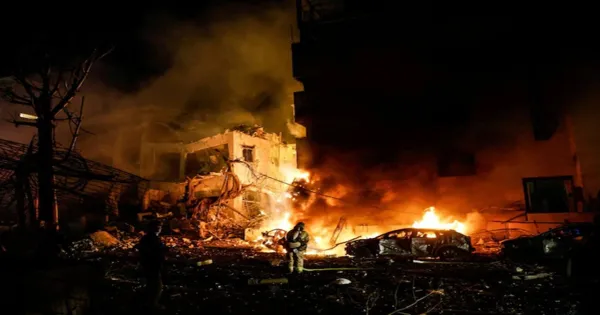
Air attacks on Iran caused huge devastation: Tehran targeted Israel and Gulf countries

Dubai. The air strikes on Iran on Tuesday caused massive destruction in the capital Tehran, but Iranian missiles and drones also targeted Israel’s Tel Aviv and several targets in the Middle East. However, US President Donald Trump said that the US is in talks with the Islamic Republic to end the war. The war appeared to be escalating as thousands more US Marines headed to the Gulf region, both sides continued to intensify attacks on each other and Iran refused to negotiate.
However, a day before this, Trump also extended the deadline given to Iran, under which it had warned of targeting Iran’s energy plants with air strikes if the Strait of Hormuz was not opened to ships. Tehran’s control of this vital waterway has disrupted the transportation of goods globally, sending fuel prices skyrocketing and threatening the world economy. Pakistan offered to host diplomatic talks, but Iran stuck to its position and vowed to fight “until complete victory is achieved”.
Any talks between the US and Iran (which appeared highly uncertain on Tuesday) will face huge challenges. Washington’s changing objectives remain difficult to achieve, especially in the context of Iran’s ballistic missile and nuclear programs. Meanwhile, it is unclear who in the Iranian government will have the authority to negotiate—or who will be willing to negotiate, especially as Israel has pledged to continue eliminating many of Iran’s leaders after killing several of its leaders.
There is strong suspicion of the US in Iran, which has twice carried out strikes during high-level diplomatic talks under the Trump administration, including the February 28 attacks that started the current war. There have been mixed signals about talks amid deep mistrust. Iranian Parliament Speaker Mohammad Bagher Qalibaf described the talks with the US as “fake news”, while Araghchi’s office acknowledged that the foreign minister had this week talked about the war with his counterparts from Azerbaijan, Egypt, Oman, Pakistan, Russia, South Korea, Turkey and Turkmenistan.
Talk of talks caused a brief decline in oil prices and a rally in the market. But the relief was short-lived, as international crude oil prices soared above US$100 a barrel on Tuesday, marking a nearly 40 percent increase since the war began. Iran’s leaders are suspicious of Washington’s intentions, as Tehran was in talks with the US before the surprise attack that started the current war. Iran was also in talks last year, when America and Israel attacked its nuclear plants.
Pakistan Prime Minister Shehbaz Sharif wrote on ‘X’ that his country is ready to facilitate meaningful and decisive talks to end the Iran war. According to three Pakistani officials, an Egyptian official and a Gulf diplomat, the US had agreed ‘in principle’ to engage in talks in Pakistan, while mediators were still attempting to persuade Iran.
Pakistani officials said that this ‘secret diplomacy’ has become more complex after the news of it was leaked. The office of Iranian Foreign Minister Abbas Araghchi said he had talked about the war with his counterparts from several countries this week. But Iranian Parliament Speaker Mohammad Bagher Qalibaf described the news of talks with the US as ‘fake news’ and a spokesman for Iran’s top military command issued a new challenging statement.
“Iran’s powerful armed forces are resolute, proud, victorious in defending the integrity of Iran, and this path will continue until complete victory is achieved,” Iranian state television quoted Major General Ali Abdullahi Aliabadi as saying on Tuesday. Iran on Tuesday appointed a former commander of the Iranian Revolutionary Guard as the new secretary of the country’s Supreme National Security Council, replacing Ali Larijani, who was killed in an airstrike. Iranian state television identified the new secretary as Mohammad Bagher Zolghadra, who was a brigadier general in the Guard.
Trump’s announcement comes as a force of thousands of Marines is headed to the region, fueling speculation that the US may try to capture Kharg Island, which is vital to the country’s oil network. The US bombed the island in the Persian Gulf more than a week ago, damaging its defenses, but said its oil infrastructure was safe.
Iran has threatened that if America is preparing to land troops, it will lay mines in the Persian Gulf. This will complicate attacks from land and sea and will also jeopardize the movement of all ships in the area. The Soufan Center, a New York-based think tank, wrote in an analysis that Trump said he would postpone threatening to bomb Iran’s power stations until talks continued – a delay presumably timed to coincide with the arrival of US Marine troops in the region on Friday.
Iran fired missiles at Israel early Tuesday in response to the airstrike on Tehran. A missile capable of carrying 100 kg of warhead hit Israeli defense systems in Tel Aviv and landed on a street in the center of the city. Due to this, the windows of a nearby building were broken and smoke started rising. “We saw devastation, smoke and chaos,” rescue worker Yoel Moshe told reporters after arriving at the scene minutes after the missile hit. He said four people were slightly injured. Emerging from the shelter, Amir Hasid said he thought the situation would be much more dire than it was.
“It feels like you are an (easy) target, waiting for missiles to fall on you or on someone next to you,” he said. In Kuwait, power lines were damaged by shrapnel from the air defense system, causing partial power outages for several hours. Missile alert sirens sounded in Bahrain and Saudi Arabia’s Defense Ministry said it destroyed 19 Iranian drones targeting the oil-rich eastern province. Israeli Prime Minister Benjamin Netanyahu said Israel would continue attacks on Iran and Lebanon despite the US considering a ceasefire.
“There will be more attacks,” he said. On Tuesday, Israel bombed the southern suburbs of Beirut and said it was targeting infrastructure used by the Iran-linked Hezbollah terrorist group. At least three people were killed, including a three-year-old girl, in an attack on a residential apartment southeast of the capital, while five others were also killed in the south, according to Lebanon’s health ministry. Meanwhile, Lebanon ordered Iran’s ambassador to leave the country by Sunday and declared him persona non grata.
Officials say Israeli attacks have killed more than 1,000 people in Lebanon and displaced more than 1 million. Meanwhile, Iran’s Health Ministry said the death toll of its citizens in the conflict has risen to more than 1,500, while 15 people in Israel have been killed in the Iranian strike, while 13 US military personnel have also been killed.

Comments are closed.