
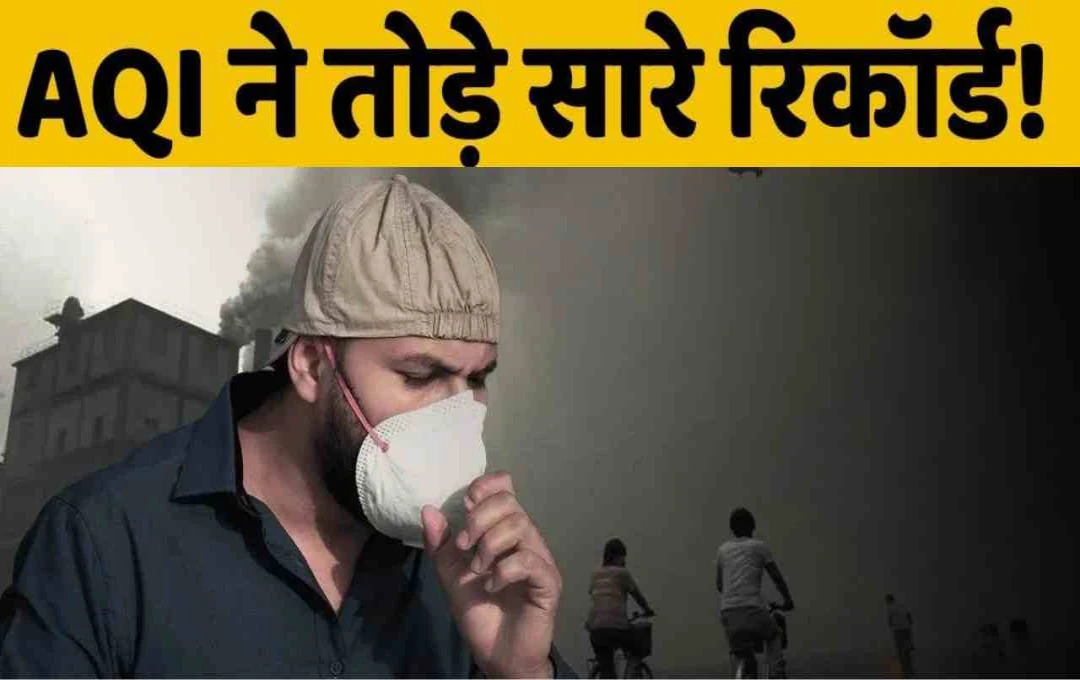

Bad weather and slow wind speed in Delhi have made the air of the capital like a gas chamber. The air quality was recorded in the severe category for the third consecutive day on Monday.
Delhi AQI: The Delhi-NCR region continues to be in the grip of severe air pollution. The air in the capital was recorded in the ‘severe’ category for the third consecutive day on Monday, making breathing difficult in most parts of the city. The average Air Quality Index (AQI) in the capital Delhi reached 456, while in many areas it was recorded between 480 and 500. Apart from Delhi, AQI has also reached dangerous levels in Ghaziabad, Noida and Gurugram.
Worst situation in Delhi
According to Central Pollution Control Board (CPCB) data, the AQI of different areas in the capital was recorded as follows at 7 am:
- Alipore: 449
- Anand Vihar: 493
- Ashok Vihar: 500
- Aya Nagar: 413
- Bawana: 472
- Burari: 454
- Chandni Chowk: 438
- Dwarka Sector 8: 464
- IGI Airport T3: 384
- ITO: 469
- Jahangirpuri: 500
- Lodhi Road: 417
- Mundka: 450
- Najafgarh: 410
- Punjabi Bagh: 480
- Rohini: 500
- Vivek Vihar: 493
- Sonia Vihar: 462
- RKpuram: 482
- Wazirpur: 500
Visibility was also very low due to mist and fog in the city. In the early morning, a thick blanket of smog made the capital look like a gas chamber.
Danger of pollution in other cities of NCR also
- In Ghaziabad, Vasundhara’s AQI was recorded 490, Sanjay Nagar 424 and Indirapuram 477.
- In Noida, AQI of Sector 125 was recorded at 461, Sector 62 was 420 and Sector 116 was 486.
- In Gurugram, NISE Gwal Pahari recorded 462, Sector 51 324, Terry Village 315 and Vikas Sadan 310 AQI.
- In Faridabad, AQI was recorded at 111 in Sector 30, 184 in New Industrial Town and 342 in Sector 11.
According to experts, Delhi’s wind speed is generally less than 10 kilometers per hour. Due to increasing cold, pollution particles remain in the atmosphere for a long time. According to Skymet Vice President Mahesh Palawat, pollution is continuously increasing due to western disturbances and slow wind speed. Vehicle smoke, construction dust and other pollutants cannot rise upward, causing them to remain trapped near the ground and become a serious health hazard.

Comments are closed.