
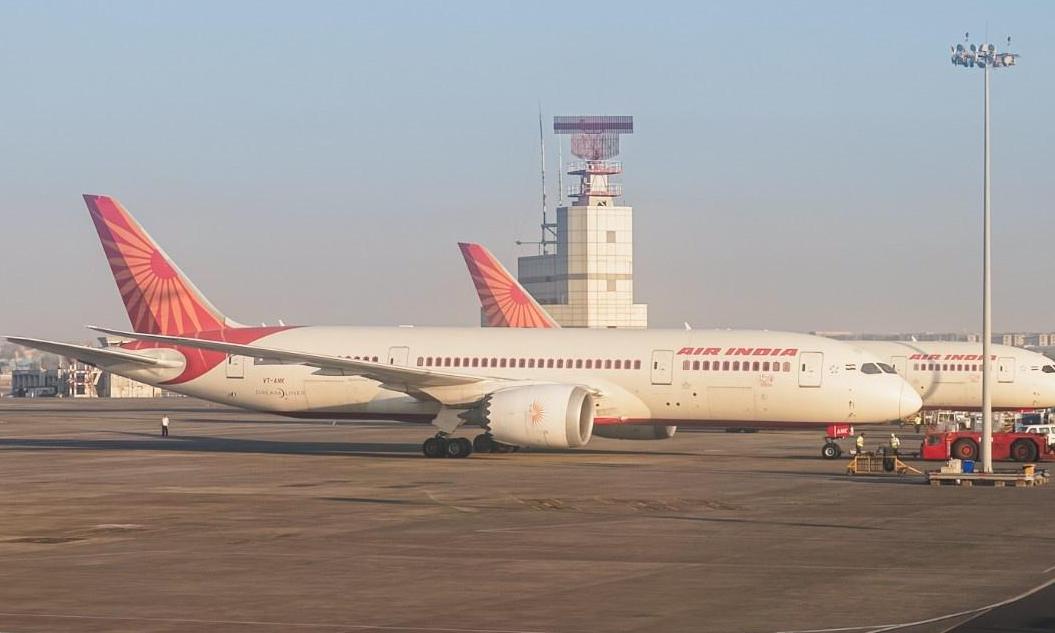

The Indian aviation community is in a tailspin. Pilots are sharply divided over the decision to pull an Air India cockpit crew from duty after their flight took an unexpected detour into Pakistani airspace while circling to land in Amritsar.
The move comes as tensions remain high, with Pakistan’s airspace having been strictly off-limits to Indian-registered aircraft since the Pahalgam attack of April 2025, followed by India’s response via Operation Sindoor.
What went wrong
What should have been a routine flight turned into a high-stakes controversy. According to a Press Information Bureau (PIB) statement, an Air India Airbus 321 operating Delhi-Amritsar was forced to hold due to a runway inspection, triggered by a bird strike. The aircraft briefly drifted across the border during radar vectoring, leading to the de-rostering of the two pilots.
♦ Bird strike causes runway inspection at Amritsar
♦ Air India flight enters holding pattern for safety
♦ ATC provides radar vectoring to the aircraft
♦ Aircraft accidentally drifts into restricted Pakistani airspace
♦ Flight crew fails to report the border transgression
♦ Authorities de-roster pilots for the unreported breach
While authorities confirmed the flight was coordinated with Pakistani Air Traffic Control (ATC) and eventually landed safely back in Delhi, the Centre’s reaction was swift: interim action was taken against both the Amritsar-based ATC and the flight crew for failing to report the boundary breach.
Also read | Pilot alert prompts Air India checks on all Boeing 787 fuel control switches
“After the aircraft commenced approach, during radar vectoring, it briefly entered the Pakistan airspace. The event was coordinated with Pakistan ATC authorities. The aircraft finally diverted back to Delhi and safely landed in Delhi. Interim action has been taken against the concerned Air Traffic Controller at Amritsar and the operating crew for non reporting the event,” the PIB statement said.
Vectoring means a radar controller guiding the aircraft by giving a series of headings and altitude commands for the aircraft to come in safely. In this case, the responsibility for navigation and obstacle clearance is that of the radar controller on the ground.
‘A little extreme’
A cross section of pilots that The Federal spoke to felt that the decision was wrong.
“The crew has been de-rostered for not reporting. That is a little extreme as there is no doubt regarding their ability to fly safely. It is only a compliance issue,” said a senior commander with an Indian airline who had earlier flown Indian Air Force planes too. “If there is no deliberate violation or negligence, punitive action should not be taken. Only a written or verbal caution should suffice,” he said.
Another commander who retired about two years ago observed that during aircraft hold, in normal circumstances, it should not enter Pakistan airspace when being vectored by the ATC because the hold would be in Indian airspace. Holding areas are specified areas in the sky over an airport where the aircraft keeps taking small loops till they are given clearance to come in and land. He added that Indian hold areas would normally be within our airspace.
One captain likened the move to using a “sledge hammer to kill a fly.”
All about optics?
Yet another senior commander, who is still in active service, pointed out that the PIB statement does not give out the version of the events as they happened and reported by the captain of the aircraft. “In normal hold and vector position, it is a controlled flight and safe,” he said, echoing what many felt — that this is no fault of the pilots.
Read/Watch | Why IndiGo is just the tip of India’s monopoly iceberg
“This has become a bit of a trend. Suspend a few. Inquiry. Seen as action taken, said a pilot cynically. “Especially because it’s a politically sensitive issue with Pakistan airspace closed.” Another added that if the cockpit crew had been informed by the ATC of the transgression they should have raised a flight safety report. “Well, then, the pilots can be de-rostered,” he added.
‘It’s a serious issue’
But a senior retired bureaucrat who had had a long innings in the Ministry of Civil Aviation, first handling the Directorate General of Civil Aviation (DGCA) and then heading the organisation, offered a different perspective.
“This is serious. If the enemy state had scrambled military aircraft and forced the Air India aircraft to land there it would have caused a major diplomatic and political embarrassment to the Indian government and people. In my view, to send a harsh message, the action is correct. Why could the pilot not head back to Delhi if there was a danger of entering the airspace which is banned for Indian registered aircraft?” the bureaucrat argued.
A second former DGCA bureaucrat pointed out that under normal bilateral relations, such an entry into Pakistani airspace would likely be overlooked, assuming the crew had properly coordinated with both sets of ATC authorities.
“It seems the ATC’s vectoring command was deficient,” the second bureaucrat added. “During vectoring, the crew should have informed the ATC that his commands were likely to push the aircraft into prohibited airspace. It is a matter of investigation why the ATC provided such vectors and whether the crew had the option to avoid the Pakistani airspace.
“The crew could have flown directly to Delhi from the hold position after coordinating with the ATC and warning him that the aircraft was nearing restricted airspace.”

Comments are closed.