
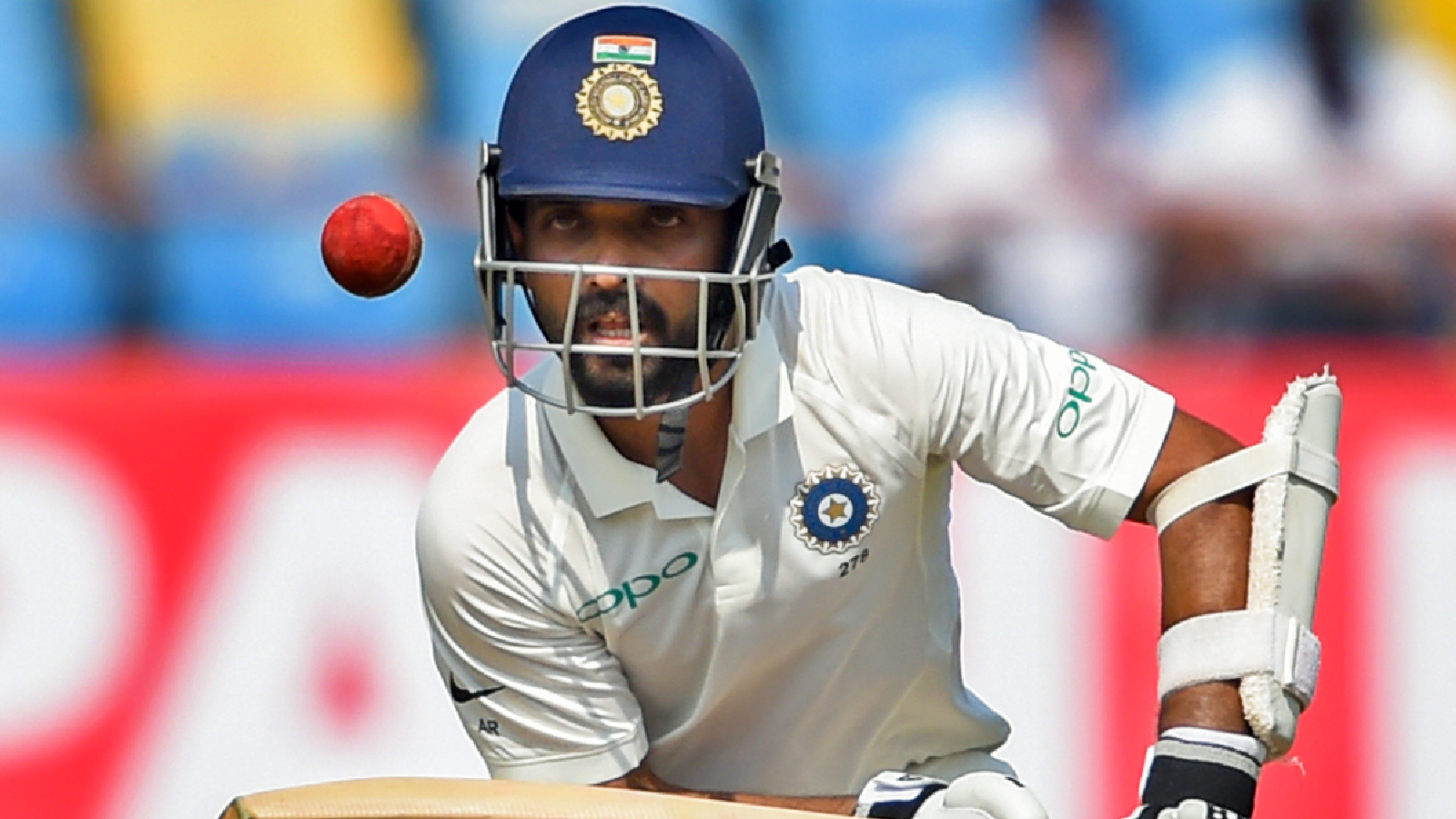

With his characteristic bashful smile, Ajinkya Rahane announced his farewell from the game that was his life for the last twenty years. In an Instagram video that was as crisp as his punches through covers, he said in a deeply philosophical tone: “The reality of life is that everything has a beginning and everything has an end. When the time comes, we simply have to respect it and move forward.” If there was a hint of regret in his voice, in the uncertainty his career traversed in the last three years, in the greatness it felt agonisingly short of, his smile did well to conceal it, as it had through the thick and thin of his career.
In the two minutes, 22 seconds video, he reflected on his greatest virtue, the gift of timing. It was about guts and grit too, his career of 8413 international runs, 5077 off them in 85 Tests, is defined not so much by the sheer numbers as by the immensity of his knocks, the moments some of his knocks have etched. The statistics took a hit in the final stretch of his career, as it did to his contemporaries Virat Kohli and Cheteshwar Pujara, dropping from mid-40s to a pedestrian 38.48, but Rahane leaves with the warmth of scripting some of his country’s most famous moments in the Virat Kohli era.
He neither craved limelight not did limelight go in pursuit of him, but he was there in Lord’s with a hundred in India’s first victory at the most sacred ground in the world; he was there at MCG twice, with a luminescent 147 and a 112 that ignited the most dramatic turnaround in the history of Indian cricket. Imperishably, Rahane would be remembered for this century and the series, the man who started the fightback after 36 all out capitulation in Adelaide, and shepherded a group of rookies to an improbably dramatic series triumph. How good a captain he would have been is a conjecture, but he had a serene authority about him that inspired the men around him, a tactical sharpness lost in his mild manners.
His leadership, the fleeting proof of it, was a reflection of his batting. He was not as immeasurably gifted as his Mumbai contemporary Rohit Sharma; he was not blessed with the irresistible rage of Kohli; he couldn’t acquire the monkish defiance of Cheteshwar Pujara. Yet, he was as valuable as all of them in the golden phase of India’s Test cricket. If performance in overseas Test victories is the touchstone of batting greatness, he towers over all the three peers. In the 20 Tests that India had won abroad in his time, he averaged 47.4, with hundreds in Australia, England, Sri Lanka and West Indies. Kohli’s was 40.56; Pujara’s 43.57 and Rohit’s 46.82. It was not always a hundred, but a fighting half-century, like the 96 in Johannesburg, rated as one of his finest knocks.
Yet, he was the most understated among them; and he showed a capacity to smile at his relative anonymity. He neither sought the adoration of the media nor did he rage at their iniquities. Even tweeting and Instagramming have been recent intrusions. He once told this newspaper: “People say I need to be in the news … I don’t have a PR team, my PR is my cricket.” It was perhaps the most headline-worthy quote he had ever spun. He rarely, said anything remotely controversial, let alone a loose statement in this era of deliberate misinterpretation. He was polite, measured and matter-of-fact, a bit like his batting
When the elements aligned, his batting in the longest format soothed the senses, sucking the tension out of a crisis. He was artistic, but without extravagant brushstrokes; he threw the punches and counterpunches, but without the swaggering audaciousness. He possessed organically fast hands, which he could twist and twerk as he desired. He masterfully manipulated the gaps, with imperceptible improvisations. A ball that Kohli would look to punch through covers or point on the back-foot, Rahane would merely glide past gully, with an open bat phase; a delivery that Pujara looked to block, he will extend his follow through for a four down the ground; he swept without the savage grace of Rohit. He largely batted at No 5, or 6, but had a flexible mind that bent his batting in the way he chose to, and could adapt himself to batting anywhere in the order. He tamed swing and seam, bounce and spin, before his confidence against spinners wavered, before lapse in concentration crept in. He was arguably better in judging the seamer’s lengths and movement than Kohli, had more aggressive routes to deal with spinners than Pujara, was more methodical and balanced in his approach than Rohit. The lament about Rahane is not about what he couldn’t perform, but what he could have. He would be remembered as a semi-great that could have easily been a great.
Like Rohit and Kohli, he could have carved a more glorious slice of white-ball cricket. It was not his fault alone. He could blame himself for failing to convert his starts into substantial knocks (24 half centuries but three hundred in ODIs), but he can’t be blamed if he felt the selectors gave him a raw deal (his last eight completed innings included five 50-plus scores). But he has made peace with the conditional clauses of his career, and buried all those in the bashful, self-effacing smile of his.

Comments are closed.