

For nearly half a century, Indian athletics ran alongside a number it could not quite reach – 2:12:00s.
Set by Shivnath Singh in 1978, it became the longest-standing national record in Indian track and field, a mark that outlived generations, systems, and promises.
It wasn’t untouched because it was impossible. It remained because Indian marathon running never quite found the athlete, or the moment to dismantle it.
On April 12, 2026, in Rotterdam, that moment arrived. Not smoothly. But in a way that may define it far more than a perfect race ever could.
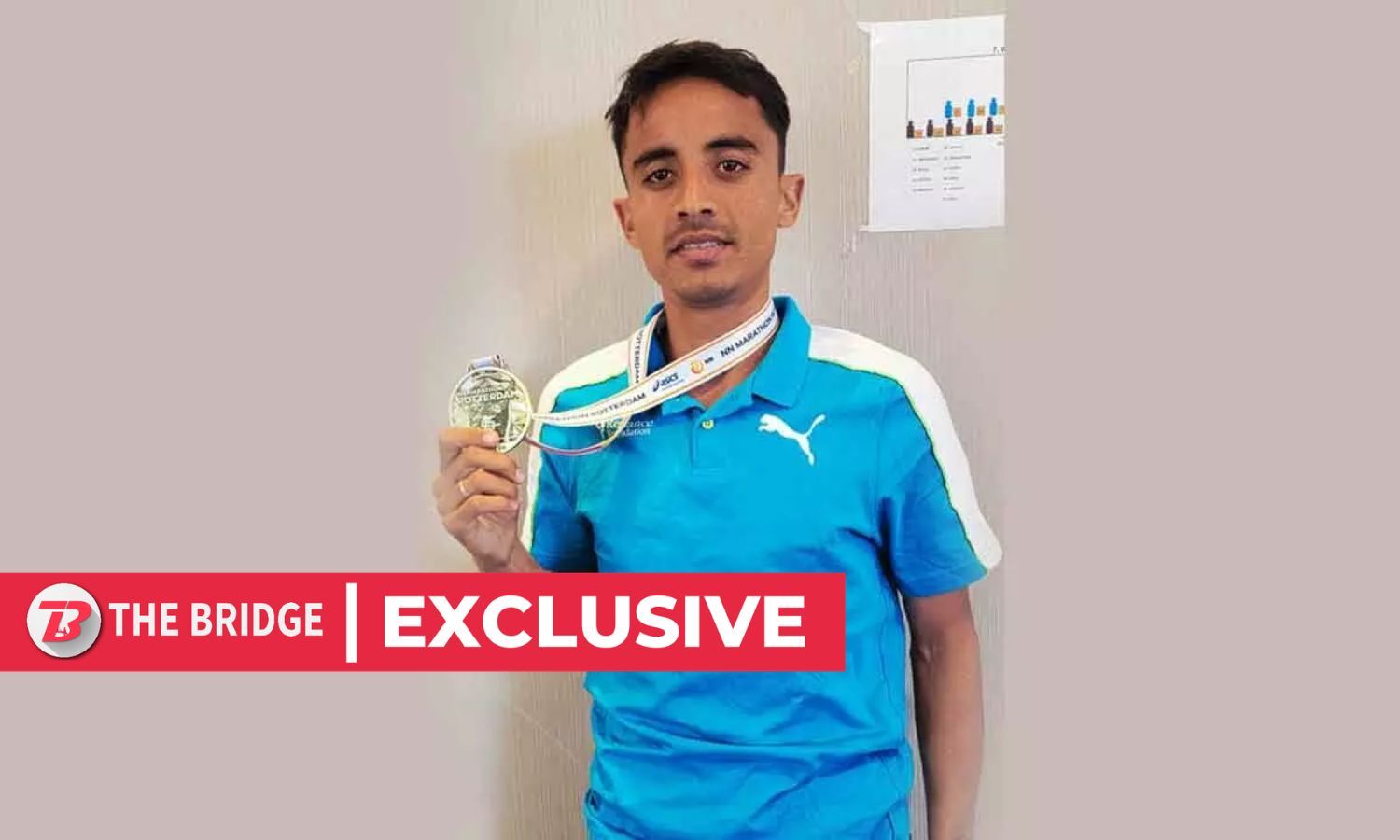
Because Sawan Barwal did not run through the finish line. He stumbled into history.
Speaking to Read exclusively, his coach Ajith Markose reflected on Barwal’s breakthrough.
A breakdown, and a breakthrough
For most of the race, the 28-year-old Army havildar from a tiny village in Joginder Nagar, Himachal Pradesh, looked like he was doing far more than just breaking a record.
On his marathon debut at the NN Marathon Rotterdam, a World Athletics Gold Label race stacked with global elites, he settled into a rhythm that suggested something extraordinary was unfolding.
“He was progressing at the pace of 2:09:14s till 40 kilometres,” said Markose.
That number matters. Because 2:09 is not just another barrier, it is the frontier Indian distance running had never crossed. And for nearly 40 kilometres, Barwal was holding it.
Then, in the final stretch, the race changed.
A cold wind cut through the closing kilometres, and its effect was immediate, disorienting.
Barwal would later explain it simply: “I fell twice with just 20 metres to go because of the effect of the cold wind on my head.”
But what unfolded in those final metres was anything but simple.
Markose, standing near the finish, had already begun preparing to capture the moment, a debut marathon, possibly a national record, maybe even something bigger. And then he saw something he hadn’t planned for.
“I was preparing to take videos and photos… I saw him running like an unconscious man,” he said. “He collapsed first, woke up, ran again, then collapsed again.”
Those last metres weren’t about time anymore. They were about getting to the line.
“He got two blackouts,” Markose said. “I thought he was going to faint there.”
A volunteer stepped in, held him, and helped him forward.
“He made him stand and run and helped him to cross the finish line,” Markose said.
Barwal crossed. The record collapsed. 2:11:58s on the clock.
He had broken Shivnath Singh’s 48-year-old mark of 2:12:00s by 0.42 seconds, and done it on his very first marathon.
The 2-minute 9 seconds barrier
Barwal had been building toward this moment through a carefully structured transition, from track (5000m and 10,000m) to half-marathon, and finally to the marathon under Reliance Foundation’s Project 2:09.
The signs had been there early.
“When he joined Reliance in 2022, we did a physiology test… that’s VO2 max test,” says coach Ajith Markose.
“His VO2 value was 78 or 79 mL per body weight. That time, he was not a highly trained athlete,” he added.
What stood out wasn’t just the number, but what it meant.
“For a moderately trained athlete to get that value is very good, because 78–79 is already at an elite level. That showed he is going to be a good road runner rather than a track runner.”
Despite the program’s strict entry criteria, Barwal’s case stood out.
“To join our endurance program, an athlete has to be a national medallist,” Markose says. “But in Sawan’s case, after testing him, we realised he has huge potential.”
At that point, Barwal hadn’t yet achieved that benchmark. He was still competing in 5,000m and 10,000m, building his profile. But the data, and the instinct, were enough.
“That time he was not a national medallist,” Markose adds. “After joining us, he got his first medal in 10,000 metres in the Calicut Federation Cup.”
From there, the transition was deliberate.
“We started him with 5,000, 10,000, then progressed him to half-marathon… where he broke 1-hour 2 minutes mark in the Delhi marathon last year. This was our long-term goal: to move him to marathon.”
And even before the results came, the belief was already firm.
“When we started this Project 2:09, we knew that he is the one who is able to do 2:09.”
Ajith Markose (left) with Sawan Barwal (seventh from left), Photo: RFYS
The progression was backed by a structured training system, one that mirrors global endurance programs.
“In our endurance program, we stay in Ooty, Wellington, normally for four months… from November to February,” Markose explained. “We do all our base training there. They have a synthetic track, gym, sauna, and all recovery facilities were available for us.”
After the base phase, the shift is equally methodical.
“Then we move to ABSF Bangalore… from there we do our pre-competition preparation and go for races.”
For Barwal, altitude was essential.
“For Sawan, most of the time he was staying in high altitude, and that’s what is required for a marathon runner. If you look at most of the best runners in the world, they are training in high altitude places like Iten or Colorado Springs.”
By the time Rotterdam came around, after a missed debut in Valencia due to injury, Barwal wasn’t just stepping into a marathon. He was stepping into a plan years in the making.
Hunt for an Asian Games medal
If Rotterdam was proof, the next step is expectation.
“In Asian Games, we are not going to chase time,” Markose asserted. “We are going to chase the medal… he has to fight.”
The challenge will be different, tactical, not paced.
With Japanese runners consistently clocking 2:07–2:09, the margins will be tighter.
But the benchmark is clear.
“If Sawan can run 2:09 in the Asian Games, he will be able to stand on the podium,” the coach said.
And beyond that, the ambition sharpens further. “His marathon goal is 2:08,” he added.
For now, though, the number that stood for 48 years is gone.
And the man who broke it did so while collapsing, getting back up, and finishing anyway.
Which is perhaps why what comes next feels inevitable.
“Everyone is pretty sure that he is going to make 2:09 very soon,” Ajith concluded.

Comments are closed.