
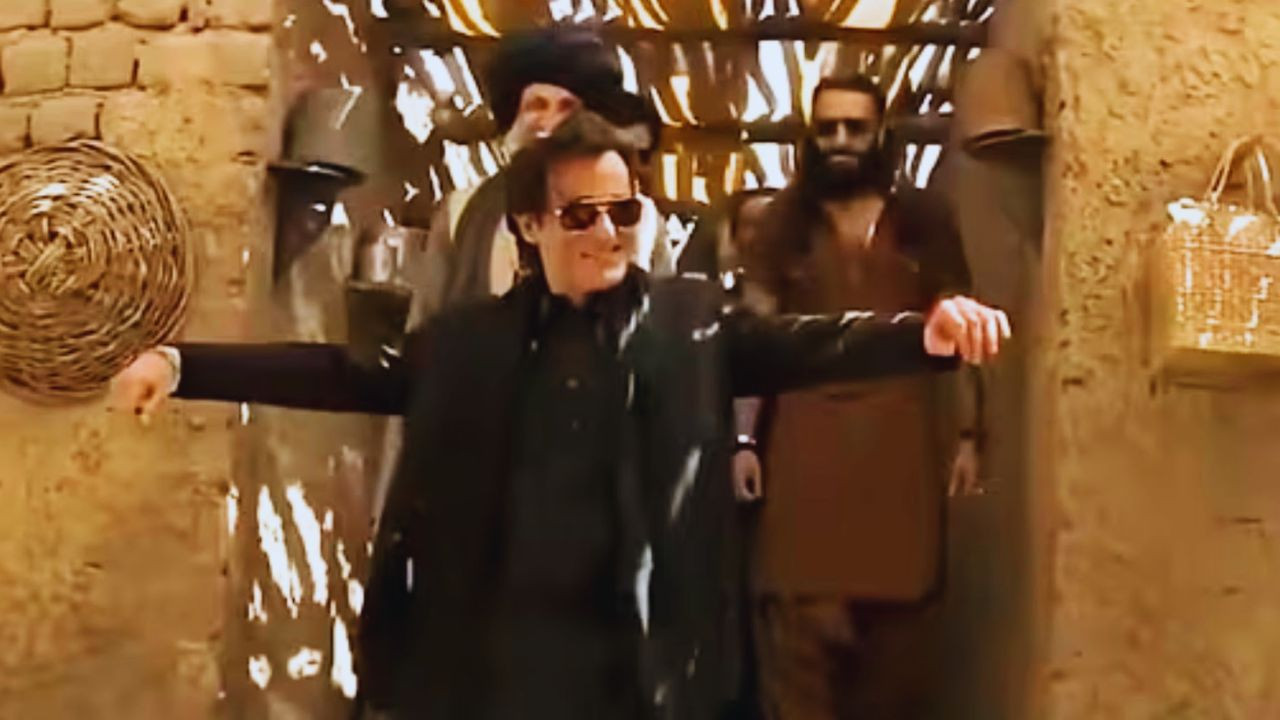
Akshay Khanna created a stir by playing dacoit Rahman in ‘Dhurandhar’, this character is being counted among the most dangerous villain till date in Bollywood.

Mumbai:There is a scene in Ranveer Singh’s film ‘Dhurandhar’ which silently defines the balance of power of the entire film. Getting out of an SUV in the Baloch camp, Akshay Khanna’s character Rehman moves forward in dacoit royalty, while Ranveer Singh’s Hamza Ali Mazari walks a few steps behind, extremely composed and alert, protecting his master. Rehman’s famous dance that comes a few moments after this scene may have been in the news, but this quiet moment before that says a lot.
This scene makes it clear that in the world of ‘Dhurandhar Part 1’, the real alpha male Rehman is the dacoit ‘Sher-e-Baloch’. In this story the brightness of the hero has been deliberately kept dim. The script demanded that Hamza, who is later revealed to be an Indian agent operating in Lyari, remain in Rehman’s shadow until the story allows him to move forward.
When the villain became the center of the story
One thing is clear in the debates regarding Ranveer Singh’s character after its release. The hero is secondary in this film. This is no coincidence, but a well-thought-out strategy of director Aditya Dhar. Hamza has been written to take a few steps back, so that the terror of Rahman the dacoit, his stature and his influence can be fully revealed.
It is not yet clear how big a platform Ranveer Singh will get in ‘Dhurandhar Part 2’, when Hamza’s real identity will be revealed as Jaskirat Singh Rangi. But by giving complete spotlight to Akshay Khanna in the first part, Aditya Dhar has given Bollywood one of its most powerful villains.
‘Sher-e-Baloch’ in the line of memorable villains of Bollywood
Although the death of Dacoit Rehman is shown at the end of the film, this character created by Akshay Khanna is not going to leave the minds of the audience. ‘Sher-e-Baloch’ has now made a place in the list of immortal villains of Hindi cinema, which includes names like Gabbar Singh, Mogambo, Kancha Cheena, Langra Tyagi and Khilji.
Akshay Khanna dominates from the entry scene itself.
Akshay Khanna’s entry as Rehman dacoit takes place in a hospital scene, where his son has died in an encounter. Strictness on the face, head held high and the entire Laav-Lashkar along with him. He mourns in private, but quickly pulls himself together in public.
This scene makes two things clear without being overdramatic. One, the storm named Rehman Dacoit is going to swallow the entire film, and second, Akshaye Khanna is back with full force.
Akshaye Khanna’s ‘negative’ journey
If we look at Akshay Khanna’s career, his mastery in villainy has gradually improved. After making his debut with ‘Himalaya Putra’ in 1997, except ‘Border’, he had to face weak scripts in the initial phase. In 2001, ‘Dil Chahta Hai’ showed for the first time how comfortable he was with nuanced and contextual roles.
In 2002, through ‘Humraj’ and ‘Deewangi’, he continuously left his mark in negative roles. After this came characters like ‘Race’, ‘Naqab’, ‘Chhaava’, ‘Section 375’, ‘Drishyam 2’, but no one has played a role as influential as Rahman Dacoit in recent years.
cruelty hidden in smile
Akshaye Khanna’s most dangerous weapon as Rehman the dacoit is his cold smile. In one scene he says that the death given by Rehman dacoit is like a butcher. On the other hand, he also shows a fatherly affection by watching Hamza and Uzair play with the new guns. This balance makes this character special.
The character is as strong as the actor
Rehman Dacoit is not just a villain, but a man hungry for power and money, whose loyalty is not to any community but only to power. In the world created by Aditya Dhar, he is a merchant of violence, who thrives on the destruction of others. His biggest counterpart in this bloody world is Arjun Rampal’s Pakistani intelligence agent Major Iqbal, although his use is limited in the first part.
Classic villain, without making any noise
What makes Rahman the dacoit special is his restraint. He does not raise his voice to create fear. His cruelty is visible, but on limited and precise occasions.
The most interesting thing is that Aditya Dhar forces you to hate a character whose last moments make you wish for his survival. Perhaps because when he dies, one wishes he had stayed alive, so that Hamza could get another perverted challenge.

Comments are closed.