
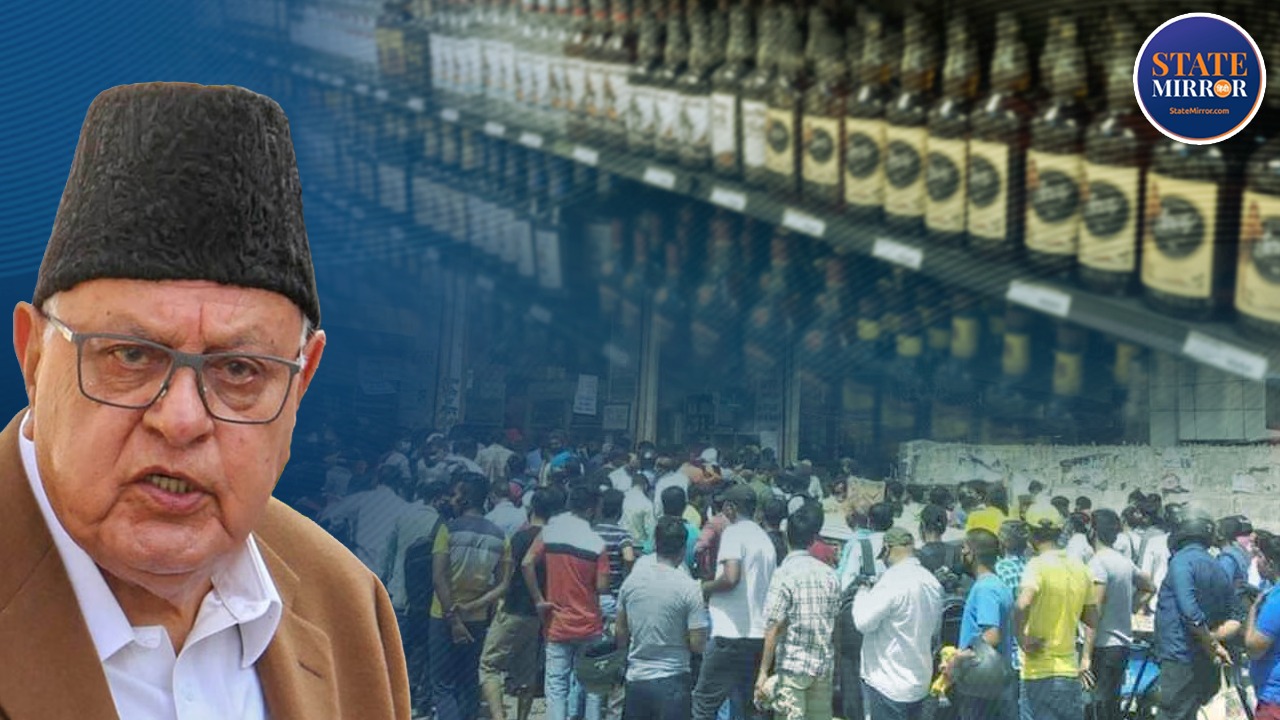
It’s dirty but it’s a business! Why is liquor necessary, governments cannot ban it even if they want to, where and who gets how much revenue.

NC chief Farooq Abdullah gave a shocking statement in response to a question regarding liquor ban. Since then this matter is once again in the headlines. Whether there should be liquor ban or not has once again become a subject of debate. The reality is that after GST, the income from liquor is the largest share of the total income of the central and state government, which is necessary for running the government. Now in India, alcohol is no longer just an intoxication or a subject of social debate, but it has become the biggest support for the economy of the states. Know what is the whole truth of this debate?
What did Farooq Abdullah say on liquor ban?
Farooq Abdullah said that it is not easy to completely eliminate alcohol or drugs just by making laws. According to him, “People who drink alcohol will keep drinking. If they don’t get it here, they will go somewhere else.” He said that governments are not able to implement liquor ban even if they want to, because the revenue generated from it is very important for the economy of the states.
What story was told about Morarji Desai and Sheikh Abdullah?
Farooq Abdullah shared an old anecdote of his father Sheikh Abdullah and former Prime Minister Morarji Desai. He told that Morarji Desai was in favor of prohibition and had proposed to stop the sale of liquor in Jammu and Kashmir. On this, Sheikh Abdullah had said that if the central government compensates the revenue from liquor, then the state will immediately implement liquor ban. However, this proposal did not move forward at that time.
How big is the drug free campaign in Jammu and Kashmir?
A 100-day ‘Drug Free Jammu and Kashmir’ campaign is being run in Jammu and Kashmir under the leadership of Lieutenant Governor Manoj Sinha, which has now reached its second month. Police and administration are continuously taking action to eliminate the drug network. The aim of the campaign is to make the area drug free within 100 days.
What did Mufti-e-Azam say in the fatwa?
Mufti-e-Azam Nasir-ul-Islam of Jammu and Kashmir has issued a fatwa against drug addiction. He said that the increasing use of drugs is not only a social evil but also the cause of moral and spiritual decline. Mufti Nasir clearly said that according to Islamic law, trade, buying and selling of drugs and the income derived from it will be considered ‘haram’ and ‘impure’.
Data from Excise Taxation Department Chandigarh, National Institute of Public Finance and Policy (NIPFP), Confederation of Indian Alcoholic Beverage Companies (CIABC) and state excise departments show that liquor tax has now become the financial backbone of many states. This is the reason why even governments that talk about prohibition on public platforms are not able to take the risk of banning it completely. In the states which are dry states, lack of revenue always remains a topic of discussion.
According to the estimated figures for the year 2025-26, India’s liquor business has turned into a market worth about ₹ 5.3 lakh crore. Industry experts believe that this sector is growing at the rate of 8% to 10% every year. The annual sales of IMFL (Indian Made Foreign Liquor) and beer in India have reached more than 1,100 million cases. This includes products like whiskey, rum, vodka, gin and beer.
How big is India’s liquor market?
India’s IMFL market has become one of the largest spirits markets in the world. According to industry estimates, more than 40 crore cases of IMFL are consumed annually in the country. The average retail price of a nine liter case is believed to be between ₹4,500 to ₹5,500. On this basis, the size of India’s liquor market is estimated to be more than ₹ 5 lakh crore. Overall, the picture is clear – liquor is definitely a subject of social and political debate, but economically it has become such a business for the states, which the governments cannot stop easily even if they want to.
How much is the budget of which state dependent on liquor?
According to the state budget and excise report for the financial year 2024-25, the income from liquor has become a major pillar of the economy of many states. In many states, state excise duty accounts for 15% to 30% of their total tax income. Puducherry is considered to be at the forefront in this matter in terms of percentage, where about 34% of the total tax earning comes from liquor. The biggest reasons for this are low local taxes, heavy tourism and high sales.
After this comes Jharkhand, where the income from liquor is considered to be about 25% to 27% of the total tax income of the state. In Kerala this figure is around 24.8%. Despite high taxes, alcohol consumption remains quite high there. Even in Uttarakhand and Sikkim, the income from liquor reaches about 23%. Tourism and high per capita consumption are considered to be the main reasons for this.
If we talk about the total amount, Uttar Pradesh is the state that collects the highest liquor revenue in the country. The state achieved excise revenue of about ₹48,800 crore in FY25. This is considered to be approximately 21.8% of its total tax income. The revenue from liquor in Karnataka is about 20.6% of the total tax income. The state ranks first in the country in terms of IMFL consumption, where about 6.88 crore cases are sold annually.
Chhattisgarh, Madhya Pradesh and West Bengal are also among the fast growing liquor markets. On the other hand, due to complete prohibition in states like Bihar and Gujarat, the official revenue from liquor is almost zero. Overall, liquor has now become the biggest tax source after GST for many states.
Who is at the forefront in liquor sales?
Karnataka has become the largest market in the country in terms of IMFL consumption. About 6.88 crore cases of liquor are sold here annually. After this comes Tamil Nadu, where consumption of about 6.47 crore cases has been recorded. Telangana (3.71 crore cases), Andhra Pradesh (3.55 crore cases), Maharashtra (2.71 crore cases) and Uttar Pradesh (2.50 crore cases) are also among the largest liquor markets in the country.
Kerala (2.29 crore cases), West Bengal (1.49 crore cases), Rajasthan (1.37 crore cases) and Delhi (1.18 crore cases) are also counted among the big consumer states. Overall, South India accounts for more than half of the country’s organized IMFL sales.
Why the dominance of South India?
According to experts, rapid urbanization, better purchasing power and organized retail network in South India have led to the rapid growth of the liquor market. Cities like Bengaluru, Chennai, Hyderabad and Mumbai have become major centers of premium liquor market. In Tamil Nadu, the TASMAC model i.e. the government-run liquor sales system has completely organized the distribution. Whereas in Karnataka, strong private and license based retail network continuously increases the sales. According to CIABC, the combined consumption of Karnataka, Tamil Nadu, Telangana, Andhra Pradesh and Kerala is about 23 crore cases annually, which is about three-fifths of the national market.
Who is earning the most from liquor?
If we talk about tax earning, Uttar Pradesh is at the forefront in the country. According to FY26 estimates, UP collected revenue of about ₹57,722 crore through liquor-related excise taxes and duties. This is followed by Karnataka (₹36,400 crore), Maharashtra (₹30,000–35,000 crore), Telangana (₹25,600–35,900 crore) and Tamil Nadu (₹22,000–44,000 crore).
Andhra Pradesh (₹15,000–21,300 crore), West Bengal (₹18,000–20,400 crore), Rajasthan (₹15,000–17,000 crore), Haryana (₹12,000 crore) and Punjab (₹10,400–11,782 crore) also earn huge taxes from liquor. States like Madhya Pradesh, Kerala, Odisha, Delhi and Chhattisgarh also earn excise earnings of thousands of crores of rupees. In many states, liquor contributes 15% to 30% of their total tax income.
Why are governments afraid of prohibition?
Liquor is outside the scope of GST, so its entire tax is directly paid to the states. This is why excise duty is one of the most reliable and independent tax sources for states. In states like Uttar Pradesh, the income from liquor has reached about 2.3% of their GSDP. This share is also quite large in states like Chhattisgarh and Karnataka.
This is the reason why governments avoid imposing prohibition despite moral and political debate. Complete prohibition is implemented in states like Bihar and Gujarat, but illegal liquor trade remains a constant challenge there.
Why are smaller states ahead in percentage?
If seen in proportion to the population, the percentage of alcohol consumers is highest in Arunachal Pradesh (38.4%), Sikkim (28.1%) and Goa (20.9%). According to experts, tourism, cultural acceptance and local food traditions are the major reasons for this.
Liquor business is dirty but why compulsion?
Liquor business may be considered a “dirty business” from the social point of view, but it has become a big compulsion for the economy of the states. The biggest reason for this is the huge income from excise tax. In India, liquor is outside the scope of GST, hence the entire tax on liquor is directly paid to the state governments. In many states, liquor revenue contributes 15% to 30% of their total tax income.
States like Uttar Pradesh, Karnataka, Tamil Nadu, Maharashtra and Telangana earn thousands of crores of rupees every year from liquor. This money is spent on roads, health, education and government schemes. If governments suddenly implement liquor ban, it could have a big impact on revenue.
Despite prohibition being implemented in states like Bihar and Gujarat, the challenge of illegal liquor trade remains. This is the reason why despite moral debate and political rhetoric, most states avoid closing the liquor business.

Comments are closed.