
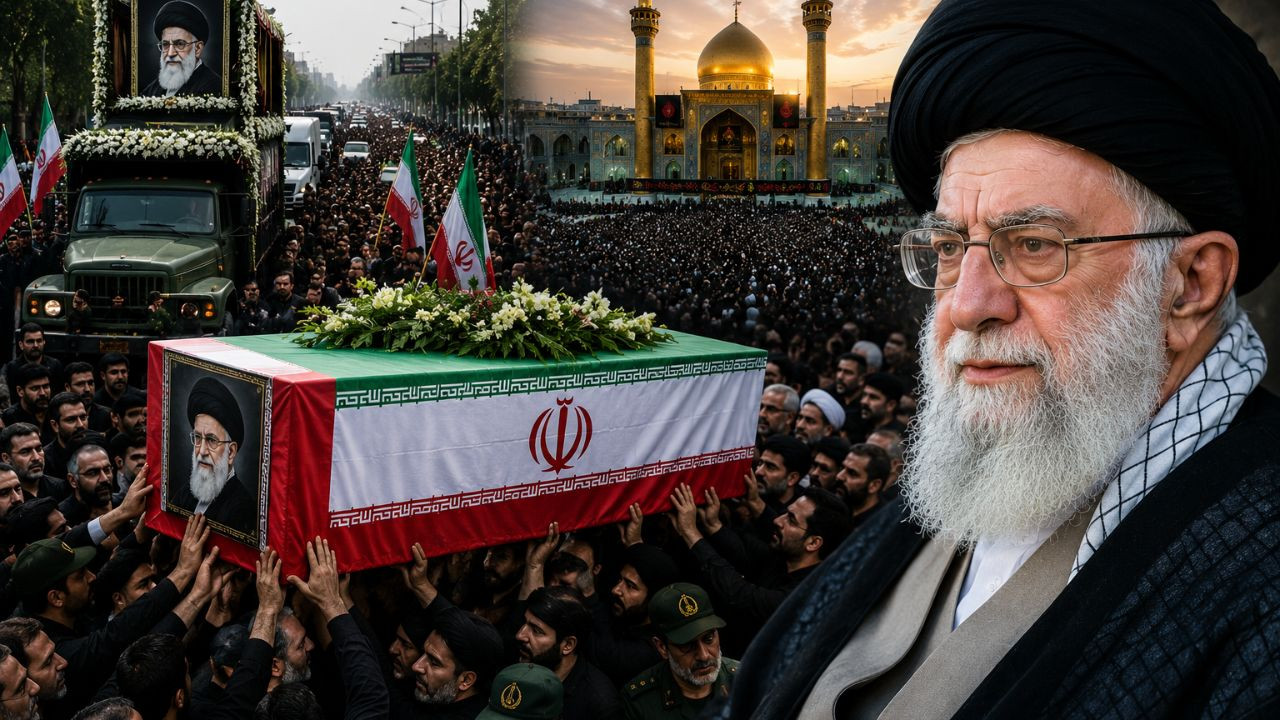
Ali Khamenei’s mortal remains reached Tehran, crores of people expected to gather for the funeral, security tightened

New Delhi: Preparations for the funeral of Iran’s former supreme leader Ayatollah Ali Khamenei have now reached the final stage. On Thursday, his body was brought to Tehran, marking the formal beginning of the last farewell ceremony that would last for several days. Iranian officials say that during this time a large number of people can arrive for the last darshan, hence security and other arrangements have been specially strengthened.
According to Iran’s state broadcaster Islamic Republic of Iran Broadcasting (IRIB), the coffin containing Ali Khamenei’s body was also taken to the place where he died. This program was not publicly announced in advance. According to government media, this was an important part of the final farewell ceremony, in which limited people were present.
Record crowd may gather at the funeral
The Islamic Revolutionary Guards Corps (IRGC) estimates that a record number of people may attend public events in Tehran on July 4 and 5. According to initial estimates, 1.2 to 1.5 crore people are likely to arrive, while some estimates put the number up to 2 crore. For this reason, the administration has made extensive preparations for security, traffic and public facilities.
United Nations chief expressed condolences
The Iranian government informed that UN Secretary-General Antonio Guterres spoke to Foreign Minister Abbas Araghchi on phone and expressed condolences on the death of Ali Khamenei. According to the government, during this conversation, topics like regional situation, Strait of Hormuz, ceasefire in Lebanon and ongoing diplomatic talks were also discussed.
Iranian Embassy in Ghana shares old memories
The Iranian Embassy in Ghana paid tribute on social media, remembering the meeting of then Ghanaian President John Dramani Mahama and Ali Khamenei in 2016. The embassy said that in that meeting, more than trade agreements, the future of Africa and cooperation between independent countries was discussed.
The post also said that Ali Khamenei believed that extremism spreads with the support of external forces and its solution lies in mutual cooperation of independent countries. He considered Africa not just a market, but a group of respectable and self-reliant countries.
Delegation will also go from India
India’s Ministry of External Affairs said that Bihar Governor Lieutenant General (retd) Syed Ata Hasnain and Minister of State for External Affairs Pabitra Margherita will visit Iran on July 4 to represent India at the funeral ceremony. The purpose of his visit is to pay tribute to the late leader and express India’s condolences at the official level.
The new supreme leader will not attend the funeral
Ayatollah Hakim Elahi, the representative of Iran’s current leadership in India, said that due to security reasons, the new supreme leader Mojtaba Khamenei will not publicly attend his father’s funeral. He said that this decision has been taken in view of the possible security threat related to Israel and the fear of surveillance.
Main events will be held on 4th and 5th July
According to Iranian state media, the final farewell ceremony will begin on the morning of July 4 at the Imam Khomeini Grand Prayer Grounds in Tehran. Here people will get the opportunity to have their last darshan. After this, funeral prayers will be offered on the morning of 5th July and then the last procession will be taken out. Officials said that a large number of religious scholars, Quran reciters, cultural groups and other guests will also participate during the program.
The route of the procession was changed in view of the crowd
IRGC officials said that it was not possible to safely handle such a large crowd on a single street in the capital. Therefore, a separate route has been decided for the last journey. Vehicular movement will be limited around the venue of the function, while special transport arrangements have been made for the convenience of the people.
According to officials, the responsibility has been assigned to the city administration, health department, army, police, cultural institutions and other government agencies to make the program successful. Tehran metro and bus services will operate at full capacity. Apart from this, welcome centers have been set up at many places, where drinking water, food, medical aid, sanitation facilities and other essential services will be available.
Ali Khamenei died in February
According to reports, Ayatollah Ali Khamenei was killed in the American-Israeli airstrike on February 28. After this incident, tension increased significantly in West Asia and widespread conflict started in the region. After his death, his son Mojtaba Khamenei was appointed the new supreme leader of Iran.

Comments are closed.