
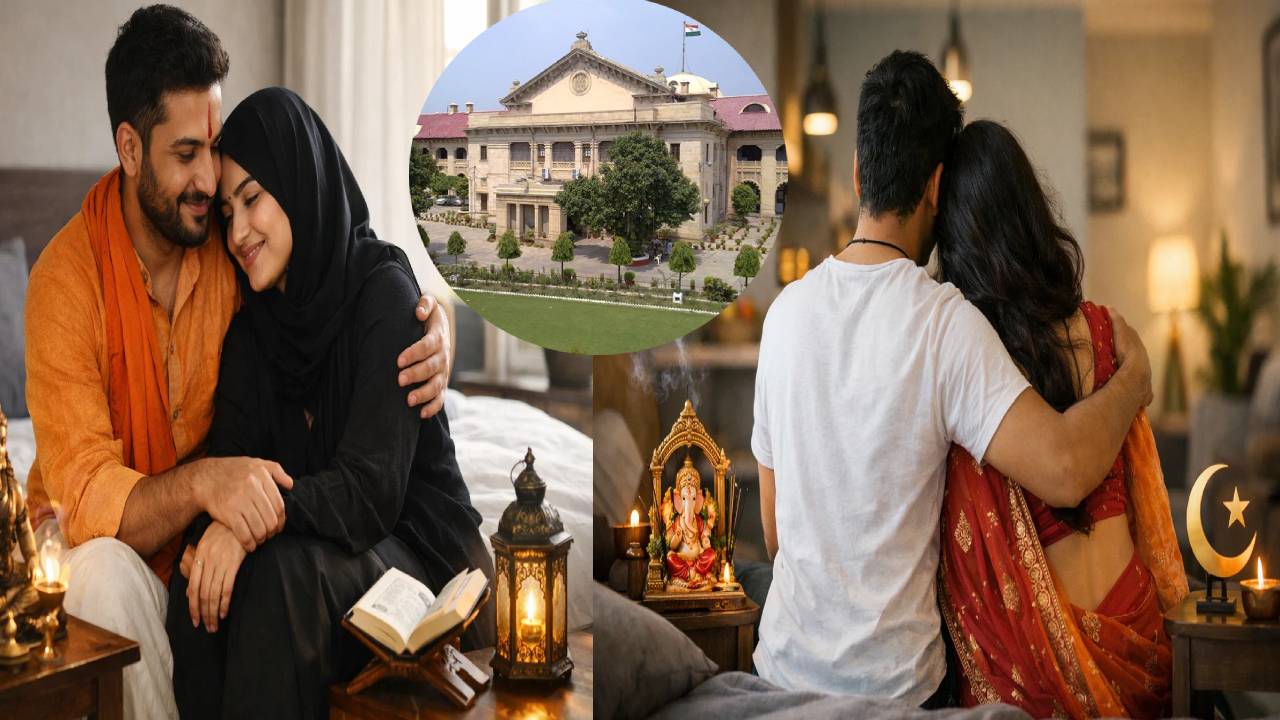
So what if religion is different? Law does not consider live-in relationship as a crime: Allahabad HC

Allahabad High Court: Allahabad High Court has directed to provide security to 12 interfaith live-in couples living together in different districts of Uttar Pradesh. The court clearly said that unless the religious conversion has taken place, the Uttar Pradesh Prohibition of Unlawful Conversion of Religion Act, 2021 will not be implemented.
Hearing a group of petitions led by Noori and others, a single bench of Justice Vivek Kumar Singh restrained the state and private parties from interfering in the life and liberty of the petitioners. The court said that police protection will be provided if needed or demanded.
What did the court order say?
– In all 12 cases the petitioners are adults and belong to different religions. In seven cases, Muslim women are living with Hindu men, while in five cases, Hindu women are in live-in relationships with Muslim men. Everyone said that they are living together of their own free will and are facing danger from family and relatives.
– The couples told the court that they had contacted the local police, but no effective action was taken. After this he had sought protection from the High Court under Article 226 of the Constitution.
On behalf of the state, it was said that the petitioners did not follow Sections 8 and 9 of the Act of 2021. In these sections, there is a provision to make a declaration in front of the District Magistrate before and after religious conversion and complete the formalities.
Citing Sections 3 and 5, the State said that the interpretation of Section 3 includes a relationship similar to marriage. Therefore, inter-religious live-in relationships can also come under the purview of this law. It was also said that earlier decisions of the Supreme Court were given before the 2021 law.
– The state cited the 2023 Kiran Rawat vs. State of Uttar Pradesh judgment and argued that Muslim law does not recognize sexual relations outside marriage, hence such relations cannot be protected.
The High Court rejected these arguments. The court said that Sections 3 and 5 will be applicable only if ‘religious conversion’ has taken place first. According to Section 2(c) of the Act, religious conversion means leaving one’s own religion and adopting another religion.
The court said that in these 12 cases, none of the petitioners has claimed religious conversion, nor has any FIR or complaint been registered for forced or fraudulent conversion.
– The court made it clear that the 2021 Act does not in itself ban inter-religious marriage. The process of Section 8 and 9 is applicable only when a person wants to change religion.
The court said that a person cannot be forced to convert to marry or live in a live-in relationship.
– The Court said that the right to life and personal liberty (Article 21) also includes the right to choose one’s partner. It is related to the dignity and freedom of the individual.
– The court ruled in Lata Singh vs. State of Uttar Pradesh (2006), Shafin Jahan vs. Asokan K.M. (2018), Shakti Vahini vs. Union of India (2018) and KS Puttaswamy vs. Union of India (2017). The court said that after attaining adulthood, family, society or the state cannot interfere in a person’s choice, unless there is a valid legal restriction.
The court said that the principles of personal law cannot be above the constitution and statutory protection. There is no penal provision in Indian law to criminalize consensual live-in relationships between adults.
The court said that Articles 14 and 15 guarantee equal protection and prohibition of discrimination on the basis of religion. If two people of the same religion can live together, then people of different religions also have the same right.
– The court allowed all the 12 petitions and prevented the state and private parties from interfering in the peaceful co-existence of the petitioners. Also, the police of the concerned districts have been instructed to ensure their safety and provide protection if needed.

Comments are closed.