
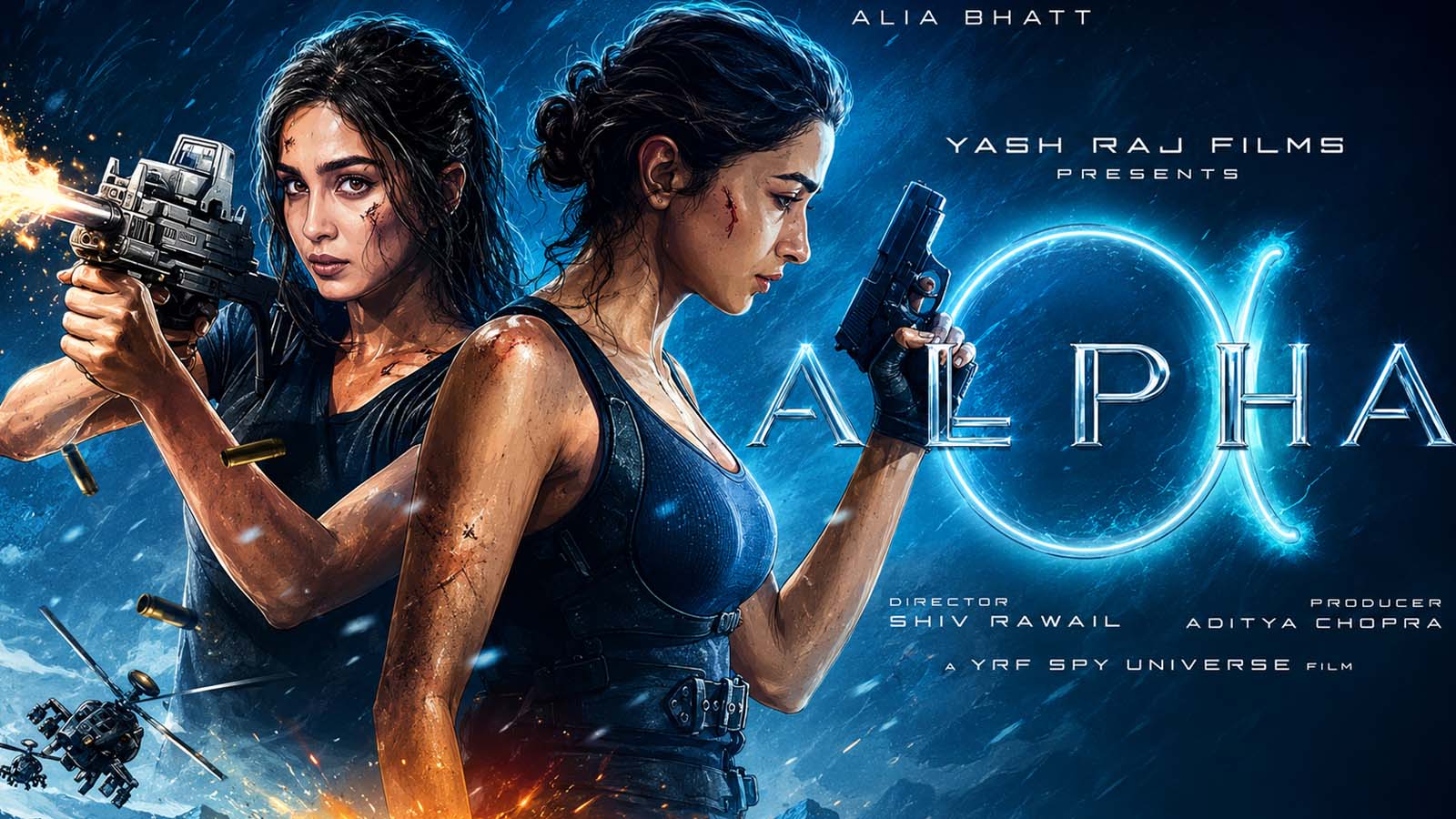

There is really nothing Alia Bhatt cannot do. In her entry scene in Shiv Rawail’s Alpha, she takes down an entire factory of soldiers — all men — with the unhurried efficiency of someone finishing her morning cardio, then pauses mid-massacre to rescue a hamster. A lab rat, like her. It’s the funniest thing in the film, and also, in its way, the saddest: a woman built and broken by the same institution, still soft enough to save something smaller than herself.
Ek Tha Tiger (2012), Tiger Zinda Hai (2017), and War (2019) were standalone hits before Aditya Chopra-led Yash Raj Films called them a universe. It was Pathaan (2023), riding on War’s success, that formally stitched them into YRF’s spy universe, a shared world of R&AW agents fighting increasingly baroque threats. Alpha is the seventh franchise entry, and the first to hand the franchise to women. Working off a story credited to Uday Chopra, Rawail — son of Rahul Rawail— directs Alia Bhatt as Sita and Sharvari as Durga, twin sisters separated at birth and raised with entirely different fates. Anil Kapoor and Bobby Deol, playing special forces officers whose friendship curdles into something else entirely, carry the older, sadder half of the story.
Claimed for country
Alpha opens in 1999, a day after the Kargil War, with officers Vikrant Kaul (a moving Kapoor) and Fateh Singh Shekhwat (Deol) staring down at an endless line of dead bodies, the cost of the victory they have just won. Out of that grief comes Alpha: a covert program built on a serum that promises soldiers with superhuman abilities of hearing, combat, and recovery until its first batch of soldiers die of brain haemorrhages. Kapoor, whose pregnant wife is dying, steals a dose for her against every warning; she survives long enough to give birth. Deol, running the program, tells Kapoor the child now belongs to India, not to him — then lies that she died. Twenty years later, when the film jumps to the present, we learn that the child is Sita (Bhatt), raised in captivity believing Deol is her father, until she learns a heartbreaking secret and goes rogue. Durga (Sharvari), her unknown twin, hidden in Spain, turns out to be the one person capable of fighting alongside her.
Also read: The Death of Robin Hood review: Despite Hugh Jackman’s towering performance, this is A-grade fan-film
Co-written by Sridhar Raghavan and Soumil Shukla, with dialogue by Ishita Moitra, Alpha is in a hurry from its first scene to its last, so anxious to get to the next mission briefing that it rarely lets a moment breathe long enough to mean something. Bhatt supplies the breathing room herself, in stray looks and line readings, doing the tonal work the writing has no time for. The film survives on Bhatt, and on the idea underneath her: that Sita’s body has never once belonged to her, used by a father figure for what it can produce, marked by a childhood she keeps flinching back into. It’s visible in the scars on her back, in the way her face blanks out mid-scene, somewhere else entirely for a second before it returns. Alpha doesn’t dwell on that the way it should — there’s real trauma sitting right under this plot, and the film mostly walks past it toward the next fight.
The story that remains ignored
The absence of Siddharth Anand, whose fingerprints were all over War and Pathaan, is visible in every frame of Alpha. Those films knew how to let a set piece breathe, how to be unashamedly silly in between the carnage — Rawail’s Alpha is in such a hurry that the lightness arrives in spurts, as does the spectacle. The hand-to-hand combat is the one place the film has any personality, mostly because Bhatt and Sharvari commit to hurting each other convincingly.
Also read: Minions and Monsters review: A rare franchise outing that almost ticks every box
Alpha also has a Deol problem it never solves. Fateh spends the first half as a man radicalised by the very patriotism that broke him — a soldier discarded for the program’s negligence, rebuilding himself out of resentment and stolen equipment. It’s almost a real villain. Then the second half makes a reveal that results in the whole thing collapsing backward into a simpler, dumber story. Worse, it makes India’s own special forces look considerably more foolish than the enemy. Deol is no John Abraham and he seems to know it; he plays the second half in a campy register that belongs to a different, less self-serious movie.
In the penultimate scene, right before Sita takes her revenge, Kapoor tells her to do it for her family, for herself, and for her country — in that order. Country comes last. I don’t know if the film means anything by that sequencing, or if it’s an accident of dialogue, but it’s the one moment where Alpha seems to know, even briefly, what it’s actually about: a woman reclaiming a body the state spent her whole life deciding it owned.
It’s a conviction the rest of the film can’t sustain. Alpha doesn’t have the belief in its own scale that War or Pathaan did. What it has instead is Ek Tha Tiger’s shrug of confidence — the sense of a franchise that knows it will get made regardless of whether it is earned. Hrithik Roshan’s cameo, all zen stillness and a mandala kick inside a monastery, is packaging rather than plot, a star having fun for six minutes before the credits reset the universe again.
Somewhere inside Alpha is a better, sadder film about a girl who was never allowed to keep anything of her own — not her body, not her serum, not even her grief. This one keeps cutting away from her to check on everybody else.

Comments are closed.