
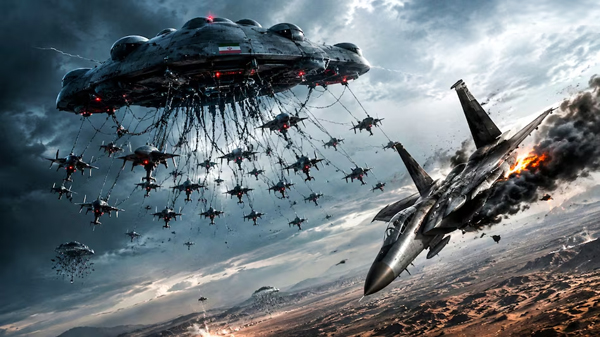

New Delhi. The incident of the downing of an American F-15 fighter aircraft over Iran in April 2026 not only changed the battlefield but also created a storm in the US intelligence agencies. What the rescued pilot told in the debriefing sounds like science fiction – several Iranian drones were floating together in the sky, connected to each other and moving in the shape of a jellyfish.
The big attack drones were hanging above like the main body and the small suicide drones were hanging below like legs. It was all together, like one unit. This incident signals a major surge in Iran’s drone technology, which has become a matter of great concern for the US and its allies.
This story is not just about the detention of a pilot. It is a glimpse of the future of modern warfare, where cheap, intelligent and swarming drones are challenging traditional aircraft. This is the first time in the ongoing conflict between America and Iran that an American plane was shot down in Iranian territory.
Both the pilot and the weapons systems officer survived, but the incident sparked debate in the intelligence world. Did the pilot really see? Was he confused due to a head injury? Or has Iran truly acquired advanced technology previously thought only to be possessed by China and Russia?
Jellyfish Formation: New Strategy for Swarm Drones
Jellyfish formation swarm is a special method of drones in which many drones connect to each other using meshed networking. In this, a main operator can control several drones simultaneously – this is called one-to-many control. Larger drones act as command centres, while smaller drones remain below for attack, surveillance or distraction. These all go together. Maintains shape. Can also be changed if needed.
This formation is dangerous because it can dodge conventional radar and anti-aircraft systems. Looking like a jellyfish, it covers a large area while remaining at low altitude, like a mindfield in the air. Small drones can attack by hanging down like legs, while larger drones handle communication and power supply. Iran seems to have developed this capability with the help of China and Russia. Earlier such swarms were believed to be with Russia and China. Now reaching out to Iran could change the regional balance.
This technique is not just for attack. In theory, it can also provide internet connectivity in remote areas, but its use in war is fatal. Expert Emma Bates says that if it attacks by maintaining the swarm size, using reserves in case the earlier drones are destroyed, then it will prove to be very expensive and dangerous. America will have to spend heavily to avoid such a threat.
Incident details and intelligence debate
The F-15 had two crew members – the pilot and the weapons system officer. Search and rescue started immediately after the plane fell. The pilot was rescued within a few hours, while the officers remained hidden in the mountains for more than a day. The pilot described this scene in the debriefing. But intelligence officials were skeptical. The officers were asking – Have you really seen what you said?
Some officials were considering it as a new capability of Iran, some were calling it a beta test or an illusion of the desert. Investigation is still going on whether the drone swarm helped in downing the plane or not. During this time, another A-10 aircraft was dropped in rescue, but its pilot got out safely.
China-Russia’s help and future threats
Iran’s drone program has been strong for a long time. Now with the advent of advanced technology like meshed networking, it has become more dangerous. American intelligence reports show that China and Russia have provided help to Iran. This can become a big problem for Iran, Gulf countries, Israel and American forces.
Swarm drones are changing warfare. Drones in the Russia-Ukraine war in Ukraine showed that small UAVs can destroy large tanks and ships. Iran’s jellyfish swarm, if true, is the next step – coordinated, intelligent, and difficult to stop. America will now have to invest more in counter-swarm technology, such as lasers, jamming systems or its swarm drones.
Will the form of war change?
This incident shows how technology is changing the rules of war. Expensive aircraft like the F-15 are now under threat from cheap drone swarms. The jellyfish formation is not only capable of attacking but also exerts psychological pressure on the enemy – looking like an alien creates fear.
This is a warning for America. Intelligence agencies will have to improve their assessment capabilities. Regional allies like Saudi Arabia and UAE will also have to strengthen their defence. Issues like drone control will definitely arise during the talks.
This is an achievement for Iran, but also a risk. If America and its allies formulate a counter-strategy, Iran’s program may come under target. Overall, this incident is the new reality of 21st century warfare – drones are now king, and swarms are their future.

Comments are closed.