
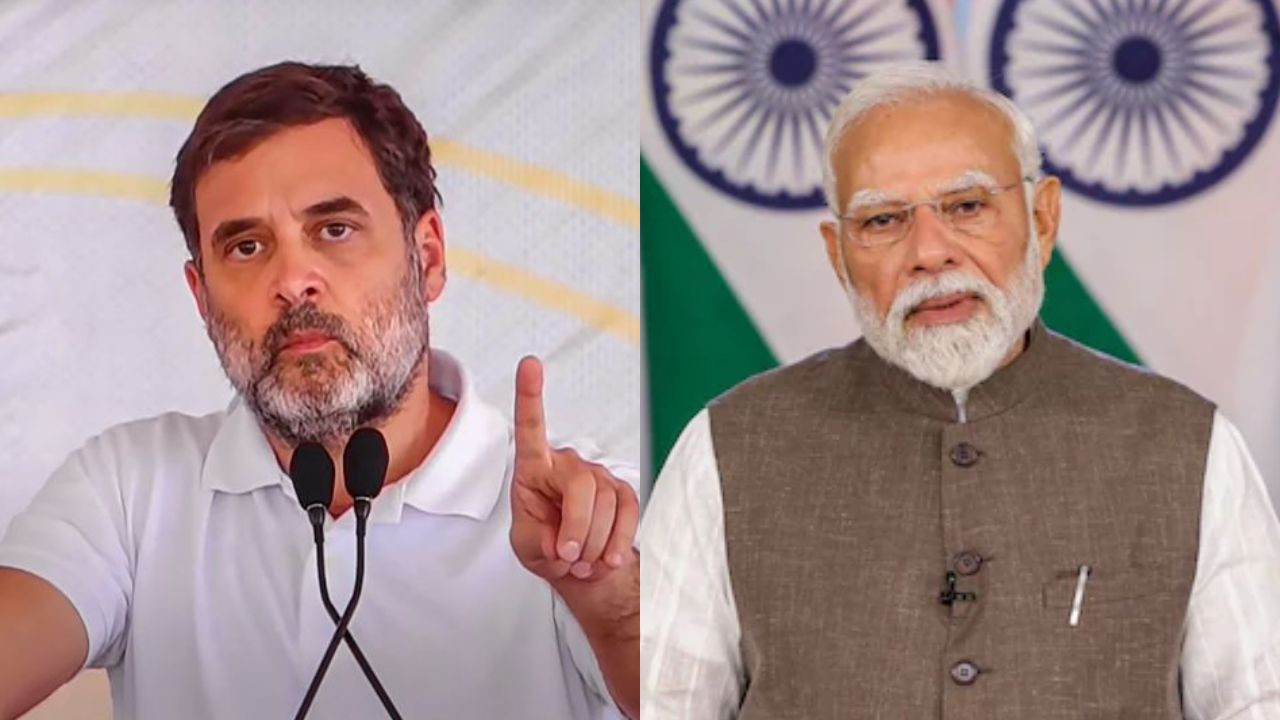
‘America will decide from whom India should buy oil?’, Rahul Gandhi’s sharp question to the government in Parliament

New Delhi:Political rhetoric regarding India’s foreign policy and energy security has intensified. Leader of Opposition in Lok Sabha, Rahul Gandhi on Friday made a scathing attack on Prime Minister Narendra Modi while raising questions on the foreign policy of the Central Government in Parliament. He said that the foreign policy of a big country like India should be independent and strong, but this is not visible in the current circumstances. He alleged that the country’s policy was being influenced by external pressures instead of any strong strategy.
Speaking in the Lok Sabha on issues related to commercial sovereignty and foreign policy, Rahul Gandhi said that India’s foreign policy should be decided by the country’s history, geography and its core ideology. He said that this policy should be made with the collective will of the people and not under the pressure of any external force.
video shared on x
Rahul Gandhi also shared the video of his statement on social media platform X. In this he said that India should have the right to decide from which country it will buy oil. He said that if America decides whether India can buy oil from Russia or Iran, then it raises questions on the country’s independent policy. Taking aim at Prime Minister Narendra Modi, he called him a “compromiser” and said that in such a situation India’s sovereignty is affected.
Congress also raised questions
After Rahul Gandhi’s statement, other leaders of the Congress Party also raised this issue. Congress General Secretary Jairam Ramesh, while posting on social media, questioned the role of America. He wrote in his post that it is important to understand how long India will continue to face situations like American pressure or blackmail. His statement expressed concern about American policy and its relations with India.
America gave temporary exemption to buy oil from Russia
Actually, this controversy came to light when America announced to give temporary exemption to India to buy Russian oil. US Finance Minister Scott Besant said that this decision has been taken to keep the global energy market stable. He told that the US government has given about 30 days exemption to Indian refineries to buy oil from Russia.
He said that this step has been taken so that the supply of oil in the global market is maintained and the energy crisis can be avoided. However, he also said that America expects India to increase imports of American oil in the future. America considers India an important partner and is talking about further strengthening energy cooperation between the two countries.
Impact of increasing tension in the Middle East
Concern about energy supply has also increased because tension in the Middle East has increased significantly recently. The situation in the region became more sensitive after the joint attack by America and Israel on Iran in late February. There were reports of death of many senior officials including Iran’s Supreme Leader Ali Khamenei in this attack.
After this, there is a possibility of increase in instability in the area. India fulfills a major part of its energy needs from this sector. About 40 percent of the country’s total oil imports come from the Middle East. A large quantity of these reaches India through the strategically important Strait of Hormuz.
Russia can also increase oil supply
Meanwhile, Russia has indicated that it can help India in case of a possible supply crisis. According to reports, Russia is ready to send additional consignment of crude oil to India. It is being told that about 95 lakh barrels of Russian oil has already reached near Indian waters and it may reach India in the coming weeks.
A new debate has started in India on energy security and foreign policy due to the increasing tension in the Middle East, America’s policies and trade with Russia. The opposition is raising questions on the government’s strategy, while the government is trying to strike a balance between the global circumstances.

Comments are closed.