
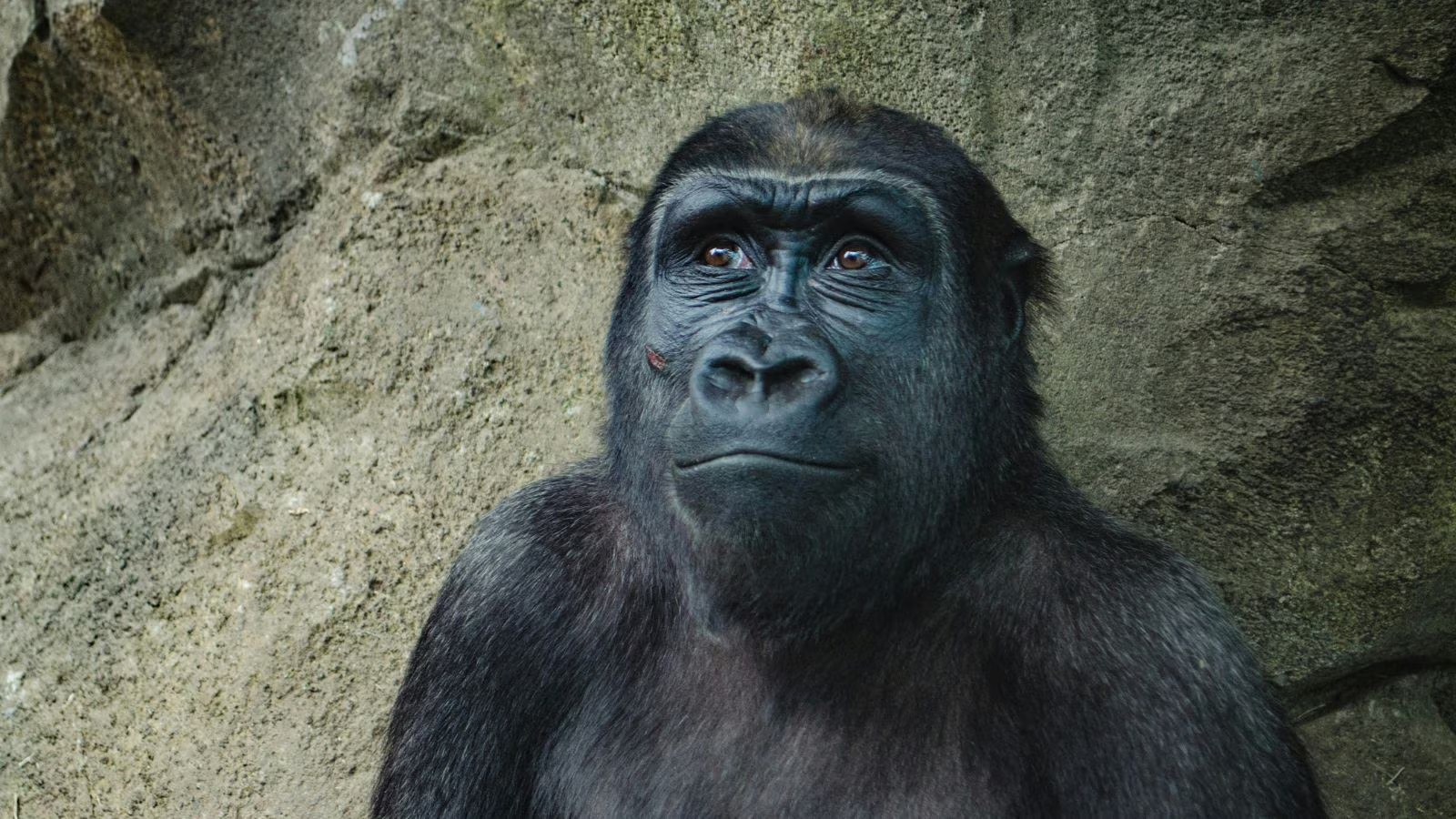

The discovery of fossils of an ape-like creature in Egypt has made scientists rethink the origin of modern apes. In the past, scientists believed that the origin of apes was in East Africa. However, the discovery of fossils of an ape-like creature has made them rethink this idea.
The fossils are believed to be between 17 million and 18 million years old. They were found in northern Egypt.
They belong to a previously unknown species of ape, offering fresh clues about early primate evolution.
“Discovering a fossil ape in this region is both significant and somewhat surprising,” said Shorouq Al-Ashqar, the study’s lead author, in an interview with Live Science. “But it also highlights how incomplete our picture has been.”
A new species emerges
The remains were discovered during fieldwork carried out in 2023 and 2024. While the fossils are limited, consisting mainly of fragments of a lower jaw and worn teeth, researchers determined that they did not match any known species.
The team has named the new ape Masripithecus moghraensis. The name is a reference to both its Egyptian origins and the Wadi Moghra site.
Despite their incomplete state, these fossils have been useful to scientists. Teeth and jawbones are usually critical to knowing how ancient mammals lived and evolved.
Rewriting the evolutionary map
To know the place of this species in the ape family tree, scientists compared the fossils to other ancient ape fossils and to the genes of living species. The results of the comparison show that Masripithecus moghraensis is possibly near the common ancestor of all living apes.
This group includes humans, great apes such as chimpanzees and gorillas, and lesser apes like gibbons.
“The highest odds are [that it lived] in the northern part of the Afro-Arabian landmass,” said Erik Seiffert, a co-author of the study.
If correct, this could mean that the earliest ancestors of modern apes lived in regions farther north than previously thought, possibly across parts of North Africa and Arabia.
Not all scientists are convinced
Despite the excitement, some researchers are urging caution. Sergio Almécija, who was not involved in the study, described the interpretation as “a bit far-fetched.” He believes more complete fossils are needed before rewriting long-standing theories.
Still, other experts see value in the findings. David Alba noted that the idea of apes moving through northeastern Afro-Arabia fits with existing fossil evidence, even if it does not fully prove their origin point.
What the discovery means
It has long been known by scientists that apes first evolved at least 25 million years ago. They also migrated to Africa, Europe, and Asia. However, it has been rare to find fossils of apes related to the ancestors of modern apes.
This latest discovery fills in one more piece of the jigsaw puzzle, even though it does not reveal everything. More exploration of the area of Egypt and other surrounding areas could reveal more.

Comments are closed.