
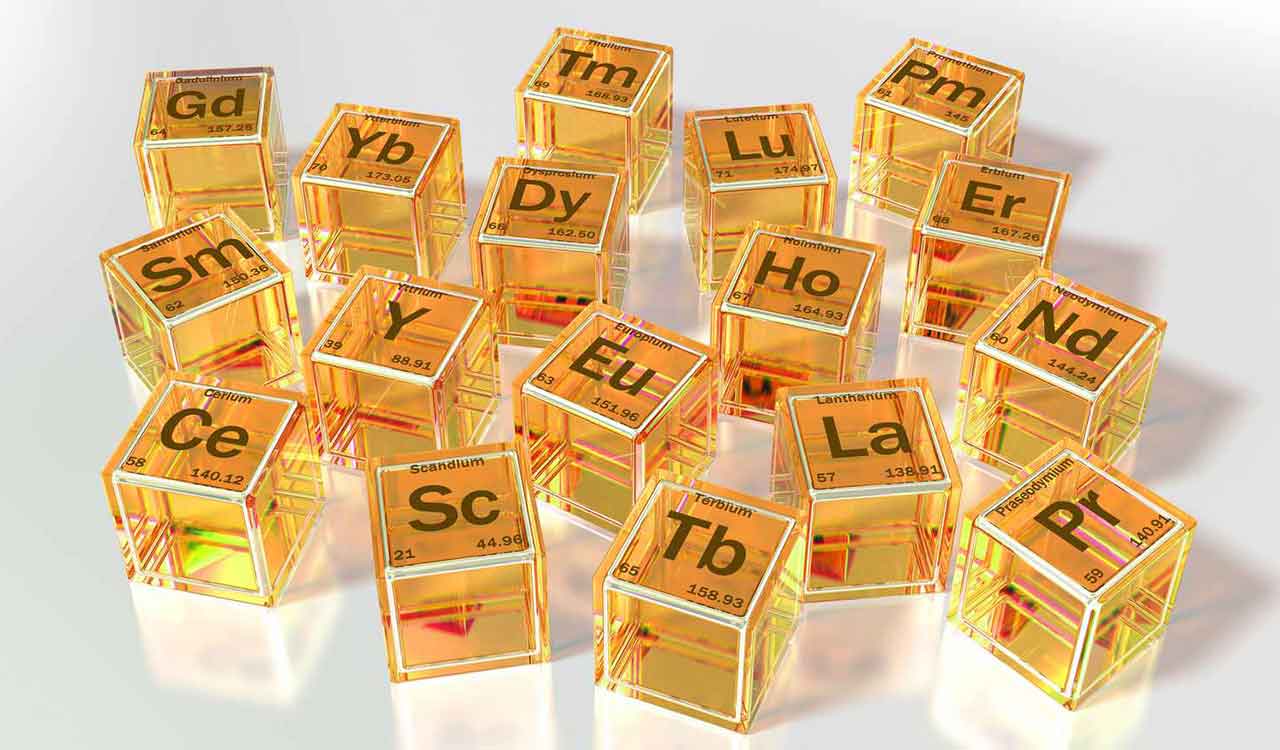

In Amaravati, the Andhra Pradesh government plans to develop rare earth and titanium-based minerals from its beach sand reserves, aiming to reduce dependence on China, build a coastal value-addition corridor, and boost domestic manufacturing for clean energy and defense
Published Date – 28 February 2026, 01:04 PM
Amaravati: The Andhra Pradesh government is foraying into rare earths and titanium-based minerals to unlock the economic potential of its sand reserves, aimed at reducing India’s dependence on China-dominated global supply chains.
The southern state intends to create a new downstream manufacturing hub along its coastline.
“Andhra Pradesh is preparing a strategic push into rare earths and titanium-based minerals by unlocking the economic potential of its vast beach sand reserves — a move aimed at reducing India’s dependence on China-dominated global supply chains,” a press release said on Saturday.
According to the Andhra Pradesh Mineral Development Corporation (APMDC), the state hosts the second-highest beach sand mineral reserves in India, accounting for nearly 25 per cent of these national resources.
These resources are particularly high in concentrations of ilmenite, rutile, zircon and monazite, which is a key source of rare earth elements (REEs), said the press release.
Beach sand minerals are critical inputs across a range of high-value industries – from paints and aerospace components to nuclear fuel and permanent magnets used in electric vehicles and wind turbines.
Ilmenite and rutile are processed into titanium dioxide pigment and titanium metal, while monazite yields rare earth oxides essential for electronics and clean energy technologies.
Currently, India imports over 75 per cent of its titanium dioxide pigment requirements, with nearly two-thirds sourced from China, despite having some of the world’s largest titanium mineral reserves, said the press release.
Incidentally, rare earth magnets are a fast-growing opportunity as they are crucial for motors, renewable energy systems, defence equipment and consumer electronics.
Rare earth magnet demand is projected to grow at over 15 per cent annually in India and double by 2030, said the press release.
Currently, India remains heavily reliant on imports for both rare earth materials and finished magnet products, exposing manufacturers to geopolitical and supply chain shocks.
To capitalise on this opportunity, APMDC has already secured approvals for 10 major beach sand deposits across coastal districts such as Srikakulam, Vizianagaram, Visakhapatnam, Kakinada and Krishna.
These deposits cover thousands of hectares of land, holding tens of millions of tonnes of heavy mineral reserves, said the press release, adding that several additional blocks are under development or in advanced clearance stages.
These deposits are not merely viewed as mining assets, but as the foundation for a full value chain — from mineral separation and refining to advanced manufacturing of titanium products and rare earth-based components, said the press release.
With six operational ports possessing over 330 million tonnes of cargo capacity, expanding industrial corridors such as the Vizag-Chennai Industrial Corridor, and strong logistics and power infrastructure near mineral-rich coastal belts, Andhra Pradesh aims to build a coastal value-addition corridor.
This proximity allows heavy mineral processing plants, pigment facilities, titanium metal units and rare earth refining clusters to be located close to raw material sources, sharply lowering logistics costs, said the press release.
Further, Andhra Pradesh’s beach sand strategy aligns closely with India’s broader push for critical mineral security and domestic manufacturing under clean energy and defence programmes.
If executed at scale, the state could emerge as India’s primary hub for titanium dioxide pigment and titanium metal, rare earth oxides and permanent magnets and advanced materials for aerospace, EVs and renewables, said the press release.
Beyond import substitution, the sector could generate significant export revenues as global manufacturers seek non-Chinese supply chains for critical minerals, it said.
In effect, Andhra Pradesh is positioning its coastline not just as a mining belt but as a strategic materials corridor powering India’s next wave of industrial growth, the press release added.

Comments are closed.