

Highlights
- Android XR 5 delivers a refined spatial OS that blends naturally with real environments.
- Gemini AI powers intuitive XR interactions, from object lookup to real-time translation.
- Samsung’s Galaxy XR hardware unlocks XR 5’s full potential through smooth, adaptive performance.
- PC Connect, Travel Mode, and lifelike avatars show that XR is finally practical for daily use.
While we were still looking ahead to Android XRNews reported that it would have an expansive roadmap, potentially immersive, and not-so-long, as claimed in reality at the same time. To us, although the OS, as described, could unite know-how, spatial talking, digital flow, and quotidian use, we had only flickering shadows as a basis. Yet now, with the first release of Android XR 5, those earlier thoughts have been refined into a feel that’s both assertive and surprisingly plush. Consequently, what was once regarded as a conceptual leap has now emerged as a refined tech system that indeed reinterprets how XR is experienced.
On December 8, Android XR 5 premiered, marking the start of Google’s significant move towards spatial computing. The operating system doesn’t aim to impress with its brilliance or to cover you with effects or anything like that. It, on the other hand, relies on finesse to transform into a natural veil over your environment rather than a diversion from it. It may be the XR 5’s first public rollout, but it exudes a quiet accuracy, as if it were already aware of the role it wishes to play in the next era of personal computing.
A Digital Layer That Feels Personal and Alive
The initial experience of Android XR 5 is far from regular VR. There is no sudden “going into a different world” incident. On the contrary, the interface smoothly insidiously enters your environment. What’s more, where the user puts them, the apps would float right there, and the area specifically created for work would be your entire view, with standard actions like opening a browser or changing a window size feeling almost instinctive.
The operating system does not intrude upon your physical space; instead, it acknowledges it. That limit gives a sense of security, which is one of the very reasons many extended reality (XR) systems fail to deliver that feeling. Sometimes, it really seems that instead of entering a virtual place, one is letting the virtual components of the world into one’s real one.
The primary factor that contributes to this naturalness is Gemini. Google’s artificial intelligence is the core of XR 5, silently controlling your interactions. You are allowed to circle an object to search for it. You are free to request translations that appear precisely where you need them. You can even arrange your apps with mere voice instructions. None of these actions is felt as being imposed. Instead, it is as if your digital space is speaking the same language as you hear the world.
For the very first time, artificial intelligence in XR is making the environment more pleasant rather than a complication.
Genuine Hardware Exposes the OS’s Real Aim
In our earlier analysis at News, we mentioned the possibilities of Samsung’s Galaxy XR. Now, with XR 5 running on it, that possibility has become a reality. The headset becomes an excellent platform for the operating system to showcase its capabilities, and together they demonstrate that Google and Samsung share the same vision in the field of mixed reality.
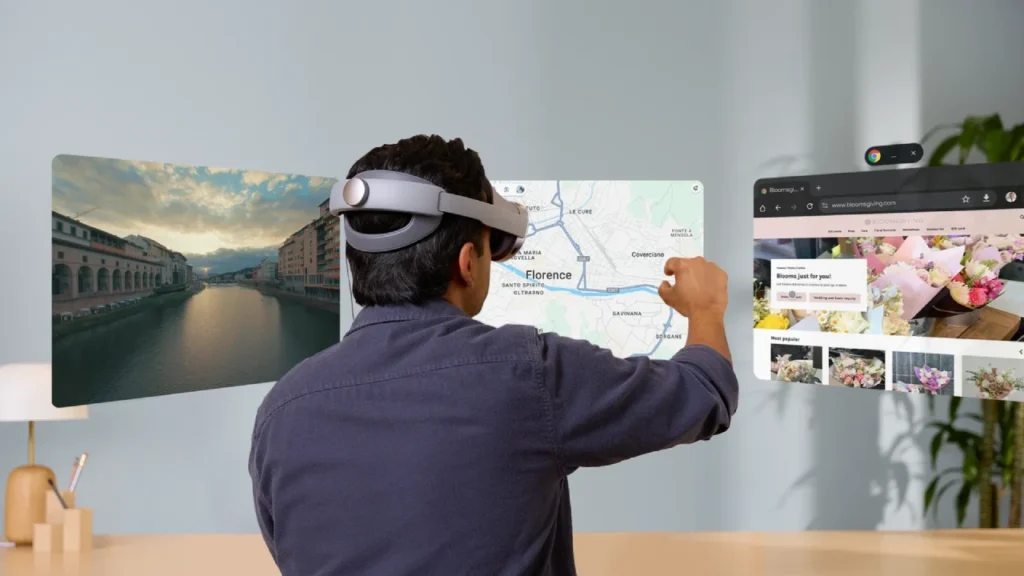
The headset is very refreshing, stable, and expertly tuned to the strengths of XR 5. The operating system identifies how users are sitting, standing, and interacting, and the device shows equally remarkable consistency in its response. But what really enhances the overall experience are the features we showcased before the launch, which are now fully developed and even more impressive in real time.
PC Connect is like riding on the productivity wave of the future. The ability to see your Windows desktop as a huge display that can be moved, resized, and repositioned with total freedom is nothing short of a revolution. Not because it has a look of the future, but because the utility aspect feels very real. For remote work, artistic creation, multitasking, or simple web surfing, XR computer presence is a turning point that raises your expectations forever.
Travel Mode is yet another indication that Google has meticulously considered the actual use. XR applications usually break down in motion; however, XR 5 provides the most stable visuals. Watching a film while moving feels smooth and private, and you are not disturbed by the outside motion at all.
The likeness takes communication a step further. Digital avatars often appear lifeless or creepy. Still, the XR 5 technology can detect even the smallest facial movements and convey them in a way that makes the interaction on the screen feel more humanlike. Virtual meetings don’t feel like a simulation anymore; instead, you get to present yourself as the charming and relatable self.
Everyday Use Cases Finally Make Sense
The very best aspect of XR 5 is that it is so easily incorporated into daily use. Maps become 3D creations you can walk around in. Chrome XR behaves exactly like a standard browser, except it can be wherever you want it to be. YouTube watching resembles a personal theater that can appear and disappear at will. Even the simplest tasks, like checking reminders or scribbling down quick notes, become more natural in a spatial context.
Google has done a great job of making XR a technology that isn’t seen as a tech demo but as something used daily. This very fact is what distinguishes it from most other companies.
A Starting Point With a Distinct Goal
The Android XR 5 has drawbacks. The app ecosystem will take time to develop, and people’s comfort with hardware varies. Some gestures are still, to a certain degree, raw and in need of further improvement. These, however, are the limitations one can expect from a first-generation spatial operating system. What is more crucial is the foundation’s strength, and the XR 5 has an incredibly strong one.
It does not appear to be an experiment. It seems to be one with a purpose. It is a thorough design. It is comfortable and familiar.
Final Decision: XR Is Personal, Practical, and Surprisingly Cozy
The Android XR 5 seems to be the first XR platform to understand what people really want. It delivers feelings via animated avatars. It provides convenience through the PC Connect feature. It offers cleverness thanks to Gemini A.I., and, above all, it creates an atmosphere of calm and a well-thought-out design that makes XR feel like a friend rather than a gimmick.
In a previous article on News, we stated that XR could do wonders if Google managed its execution well. Now that Android XR 5 is fully launched, it’s clear: Google not only got it right, but they also established a standard.
This is the time when spatial computing stops being a mere idea and begins to take root in our daily lives.

Comments are closed.