

AP-NORC Poll: Americans Question Trump’s Military Judgment amid Iran Talks/ TezzBuzz/ WASHINGTON/ J. Mansour/ Morning Edition/ A new AP-NORC poll finds many Americans see Iran’s nuclear program as a serious threat. But confidence in President Donald Trump’s judgment on military force and foreign policy remains limited. The survey reveals generational and partisan divides as U.S.-Iran nuclear talks resume in Geneva.
Americans question Trump’s military judgment amid Iran talks Quick Looks
- Nearly half of U.S. adults say Iran’s nuclear program is a major threat.
- 61% of Americans describe Iran as an “enemy” of the United States.
- Only about 3 in 10 Americans highly trust Trump’s judgment on military force.
- More than half say they trust him “only a little” or “not at all.”
- Republicans show stronger trust in Trump than Democrats and independents.
- Younger Republicans are less confident than older Republicans.
- Americans under 45 are less likely to see Iran as an enemy.
- Poll conducted Feb. 19–23 among 1,133 adults, margin of error ±4 percentage points.

Deep Look: AP-NORC Poll: Americans Question Trump’s Military Judgment amid Iran Talks
WASHINGTON — As U.S. and Iranian negotiators prepare for another round of nuclear talks in Geneva, a new AP-NORC Center for Public Affairs Research poll highlights a complex public mood: many Americans consider Iran’s nuclear program a serious threat, yet relatively few express strong confidence in President Donald Trump’s judgment when it comes to military force or managing adversaries.
The survey, conducted Feb. 19–23 as tensions escalated in the Middle East, shows that about half of U.S. adults are “extremely” or “very” concerned that Iran’s nuclear program poses a direct threat to the United States. Roughly 3 in 10 are “moderately” concerned, while about 2 in 10 report being “not very” or “not at all” concerned.
The findings come at a pivotal moment. The Trump administration has resumed nuclear negotiations with Iran under Omani mediation, seeking to limit Tehran’s nuclear capabilities and ensure it does not develop atomic weapons. Iran, meanwhile, maintains that its program is peaceful and has resisted demands to halt uranium enrichment or surrender its stockpile of highly enriched material.
Trump, who withdrew the U.S. from the 2015 nuclear agreement during his first term, has alternated between diplomacy and sharp warnings. He has threatened military action if Iran refuses to curb its program, asserting that prior U.S. strikes “obliterated” Iran’s nuclear infrastructure during last year’s 12-day conflict. Iranian officials have warned they would retaliate in the event of further attacks.
As negotiations resume, the U.S. has amassed one of its largest military deployments in the Middle East in decades, underscoring the high stakes of the diplomatic effort.
Low Confidence in Trump’s Military Judgment
Despite widespread concern about Iran, Americans remain skeptical about Trump’s decision-making in foreign affairs.
The poll finds that only about 3 in 10 U.S. adults have “a great deal” or “quite a bit” of trust in Trump’s judgment regarding the use of military force, relations with adversaries, or the use of nuclear weapons. More than half say they trust him “only a little” or “not at all” on these issues.
The partisan divide is stark. Roughly 6 in 10 Republicans express high trust in Trump’s military and foreign policy judgment. In contrast, about 9 in 10 Democrats report low levels of trust. Independents fall closer to Democrats than Republicans on these measures.
Yet even within Trump’s own party, confidence is not uniform. Younger Republicans — those under age 45 — are less likely than older Republicans to say they have strong trust in his handling of military force. About half of younger Republicans express high trust, compared with about two-thirds of Republicans 45 and older.
Iran Viewed as an Enemy
Public attitudes toward Iran remain largely negative. Sixty-one percent of Americans describe Iran as an “enemy” of the United States, a slight increase from 2023 polling. About 3 in 10 say the countries are “not friendly, but not enemies,” while only around 1 in 10 consider Iran a “friendly” nation or “close ally.”
Still, generational differences are notable. Only about half of Americans under 45 label Iran an enemy, compared with roughly 7 in 10 adults aged 45 and older.
The same age divide appears in views of Iran’s nuclear program. Approximately one-third of younger adults say they are highly concernedcompared with about 6 in 10 older Americans.
The generational gap may reflect lived experience. Older Americans have witnessed decades of strained U.S.-Iran relations, from the 1979 hostage crisis to repeated confrontations over nuclear development. Younger Americans, by contrast, have come of age during shifting geopolitical priorities and prolonged Middle East conflicts.
Nuclear Concerns Remain Steady
The level of concern about Iran’s nuclear ambitions has remained relatively consistent over the past year. Before the 12-day conflict last JuneIran had enriched uranium to 60% purity — a short technical step from weapons-grade levels. The International Atomic Energy Agency has said Iran was the only country enriching to that level without already possessing a nuclear weapon.
Following the conflict, Iran has limited access for inspectors to certain bombed sites, raising questions among nonproliferation experts about the current status of its program.
Republicans are somewhat more likely than Democrats to view Iran’s nuclear activities as a major threat. Fifty-six percent of Republicans say they are “extremely” or “very” concerned, compared with 44% of Democrats.
High-Stakes Diplomacy
The renewed talks in Geneva represent the third round of negotiations this year under Omani mediation. Previous diplomatic efforts collapsed last year after Israel launched strikes that escalated into open conflict, drawing the United States into direct military action against Iranian nuclear facilities.
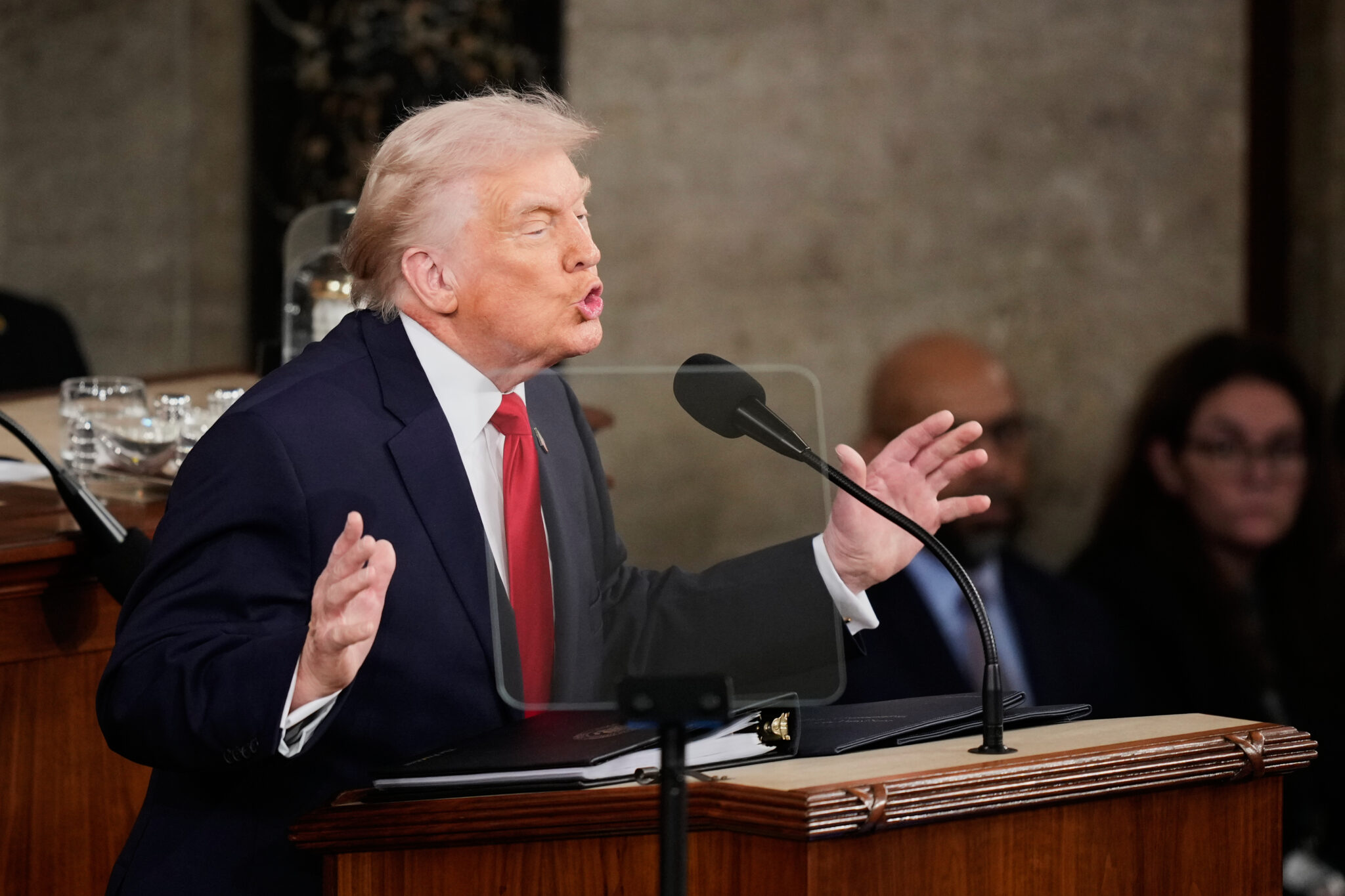
In his recent State of the Union address, Trump emphasized that negotiations are ongoing but expressed skepticism about Iran’s intentions.
“We are in negotiations with them,” Trump said, adding that he is waiting to hear Iran declare it will never pursue nuclear weapons.
The poll suggests that while Americans broadly share concerns about Iran’s nuclear capabilities, they are less unified in their confidence that military threats or force are the best tools to address the challenge.
Poll Methodology
The AP-NORC poll surveyed 1,133 adults nationwide from Feb. 19 to Feb. 23 using NORC’s probability-based AmeriSpeak Panel, designed to represent the U.S. population. The margin of sampling error is plus or minus 4 percentage points.
As diplomacy continues and military forces remain positioned across the region, the public’s mixed views underscore a delicate balancing act for policymakers: managing a perceived security threat abroad while maintaining domestic confidence in leadership decisions at home.
More on US News

Comments are closed.