
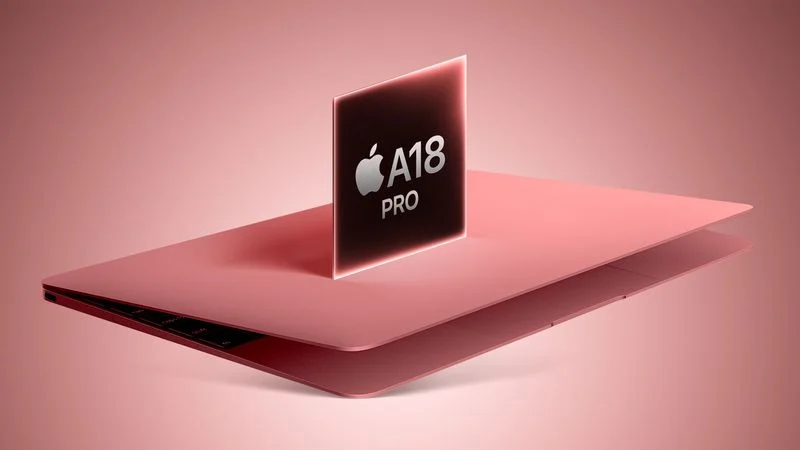

For years, the entry-level Mac experience has been defined by “last year’s hardware at a discount.” However, according to the latest intelligence and supply chain analysts like Ming-Chi Kuo, Apple is preparing to break its own rules. On March 4, 2026, the company is expected to unveil a device that could be its most disruptive laptop in a decade: a truly low-cost, vibrant MacBook designed to dismantle the dominance of Chromebooks in the education and budget sectors.
The most radical rumor surrounding the upcoming laptop is its heart. Rather than using a scaled-down M-series chip, Apple is reportedly pivoting to the A18 Pro, the same silicon currently powering the iPhone 16 Pro. This marks the first time an A-series chip will be the primary processor for a macOS device.
While purists might scoff at “phone chips” in a computer, the technical reality is formidable. Benchmarks suggest the A18 Pro offers single-core performance that rivals the original M1 and even the M2, making it more than capable of handling macOS 26.3. By utilizing the iPhone’s high-volume chip production, Apple can significantly reduce manufacturing costs, passing those savings to the consumer while ensuring enough power to run Apple Intelligence features natively.
A Rainbow of Aluminum: The Return of the “Fun” Mac
Design-wise, the new MacBook (potentially dubbed simply “MacBook” or “MacBook E”) is expected to be a visual departure from the professional silver and space gray of the current lineup. Leaks suggest a palette of six vibrant colors, including light yellow, light green, blue, pink, and silver.
To keep the price point near the rumored $599 to $699 rangeApple is reportedly using a new, faster manufacturing process for the aluminum chassis. This allows for a premium, durable feel that differentiates the device from the “sea of plastic” found in budget Windows and ChromeOS alternatives. The display is expected to be a 12.9-inch LCD, a slight step down from the MacBook Air’s Liquid Retina panels, lacking the wide P3 color gamut and peaking at around 500 nits of brightness.
The 24-Hour Battery Promise
Perhaps the biggest selling point of the A-series transition is efficiency. Because the A18 Pro is designed for the thermal constraints of a smartphone, its power draw in a laptop-sized chassis is negligible. With no fan and a significantly larger battery than a phone, rumors point to a “breakthrough” battery life that could exceed 24 hours of continuous use.
This “multi-day” battery life is the holy grail for students and travelers. It positions the MacBook not as a workstation, but as an ultra-portable “lifestyle” device that can survive a full weekend of lectures or a cross-continental flight without ever seeing a charging brick.
Calculated Trade-offs: What’s Missing?
To achieve this aggressive pricing, Apple has had to make surgical cuts. Beyond the LCD display, the A18 Pro’s architectural limitations mean the device will likely lack Thunderbolt support. Instead, users should expect standard USB-C ports with 10Gb/s speeds, limiting the device to a single external display.
Storage is another area of compromise. While the MacBook Air starts at 256GB, rumors suggest the budget model may offer a 128GB base tier. Furthermore, by capping the RAM at 8GB (the bare minimum required for Apple Intelligence), Apple ensures a clear “performance ceiling” that prevents the budget model from cannibalizing sales of the $999 MacBook Air.
The Chromebook Killer: Strategic Market Shift
This isn’t just a new product; it’s a defensive maneuver. Apple has watched Google’s Chromebooks dominate the K-12 education market for years. By offering a “premium budget” alternative that integrates perfectly with the iPhone and iPad ecosystem, Apple aims to capture users during their formative years.
If the $599 price tag holds true, Apple will be competing directly with high-end Chromebooks and mid-range Windows laptops. The “MacBook E” represents Apple’s bet that consumers would rather have a slightly slower, beautifully designed Mac than a faster, utilitarian plastic PC. As the March 4 “Special Experience” event approaches, the tech world is watching to see if Apple can finally make the Mac truly universal.

Comments are closed.