
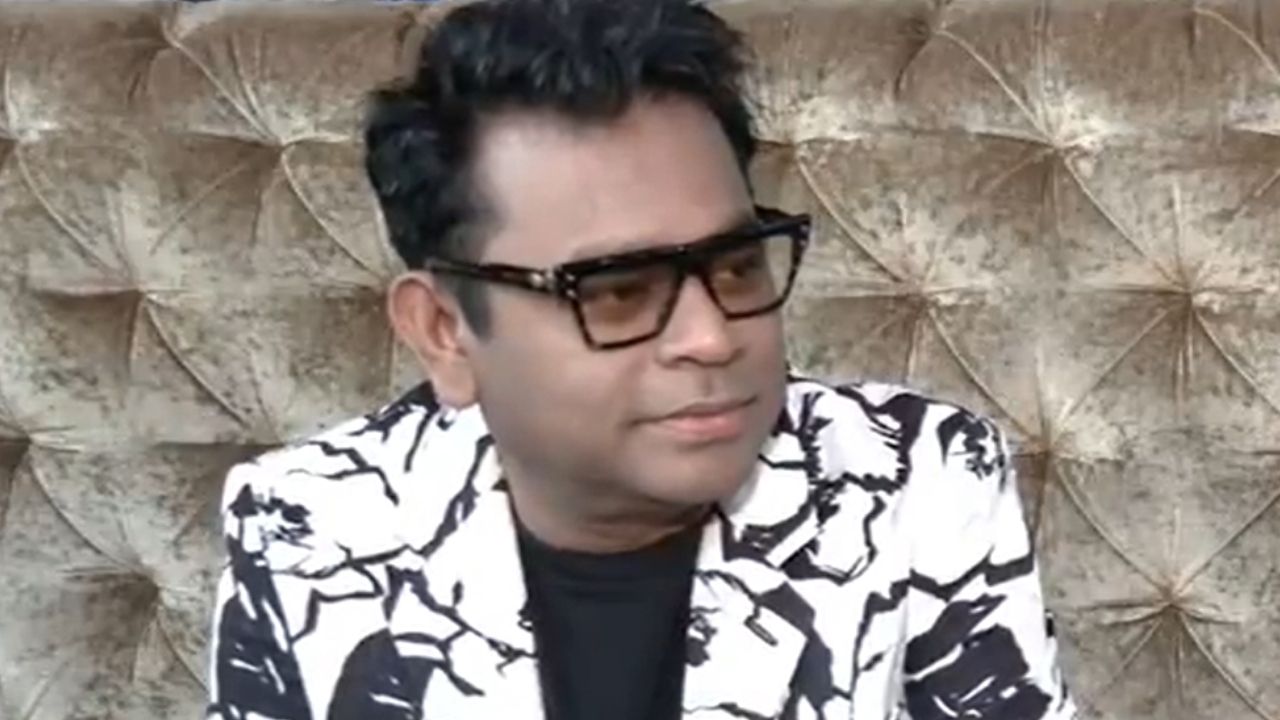
Is Hindu-Muslim conflict going on in Bollywood also? AR Rahman’s revelation that he was yearning for work for 8 years sparked a new debate.

The name of AR Rahman, Oscar winner, Grammy Awardee and the person who gave global recognition to Indian music, is still synonymous with respect and class. But this great musician has recently given such a statement, which has raised serious questions on the inner truths of Bollywood. Rehman has admitted that his work in the Hindi film industry has declined significantly over the past eight years, and this may be due not just to professional changes but also to power slipping from creative hands and possibly communal factors.
Rehman gave this statement in an interview given to BBC Asian Network, where he not only talked about the ups and downs of his career, but also openly exposed the changing character of Bollywood.
The pain of being an ‘outsider’ for seven years
AR Rahman entered Bollywood in 1991 with Mani Ratnam’s film ‘Roja’. After this, films like ‘Bombay’ (1995) and ‘Dil Se’ (1998) gave him artistic recognition, but Rahman admits that despite these three films, he could not feel himself a part of Hindi cinema. Rahman said, “Even after these films, I considered myself an outsider. I could not even speak Hindi.” Coming from Tamil background, it was not easy for Rahman to learn Hindi. Emotional connection with the language was also a big hurdle.
‘Taal’ which changed identity
Subhash Ghai’s film ‘Taal’ released in 1999 became the turning point of Rahman’s career. Rahman himself believes that after this film he truly became a part of Hindi cinema. “Taal reached every house, every kitchen. Even today this music flows in the blood of the people of North India.” The songs of ‘Taal’ – ‘Taal Se Taal’, ‘Ishq Bina’, ‘Nahi Samne Tu’, ‘Kahin Aag Lage’ – connected Rahman with the mass audience and made him a ‘household name’.
Journey from Hindi to Urdu and then to Arabic
Rehman told that Subhash Ghai had clearly told him – if you want to survive in Bollywood, you will have to learn Hindi. Rehman took it as a challenge and took it a step further and started learning Urdu, because according to him, the Hindi film music of the 60-70s was connected to the soul of Urdu. He didn’t stop there – he also learned Arabic because of its similarity in pronunciation to Urdu. After this he got associated with Punjabi music, the main reason for which was Sukhwinder Singh.
Sukhwinder Singh and historical partnership
The duo of Sukhwinder Singh and AR Rahman gave some immortal songs to Indian cinema –
- ‘Chaiya Chaiya’ – From the heart
- ‘Ramata Jogi’ – Rhythm
- ‘Jai Ho’ – Slumdog Millionaire (Oscar Winning Song)
Rehman tells that he himself discovered Sukhwinder because he wanted a singer who could write and sing Punjabi.
Why has Bollywood’s work decreased in 8 years?
The most shocking part of the interview came when Rahman was asked if there is prejudice in Bollywood against the Tamil community or non-Maharashtrian actors?
Rehman’s answer was simple but profound – “Maybe it was hidden earlier, but the balance of power has changed in the last eight years. Creative people are no longer in power.” He also said that it could also be a ‘communal factor’, although it is not directly visible on his face. Sometimes they only learn through “Chinese whispers” that they were to be signed, but the music companies gave the work to five of their ‘in-house’ composers.
‘I am not looking for work’
While most artistes curse the system for not getting work, Rahman has a different perspective – “I don’t care. I get more time with my family. I don’t go looking for work, I want work to come to me.” This statement reflects Rahman’s confident thinking and his creative self-respect.
Why did you switch from dubbed versions to Hindi films?
Rahman had shared another painful experience in an old interview given to NDTV. He told that when the songs of films like ‘Roja’ and ‘Dil Se’ became hits, very poor translations of Tamil songs were used in many Hindi films. “People used to say – Hindi lyrics are useless, Tamil version is better. It was insulting to me.” After this experience, Rahman decided that he would focus more on original Hindi films instead of dubbed films, so that the soul of the music is not compromised.
Changing Bollywood and rising questions
This statement of AR Rahman is not just the pain of an artist, but the story of the changing power structure of Bollywood. Where once music, story and experimentation were given importance, now corporate control, formula music and instant hits have taken over. Rahman’s statement that “those who are not creative are the ones in power today” is both a mirror to the industry – and a warning.
AR Rahman is the same even today – honest, deep and full of self-respect. If Bollywood has given him less work, it does not reflect Rahman’s lack, but the decline in priorities of the industry. Perhaps time will prove again that no industry can survive for long by ignoring creativity – and when it comes to music, AR Rahman’s name will always be at the top.

Comments are closed.