
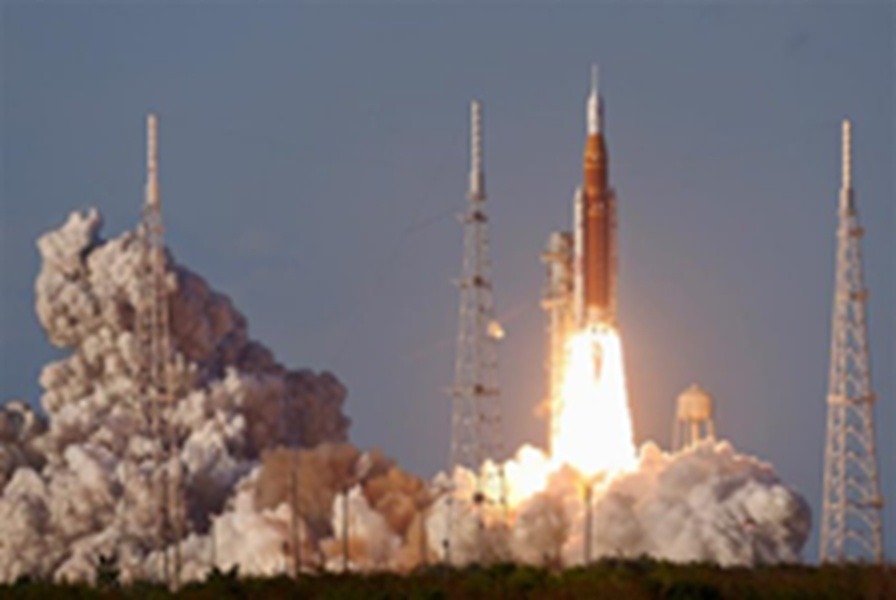
Artemis II: NASA’s Artemis-2 mission launched, human steps again towards the moon after 50 years

Florida, April 2. NASA’s Artemis II lunar mission launched from Florida, USA. It marked the first manned flight around the Moon in more than 50 years, carrying four astronauts. The Space Launch System rocket with the Orion spacecraft on top lifted off from NASA’s Kennedy Space Center on Wednesday at 6:35 p.m. (Eastern Time). This is NASA’s first manned mission under the Artemis program. The four-member crew includes NASA astronauts Reed Wiseman, Victor Glover and Christina Koch. Canadian Space Agency astronaut Jeremy Hansen is also part of the team.
The launch countdown was briefly stopped at the T-10 minute mark, after which it was resumed within a few minutes. The Artemis II mission will demonstrate many of the capabilities required for deep space missions. According to NASA, its purpose is to verify Orion’s life-support systems and give astronauts the opportunity to practice critical operations necessary for the success of Artemis III and upcoming lunar missions. The crew will travel about 7,400 kilometers beyond the far side of the Moon and then return to Earth. This mission will take astronauts further away from Earth and closer to the Moon than ever before in half a century.
Re-entry will be one of the most challenging phases of this mission. Orion is expected to enter Earth’s atmosphere at about 25,000 miles per hour, where it will encounter temperatures of about 5,000 degrees, before landing in the Pacific Ocean. During the mission, astronauts will evaluate spacecraft performance, practice emergency procedures and take photographs of the far side of the Moon. This team also represents many historical achievements. The mission includes the first woman, the first African-American astronaut, and the first Canadian to travel to the Moon.
Artemis II is seen as an early step in NASA’s broader plan, which aims to establish a long-term human presence on the Moon and eventually send astronauts to Mars. The Artemis program follows the Apollo missions, which sent 24 astronauts to the Moon between 1968 and 1972, 12 of whom walked on its surface. NASA wants to take this legacy forward by establishing a long-term lunar base and is planning missions to the Moon’s south pole by the end of this decade. After this it will move towards Mars.

Comments are closed.