
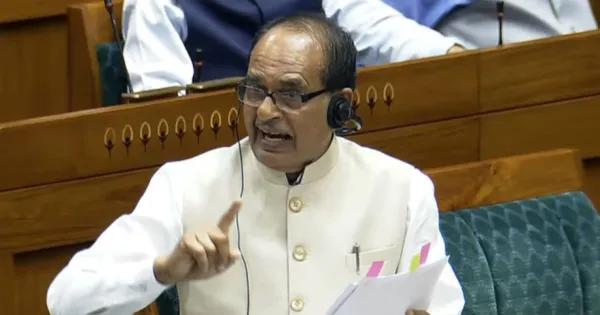

New Delhi. The government is preparing to enact a law named Vikas Bharat-Guarantee for Employment and Livelihood Mission (Rural) or VB-Ji Ram Ji. Shivraj Chauhan will present this bill in Parliament today. It is better than MNREGA in many ways. The provisions of this bill, which is being brought with the aim of creating strong and sustainable rural infrastructure, will ensure the interests of not only the rural laborers but also the farmers. According to the government, along with strengthening the rural economy, this law will further strengthen the foundation of developed India.
The assets created under the new scheme will be recorded in the developed India National Rural Infrastructure Stack. This will help in making national development strategies in an integrated and coordinated manner. This law, which provides a legal guarantee of 125 days of unskilled employment annually to adult members of rural families, will replace the 20-year-old scheme MNREGA. In such a situation, the question arises that why there was a need for changes in an already running scheme. How is it different and better than that and will it really change the picture of rural India? Let’s try to understand all such questions and their answers…
Why was there a need to change MNREGA?
MNREGA was created for the India of 2005, but rural India has completely changed. It is necessary to create a fast, sustainable and inclusive employment structure for the development of rural India. There has been a huge decline in poverty, from 25.7% in 2011-12 to only 4.86% in 2023-24. This decline has been possible due to the increasing consumption, income and financial access recorded in the Rex survey of MPCE and NABARD. The old framework no longer matches today’s rural economy with strong social security, better connectivity, deeper digital reach and diverse rural livelihoods. Due to structural changes, the uncontrolled and open model of MNREGA had now become irrelevant.
Steps towards standard financing
Standard financing links MNREGA to the budget system adopted in most schemes of the Government of India, and will also not reduce the employment guarantee. This change will make the plan more disciplined, transparent and effective, where resources will be used in a logical manner. The demand-driven model creates unpredictable allocations and budget inconsistencies. In contrast, standard financing is based on objective parameters, allowing predictable and logical planning. The Center and states will share responsibility for standard funding. If work is not given within the stipulated time, unemployment allowance will have to be paid. The right to guaranteed employment will be fully protected and protected by law.
Didn’t try to improve first
Many major reforms took place in MNREGA, but deep structural problems could not be addressed. However, compared to the financial year 2013-14, there were many major achievements of MNREGA during the year 2025-26. Women’s participation increased from 48% to 56.74%. Also, the number of Aadhaar-seeded active laborers increased from 76 lakh to 12.11 crore. Geo-tagged properties increased from zero to 6.44 crore. E-payments increased from 37% to 99.99%, personal assets increased from 17.6% to 62.96%. However, despite this progress, incidents of abuse continued, with digital presence being circumvented. Therefore, there was a need for a modern and robust system.
What are the arrangements for transparency and security?
AI (Artificial Intelligence) will be used to prevent irregularities. Also, steering committees will be formed at the central and state level for monitoring. The work will be monitored through GPS and mobile. In such a situation, there will also be an AIS dashboard showing information in real-time. Work and expenses will be publicly disclosed every week. Strict social audit will also be conducted in every gram panchayat twice a year.
Will the financial burden on the states increase?
This is not so, because this system is balanced and has been made keeping in mind the capacity of the states. Better monitoring will reduce the damage caused by corruption in the long run. 60% is not so, because this system is balanced and has been made keeping in mind the capacity of the states. Better monitoring will reduce the damage caused by corruption in the long run.
Even after reforms, systemic flaws remained
Many efforts were made to improve the functioning of MNREGA, but systemic flaws persisted. Investigations in 19 districts of West Bengal revealed that many works remained on paper, rules were violated and funds were misused, due to which funding was stopped. Monitoring in 23 states in FY 2025-26 revealed that many functions either did not exist or were not in proportion to expenditure; Where wage-based work should have taken place, machines were used and NMMS presence was largely circumvented. A total misuse of Rs 193.67 crore was found in various states in 2024-25. In the post-pandemic era, only 7.61% households completed 100 days of work.
How will the new scheme benefit the rural economy?
Creation of productive assets, higher income, better resilience will give wings to the rural economy. Along with providing immediate employment, this will lay a strong foundation for making rural India prosperous and self-reliant in the long run. Water conservation has been given priority. Mission Amrit Sarovar has already constructed and renovated more than 68 thousand reservoirs. Roads, connectivity and infrastructure will increase market access in villages.
Rural business activity will intensify. Storage, market and production assets will help in diversification of income. Increase in household income will boost demand and consumption in villages. Increasing opportunities and creation of sustainable assets will reduce the pressure of migration to cities.
Will the new law be better than MNREGA
This will remove the structural weaknesses of the old scheme and strengthen employment, transparency and accountability. This will not only generate employment in villages, but by linking every work into the framework of national development, rural India will be made prosperous and more resilient to challenges.
Increasing the number of guaranteed days from 100 to 125 will provide greater income security to rural families. MNREGA works were scattered across multiple categories and there was no strong national strategy. In the new law, sustainable assets will be created to support water security, basic rural infrastructure, livelihood-related infrastructure and climate adaptation. Developed Gram Panchayat Plans have been made mandatory, which will be prepared by the Panchayats themselves. These will be linked to PM Gati-Shakti.
There will be no shortage of laborers during agricultural work
States may notify a total period of 60 days during sowing and harvesting of crops when public works will not take place. Due to this, there will be no shortage of laborers during agricultural work. Due to closure of public works during the harvest season, wage rates will remain controlled and the cost of food production will not increase.
By giving priority to water related works, irrigation facilities will improve and ground water level will increase. The possibility of multi-crop farming will be strong. The key and livelihood infrastructure will enable farmers to store their produce safely, reduce crop losses and increase their access to markets. Drainage of flood water, water harvesting and soil conservation works will protect the crops. Will reduce damage from natural disasters.

Comments are closed.