
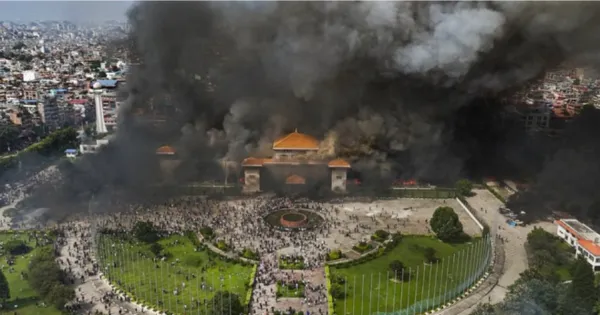
Huge anger among youth around the world, 128 movements took place in 70 countries in one year

New Delhi. The year 2025 will witness tremendous anger among the youth across the world. From Asia to Africa, Europe to America, the increasing number of anti-government protests in different parts of the world is sending a common global signal. Gen Z i.e. the young generation is deeply dissatisfied with the existing political and economic systems. The most important feature of these movements is that the majority of the participants are youth, but their issues are not the same. At some places there is anger against inflation and unemployment, at other places there is a direct demand for change of power and political accountability.
Total 128 movements in 70 countries in 12 months
According to data from Carnegie’s Global Protest Tracker, 35 anti-government protests were recorded around the world on November 1, 2025 alone. In the preceding 12 months, a total of 128 such movements took place in 70 countries. This figure shows that protest is no longer limited to one region or political culture. The structure of these movements is different from traditional political movements. Most of the protests have neither any formal leadership nor any established political party. These movements have been issue-based, organized through social media, spread rapidly and just as quickly taken new forms. Be it the August 2025 student movement in Bangladesh and Nepal or the tax proposals withdrawn under the pressure of Gen-G youth in Kenya, youth everywhere directly challenged the government.
The largest youth population in history
According to the report, this global uneasiness is emerging at a time when the number of youth in the world is at a historically high level. According to the US Agency for International Development, there are approximately 2.4 billion people in the age group of 10 to 29 years in the world. That is, the largest youth generation ever. The UNICEF report shows that the willingness to participate in protests has reached its highest level since the 1990s and that youth have played a decisive role in this change.
Agenda changed, anger deepened
The agenda of youth movements has changed continuously in the last two decades. While there was opposition against globalization and liberalization in the early 2000s, its scope expanded in later years. Climate justice, food and energy inflation, rising inequality and now demands for direct regime change. According to one study, there has been a marked increase in power-oriented youth movements after 1990 in countries like Bangladesh and Nepal. Interestingly, such movements have emerged in all three countries, poor, developing and developed. However, the current movement in Bangladesh has now fallen into wrong hands and is moving towards radicalism. This is the first movement of the youth which took a sudden U turn.

Comments are closed.