
NASA discovered ghost galaxy made of dark matter with the help of Hubble Space Telescope

Washington. Astronomers from the National Aeronautics and Space Administration (NASA), America’s government agency for space exploration, aeronautical research and civilian space programs, have detected a ghost galaxy made of dark matter with the help of the Hubble Space Telescope. It is made up of 99 percent dark matter. Astronomers claim that this is one of the mysterious galaxies, ‘CDG-2’.
NASA has uploaded details of this achievement on its website. It says that the sparsely populated galaxy CDG-2, shown in this image taken from the Hubble Space Telescope, has more dark matter and less scattering of stars. This galaxy is almost invisible, but using advanced statistical techniques, scientists identified it by discovering a small group of stars (globular cluster).
According to the National Aeronautics and Space Administration, this extremely faint galaxy, located in the Perseus Galaxy Cluster, about 300 million light years from Earth, was identified not by ordinary stars, but by four dense globular clusters. Initial estimates suggest that about 99 percent of CDG-2’s total mass is dark matter.
According to NASA, generally most galaxies are visible far away due to the brightness of billions of stars, but some special galaxies are so faint that it becomes very difficult to identify them. These are called low-surface-brightness galaxies. They contain very few stars and most of their mass is made up of dark matter, a substance that neither emits, reflects, nor absorbs light.
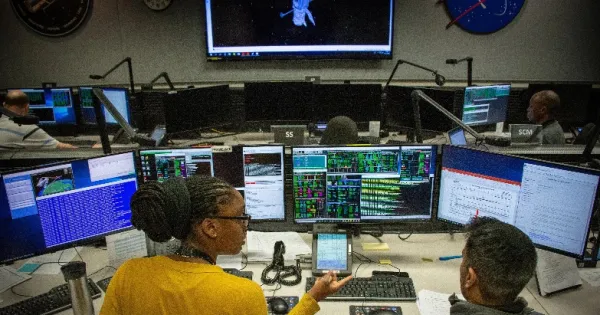
Preliminary measurements suggest that CDG-2 has a total luminosity equal to that of approximately 6 million Sun-like stars. This is extremely small compared to a normal galaxy. Details of this discovery have also been published in The Astrophysical Journal Letters. It is noteworthy that the Flight Operations Control Center of the Hubble Space Telescope is located at NASA’s Goddard Space Flight Center. This center is in Greenbelt (Maryland). This center remains active 24 hours. A team of engineers, scientists, and flight controllers oversee Hubble’s operations.

Comments are closed.