

Kathmandu. Nepal Police has expressed strong objection to a documentary broadcast by BBC World Service on the ‘Genji Movement’ that took place on September 8 and 9 last year in Nepal and has warned of legal action against BBC.
This 41-minute BBC documentary, with footage of two days of events, accuses the Nepali police of acting in a spirit of hostility towards the youth and holds the then Inspector General of Police Chandra Bahadur Khapung as the main responsible for the firing incident.
In the movement that took place on September 8, 2025, 19 youth had died due to bullet injuries. The documentary shows scenes of protesters attacking the Parliament building and pelting stones at police before shots were fired. Nepal Police says that this documentary has been made to defame him.
The protesters broke the police barricade and moved towards the Parliament House. Police used tear gas and water cannon after breaking the wall of the Parliament building and setting the gate on fire, the documentary shows. But the protesters did not step back, after which shots were fired. Despite not being in the front line, some other youth were also shot.
Nepal Police has issued a statement expressing its objection to the use of words like ‘shot like an enemy’ in the title of the documentary. Police believe that by giving such a headline, BBC has tried to defame the police and spread sensationalism.
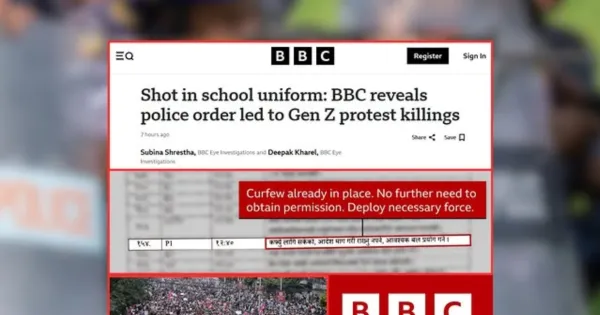
In the documentary, an attempt has been made to hold the then Inspector General of Police, Chandra Bahadur Khapung, responsible for the firing incident that day. Citing an internal police report, the BBC has claimed that the shooting was done on the orders of police chief Khapung.
Citing the police ‘log’, the report states that the order to open fire came from the callsign ‘Peter 1’. According to the report, the callsign ‘Peter 1’ belonged to the then IGP.
According to the report, when the policemen present in the field repeatedly asked for orders, Khapung said through the callsign, “Curfew has been implemented. No need to take permission. Use necessary force.”
On this basis, BBC has accused the then IGP Khapung as the main responsible. However, there is no comment in the documentary regarding the role of the political leadership in the incident.
Central police spokesperson Deputy Inspector General (DIG) Avinarayan Kafle said the police callsign communications mentioned in the report are not official. He said, “When the documentary itself states that the dialogues have been compiled based on various footage, questions arise over their legality.
Police related issues can be asked directly from us, thus there is no need to compile in a difficult manner.” He said that the organization has already made public all the available facts related to the incident through a press conference, hence any arbitrarily made report or documentary is exaggerated journalism of BBC.
Dialogues including police callsigns are mentioned in the documentary. Spokesman Kafle said police callsigns are publicly known, but any reports based on them should not be considered official.
He said, “Our organization has been clear about what happened that day. If additional information is required, we are always ready to provide the real facts.”
Police spokesperson has said that the Election Commission and the Press Council have already taken cognizance of this matter. He said that consideration is being given to finding legal remedy against defaming the Nepal Police, tarnishing their image and presenting the police’s side in a conspiratorial manner.
DIG Kafle said that an attempt has been made to demoralize the entire police department through the BBC documentary. He said that during this time the policemen had risked their lives and performed their duty, yet BBC has made the police the villain against which there is anger in the police organization and there is a demand for legal action against it.

Comments are closed.