
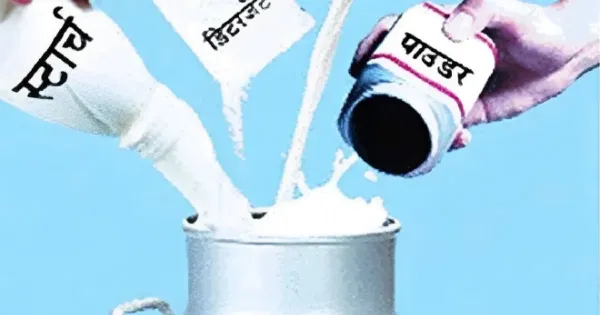
Laxity on food safety, adulterators fearless, sample testing increased, action remained half

- System limited to fine, figures are shocking in UP
New Delhi. Amid increasing reports of fake cheese, adulterated honey, contaminated milk and mislabeled food products in the country, serious questions are being raised on the effectiveness of the food safety system. Recent government figures show that the scope of surveillance continues to be wide, but the cases of strict action are decreasing. This contradiction is now raising questions about both policy and enforcement.
According to the reply given by the Ministry of Health and Family Welfare in the Lok Sabha on March 13, a total of 5.18 lakh food samples were tested across the country in the last three years. On an average, about 1.7 lakh samples were tested every year—1.77 lakh in 2022-23, 1.70 lakh in 2023-24 and almost the same number in 2024-25. That is, the scope of investigation is stable and wide.
But during the same period, there has been a huge decline in strict action like cancellation of licenses. While 533 licenses were canceled in 2022-23, it came down to 408 in 2023-24 and only around 220 in 2024-25. That means the cases of license cancellation reduced by more than half in three years.
On the contrary, the number of cases disposed of with conviction and fine has increased. There were 1188 convictions in criminal cases in 2022-23, which increased to 1265 in 2024-25. Whereas in civil cases, the number of cases settled through fine increased from 28,464 to 30,142. This trend clearly indicates that violations are coming to light, but in most cases, action is limited to fines or warnings.
State-wise figures further illustrate this imbalance. In a big state like Uttar Pradesh, more than 30 thousand samples were tested during 2024-25 and violations were registered in about 15 thousand cases, but the action to cancel the license was limited to only 16 cases. The situation is no different in Rajasthan and Madhya Pradesh, where strict action is negligible despite thousands of violations.
In some states of South India like Tamil Nadu and Kerala, the number of criminal cases is relatively high, but even there the final punitive action seems to be limited. This raises the question whether the current system lacks the will to take strict action or whether the legal process is so complex that it becomes difficult to reach a final punishment.
The central government says that enforcement of the food security law is a joint responsibility of the states and the Centre. While the Center sets the standards, the responsibility for their implementation rests with the states. Food safety officers and inspection mechanisms work under the states. But statistics show that this system lacks both coordination and rigidity.
Experts believe that the current system is limited to ‘fine based compliance’, which is not proving effective in preventing adulteration on a large scale. Unless stringent measures such as license cancellation and criminal action are taken regularly, food safety may remain a mere paper monitoring. Overall, the picture is clear, investigation is being done, but there is a lack of fear. And unless there is no fear of action against those involved in adulteration, it will be difficult for consumers to keep their plates safe.

Comments are closed.