
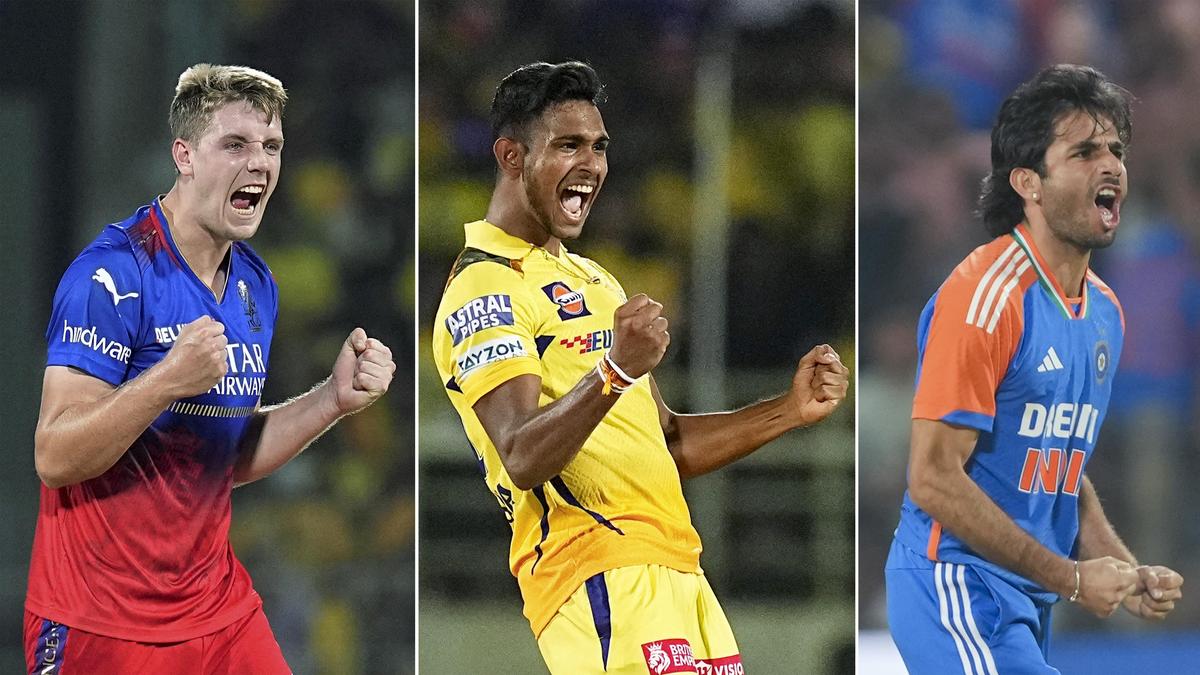

The IPL 2026 auction saw a combined total of Rs. 215.45 crore spent on 77 players by the 10 franchises. Emerging from the exercise was a clear pattern of calculated signings targeting specific roles, driven by sharp, ground-level scouting.
Unsurprisingly, Kolkata Knight Riders (KKR) and Chennai Super Kings (CSK) were the busiest teams at the auction, having entered the proceedings with the biggest purses.
Their approaches, however, diverged sharply. While KKR focused on marquee overseas names, CSK trained its sights firmly on uncapped Indian talent.
Overseas firepower
KKR made three of the six most expensive signings of the IPL 2026 auction: Cameron Green (Rs. 25.20 crore), Matheesha Pathirana (Rs. 18 crore), and Mustafizur Rahman (Rs. 9.20 crore).
Green, expectedly, emerged as the most expensive player of the auction and is now the third-most expensive player in IPL history. The 26-year-old’s power-hitting ability, combined with his capacity to deliver disciplined medium pace, sparked a bidding war between KKR and CSK, with the Knight Riders eventually prevailing.
“If we felt it would affect the rest of the auction, we would have let it go. Fortunately, it came within the range we were looking at. He adds a lot to our team, especially with our new power coach Russell,” KKR CEO Venky Mysore said.
KKR views Green as a like-for-like replacement for the now-retired Andre Russell, both in role and impact.
Calculated gamble
While Green’s acquisition was largely expected, KKR’s move for Pathirana at that price point raised eyebrows. The Sri Lankan slinger endured a difficult IPL 2025, managing just 13 wickets at an economy of 10.14, which led to his release by CSK.
KKR appears to be banking on Pathirana as a long-term death-overs specialist, another role Russell once fulfilled. Alongside Pathirana and Mustafizur, the franchise also added Akash Deep and Kartik Tyagi, bolstering an already imposing pace unit that includes Harshit Rana, Vaibhav Arora, and Umran Malik.
Doubling down on youth
CSK’s auction strategy reflected a broader shift in philosophy. After a disastrous start to IPL 2025, the franchise introduced young replacements such as Ayush Mhatre, Urvil Patel, and Dewald Brevis, all of whom made an immediate impact.
That youth-first approach carried into the auction. CSK spent the bulk of its purse on uncapped players rather than established names.
Uttar Pradesh all-rounder Prashant Veer and Rajasthan wicketkeeper-batter Kartik Sharma were the biggest beneficiaries, with both landing Rs. 14.2 crore deals, the highest ever paid for uncapped players in IPL auction history.
“As the game evolved, we may have been slow to evolve with it,” CSK coach Stephen Fleming admitted midway through the auction. “Halfway through (the 2025) tournament, we made a big shift. We identified that we needed to change.”
On paper, Prashant, a 20-year-old lower-order batter who bowls left-arm spin, looks like a long-term replacement for Ravindra Jadeja, who was traded to Rajasthan Royals for Sanju Samson.
Kartik’s signing, however, creates a problem of plenty. The 19-year-old power-hitter becomes CSK’s fourth wicketkeeper, alongside Samson, Urvil, and MS Dhoni.
Domestic pacers in demand
The other major uncapped windfall went to Jammu & Kashmir pacer Auqib Nabi, snapped up by Delhi Capitals for Rs. 8.4 crore. A consistent performer in domestic red-ball cricket, the 29-year-old has recently sharpened his death-bowling skills, earning him a maiden IPL contract.
Defending champion Royal Challengers Bengaluru also chased domestic pace, signing left-arm quick Mangesh Yadav for Rs. 5.20 crore, making him its second-most expensive buy behind all-rounder Venkatesh Iyer (Rs. 7 crore).
Big reputations, little interest
The scramble for domestic talent coincided with a cautious approach towards overseas players, particularly early in the auction. Liam Livingstone, Jake Fraser-McGurk, and Devon Conway all went unsold initially.
Livingstone eventually found a home at Sunrisers Hyderabad for Rs. 13 crore.
Indian batters Prithvi Shaw and Sarfaraz Khan also needed re-runs before finding teams, both eventually being picked up at their base price of Rs. 75 lakh. Their modest valuations underscored the league’s unforgiving nature and its growing preference for future-facing investments over stalled potential.
Losing value
Franchises were notably wary of capped Indian players not in the national reckoning. Six of the nine capped Indians who received bids were sold at base price, including Test regular Akash Deep.
Venkatesh Iyer and Ravi Bishnoi also saw sharp valuation drops after falling out of favour with the Indian team. Venkatesh’s price plummeted from Rs. 23.75 crore at the mega auction, while Bishnoi, retained for Rs. 11 crore by Lucknow Super Giants, fetched Rs. 7.2 crore.
State T20 League pipeline
In contrast, 32 uncapped Indian players secured contracts, with franchises spending Rs. 63.45 crore on them. That figure represents 72.59 per cent of the total spend on Indian players.
Eleven of those uncapped players earned more than their base price, many emerging from State T20 leagues. Robust scouting networks ensured names such as Prashant (UP T20 League), Akshat Raghuwanshi (MP Premier League), Mangesh (MP T20 League), Tejasvi Singh Dahiya (Delhi Premier League), and Naman Tiwari (UP T20 League) were already well known before auction day.
This influx of State-league talent comes at a time when the IPL is witnessing higher scoring rates, flatter pitches, and shrinking margins for bowlers. If pedigree and long domestic grind were once considered essential, the success of players like Priyansh Arya, Digvesh Rathi, and Vipraj Nigam suggests otherwise.
As conditions become increasingly unforgiving, the sustained success of this new crop of T20 specialists could further establish the IPL as an alternative and effective pathway for elite talent, reinforcing its position as the global benchmark for the modern game.
Published on Dec 17, 2025

Comments are closed.