
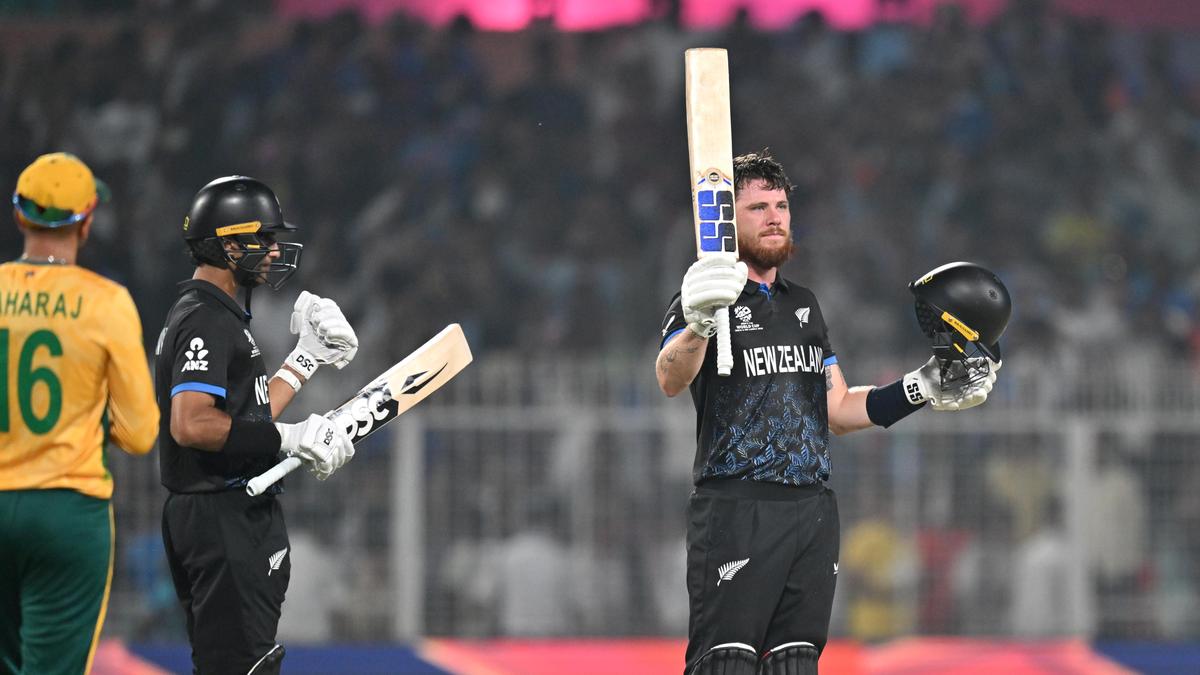
NZ vs SA, T20 World Cup 2026: Allen’s ton helps New Zealand stun South Africa to secure final berth

New Zealand reached its second men’s T20 World Cup final with a victory so complete that, for all the intrigue of its first half, the chase carried scarcely a tremor of uncertainty. Chasing 170 at Eden Gardens against South Africa, it surged home with nine wickets in hand as Finn Allen blazed an unbeaten 33-ball hundred that turned the pursuit into a display of controlled violence.
The finish was emphatic: 4, 4, 6, 6, 4 off Marco Jansen as New Zealand sealed the chase with 43 balls to spare.
The match had earlier drifted through several emotional shapes.
For much of South Africa’s innings, the total seemed modest. That impression owed much to New Zealand’s reading of the surface and the match-ups. The pitch was slower than the one used for the India–West Indies Super Eight game here. The ball gripped and refused to arrive cleanly on the bat. Mitchell Santner recognised it quickly and acted accordingly.
Quinton de Kock’s modest record against off-spin prompted the introduction of Cole McConchie inside the PowerPlay. The move worked immediately. De Kock, having just driven a short, wide ball for four, was denied room next delivery and miscued the pull to mid-on. Ryan Rickelton fell next ball, slicing to backward point.
South Africa never quite regained fluency. Dewald Brevis made a brisk 34, but the middle overs were squeezed by Santner and Rachin Ravindra operating in tandem. Ravindra’s intervention carried particular weight. Having earlier spilled Aiden Markram, he removed him in his first over and then dismissed David Miller in the next.
At 77 for four after 10 overs, the innings appeared stalled.
T20 cricket, though, rarely respects tidy scripts.
Jimmy Neesham’s 18th over loosened New Zealand’s grip. Jansen and Tristan Stubbs clubbed 22 runs and altered the tempo in a single passage. Jansen then struck two authoritative sixes off Lockie Ferguson to bring up a 27-ball half-century. What had been shaping as a 140-type total suddenly gathered weight.
Jansen finished unbeaten on 55 from 30 balls, the highest score of his T20I career, and his 71-run stand with Stubbs carried South Africa from 77 for five to 169 for eight.
Yet even within that recovery, there was a sense of unfinished business. Matt Henry delivered an excellent final over, dismissing Corbin Bosch and Kagiso Rabada while conceding only six. Jansen faced just two balls in it, managing three runs. In a format where momentum shifts quickly, South Africa might feel that 20 or 30 runs were left unclaimed.
New Zealand’s chase ensured that calculation never became relevant.
Tim Seifert and Allen recognised immediately that the best moment to seize the game was when the new ball was in play on a pitch where dew was now also going to play a hand. Jansen, South Africa’s principal PowerPlay weapon, was attacked from the outset. His first two overs cost 29.
There was fortune along the way. Seifert miscued a pull that ballooned behind the wicketkeeper, where miscommunication between De Kock and Dewald Brevis allowed the chance to fall untouched.
Lungi Ngidi, South Africa’s most reliable bowler in this tournament with his variations of pace, was also taken for 11 in his first over.
By the midpoint of the sixth over, the chase already carried the feel of inevitability. Allen drilled Corbin Bosch down the ground for four in an over that yielded 22 runs. As the field reset, Seifert walked down the pitch, and the pair brushed gloves with gusto, the gesture quiet but unmistakable.
New Zealand closed the PowerPlay on 84 without loss, the second-highest score of the tournament in that phase.
Curiously, the tactical approaches of the two sides in the PowerPlay diverged. While New Zealand had turned to spin almost immediately, Aiden Markram persisted with pace despite two right-handers at the crease. The South African quicks did not lean heavily on pace-off variations, with Ngidi the only one to dip under 120 kmph in the phase. Left-arm spinner Keshav Maharaj was introduced only in the seventh over, by which point the chase had already surged forward.
Seifert powered to 58 before Rabada finally broke the stand, but by then Allen had assumed full command of the evening with his third T20I hundred – the fastest-ever in T20 World Cup history.

Comments are closed.