
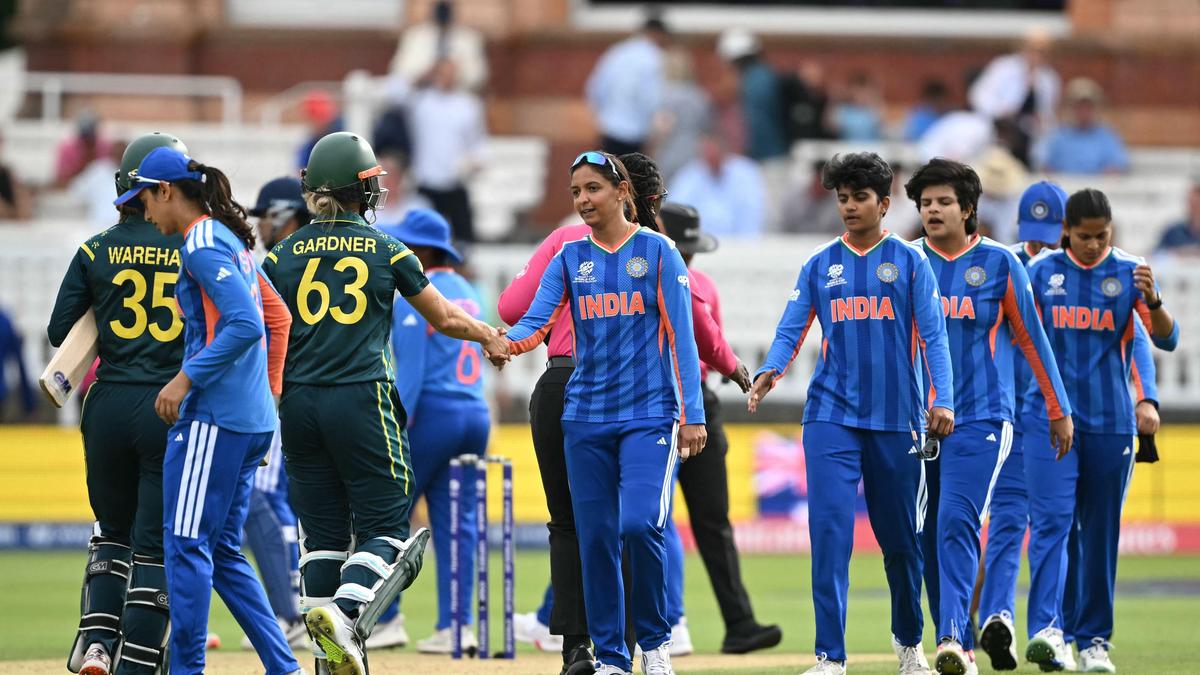

And then it was 10.
As Georgia Wareham drove down the Lord’s slope and into the boundary, India’s wait for a maiden Women’s T20 World Cup title stretched into a 10th edition.
For the second tournament in a row, Harmanpreet Kaur and Co. suffered a group-stage exit, paying the price for crucial defeats to South Africa and Australia in an unforgiving format that left no room for error.
History repeats itself
Hopes were high for India. The reigning ODI champion had one of the most talented batting units in international cricket, and a squad strengthened by experience at the highest level in the Women’s Premier League.
The team also prepared by touring Australia (three matches), South Africa (five matches), and England (three matches) for T20I series against all three sides, each of which ultimately reached the semifinals of the tournament.
The South Africa and England series ended in defeat (4-1 and 2-1 respectively). With hindsight, some may view those losses as a warning of what lay ahead, but they also gave a young side valuable preparation against the strongest opposition in the toughest conditions.
By the end of the World Cup, however, things looked much the same as they had at the end of the 2024 edition. India was knocked out of that tournament after defeats to New Zealand and Australia.
In 2026, it beat Pakistan, the Netherlands, and Bangladesh, but lost to South Africa and Australia, leaving Harmanpreet lamenting India’s performances against the tournament’s strongest sides.
“If I have to think about the entire tournament, I think we didn’t play well enough against the good teams,” she told broadcasters after the Australia defeat. “As a group, we really have to rethink what we do against (those) good teams.”
Is good enough really good enough?
Both of India’s defeats followed a similar pattern. It won the toss and opted to bat first on both occasions, posting totals that proved to be around par.
Each effort was respectable, but ultimately fell short of winning totals as India’s batting plateaued after the PowerPlay. Although scoring never stalled, the final flourish arrived too late on both occasions.
Across both matches, 15 of the 28 post-PowerPlay overs went for six to nine runs, but only six went for 10 or more. Only against Australia did India string together consecutive 10-plus overs, in the 19th and 20th, an indication that it never managed to move through the gears in its innings.
Most tellingly, Richa Ghosh, India’s designated finisher, managed a collective 16 from 15 balls with two boundaries, while Shafali Verma was the only batter to face at least 10 balls and score at a strike rate above 120 in both games.
Muddled bowling plans
India may have managed par totals, but its performance with the ball was a more glaring issue. The bowlers went at 7.43 runs per over across the tournament, more than all four semifinalists, and came undone when put under pressure by opposition batters.
More than execution, however, India’s problems lay in its planning. It fielded a different bowling combination in all five matches, altering both its seam attack and new-ball pairing each time.
The seam attack was a particular concern, as Renuka Singh, Kranti Gaud, Arundhati Reddy, and Nandni Sharma managed a collective five wickets at an average of 47. That none of them took the new ball more than twice was evidence that India lacked a settled PowerPlay strategy.
One mitigating factor is that Kashvee Gautam and Amanjot Kaur, both of whom have been part of the team in recent times, missed the tournament through injury, while Shreyanka Patil suffered an ankle injury midway through the World Cup, affecting the balance of the side.
The biggest positive, meanwhile, was the emergence of N. Shree Charani, who finished the league phase as the leading wicket-taker and broke the record for the most wickets by an Indian bowler in a single edition of the Women’s T20 World Cup.
The bowling attack’s struggles were exacerbated by some poor fielding displays. India dropped 10 catches across the tournament. The low point came against Bangladesh, when it spilled four chances in five overs, before twice putting down Marizanne Kapp against South Africa.
A reset to come?
In the aftermath of this elimination, it seems unquestionable that change is around the corner. Both captain and coach alluded to it after the match, speaking of the need for a “reset” and “rethink” of India’s T20 plans.
Exactly what that reset looks like remains unclear, but with its next T20 assignment against Zimbabwe scheduled for October, and a 20-over Champions Trophy in 2027, the time is now for India to begin reworking its T20 strategy.
Published on Jun 29, 2026

Comments are closed.