
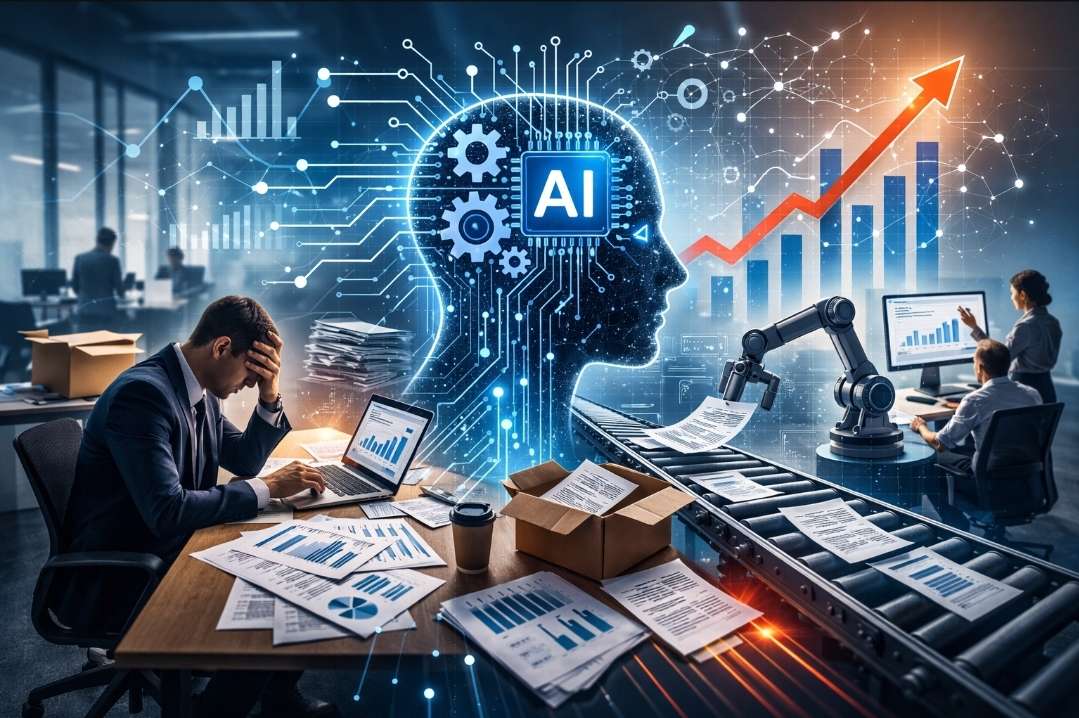
Artificial Intelligence at Work: Employees Say AI Is Increasing Pressure Instead of Lightening the Load

For more than a decade, the technology industry has promoted artificial intelligence as a transformative force that would dramatically reshape the modern workplace. Companies and executives in Silicon Valley have often described a future where intelligent software handles repetitive and time-consuming tasks, allowing employees to focus on higher-value work.
According to that vision, automation would not only increase efficiency but also improve quality of life for workers. Supporters suggested that AI could eventually reduce working hours, make four-day workweeks more common, and help professionals achieve a better balance between their careers and personal lives.
Businesses across the United States embraced this promise. Organizations rushed to integrate artificial intelligence tools into everyday workflows, from writing assistance and data analysis to automated customer support and project management. Corporate leaders frequently presented these technologies as tools that would remove routine burdens and allow teams to complete tasks more quickly.
But as AI becomes more embedded in daily operations, some employees say the experience has been far different from what was originally promised.
Workers Say AI Tools Are Creating More Work
At Amazon, some corporate employees have reported that the company’s push to adopt artificial intelligence tools internally has not delivered the productivity improvements that management expected. Workers who spoke with the British newspaper The Guardian described the tools as still being underdeveloped and sometimes unreliable.
Rather than eliminating work, employees say the technology often introduces new complications. In many cases, AI systems generate responses, code suggestions, or analytical outputs that contain mistakes or incomplete information. Workers then have to spend additional time reviewing the results and correcting errors before the material can be used.
This extra verification process can slow down tasks instead of speeding them up. Employees report needing to double-check AI-generated results, compare them with other data sources, and occasionally consult colleagues to confirm whether the information is accurate.
For some teams, the result has been a more complicated workflow. Instead of completing a task directly, workers may first review AI suggestions, revise them, and then conduct further checks to ensure the final output is correct.
At the same time, employees say expectations around productivity have not changed. Managers continue to encourage teams to work faster and produce more results, often presenting AI as a tool that should make that possible.
Research Shows Workloads Rising After AI Adoption
The experiences described by Amazon employees appear to reflect a broader pattern across the corporate world. Research conducted by workforce analytics company ActivTrak suggests that artificial intelligence may actually be increasing workloads rather than reducing them.
The company analyzed workplace activity from more than 163,000 employees across 1,100 organizations over a three-year period. The findings indicated that workers using AI tools spent more time on several categories of work after those tools were introduced.
One of the most noticeable changes involved communication. The study found that the number of emails sent by workers rose significantly, more than doubling in some cases. Activity on chat and messaging platforms also surged, while time spent using business management and productivity tools increased sharply.
Importantly, the research did not identify a single work category where time spent decreased after AI adoption.
According to the study’s conclusions, artificial intelligence is frequently being layered on top of existing workflows rather than replacing them. Employees continue to perform the same tasks they handled before, but now they also interact with AI systems as part of the process.
Faster Tasks Often Lead to More Assigned Work
The research also highlights a dynamic that has appeared repeatedly throughout the history of workplace technology. When new tools help employees complete certain tasks more quickly, the saved time is often used to assign additional responsibilities instead of reducing the overall workload.
Artificial intelligence can sometimes speed up particular tasks, such as generating reports or analyzing data. However, companies often respond to these efficiency gains by increasing expectations for productivity.
Instead of working fewer hours, employees may simply be expected to produce more output within the same amount of time.
In other words, while AI can improve efficiency at the task level, it does not necessarily translate into less work for employees. For many workers, the result is a faster pace rather than a lighter schedule.
A Familiar Pattern With New Technologies
The discussion surrounding artificial intelligence echoes earlier debates about the impact of technology on everyday life. Innovations such as smartphones and social media were also once promoted as tools that would simplify communication and free up time.
Mo Gawdat, a former executive at Google, has discussed this recurring pattern in public conversations about technology. He has argued that new digital tools often amplify existing behaviors rather than fundamentally changing them.
In the case of workplace technology, this means that efficiency improvements may simply accelerate the pace of work rather than reduce the amount of work people are expected to do.
As businesses continue to compete in fast-moving markets, productivity gains frequently translate into higher output targets rather than reduced workloads.

Comments are closed.