
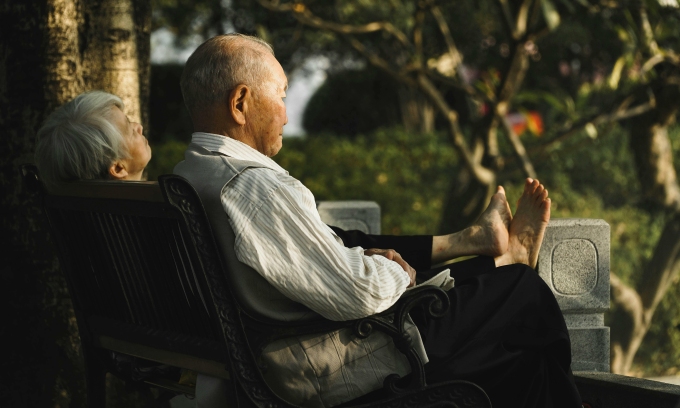

“As long as you have money and good health, life is comfortable in any form,” Zhang says, explaining why she chose not to have children. In her view, retirement security can be solved with savings rather than family ties.
A retired employee of a state-owned enterprise in Xuzhou, Jiangsu Province, Zhang told Lianhe Zaobao that her husband never liked children, while she herself was carefree and sports-obsessed in her youth. After an unplanned pregnancy, she chose to have an abortion. From then on, the couple became a classic “DINK” household: double income, no kids.
The term “DINK” emerged in the U.S. in the early 1980s, describing couples with stable careers and comfortable incomes who deliberately remain childfree. When the concept reached China during the early reform era, it was quickly embraced by intellectual circles. The late writer Wang Xiaobo and sociologist Li Yinhe were among the first to publicly live this way.
Now in her seventies, Li Yinhe says she has never regretted her decision and plans to grow old alongside close friends.
Zhang Xiaomei feels the same. With a generous pension, her days are packed with dance lessons, singing, African drumming, card games, mahjong and trips with friends.
But beyond these images of freedom and financial independence, China’s childfree lifestyle is becoming a major demographic challenge.
Data from China’s seventh national census in 2020 show there were about 188 million two-person households, accounting for nearly 38% of all households. This figure includes both voluntary DINK couples and people who are infertile.
The mindset is also spreading rapidly among the young. A survey released last June by the Institute of Psychology under the Chinese Academy of Sciences found that 70% of university students accept childfree marriage. Among female students, 85.3% said having children was “not important.”
This shift is colliding with traditional Confucian values, where raising children to support parents in old age is seen as a moral obligation.
As China’s first generation of DINK couples enters later life, debates over the “price” of childlessness have intensified across state media and social platforms.
Headlines increasingly focus on bleak scenarios: lonely old age, sudden illness, or helplessness in hospital without family caregivers.
The debate peaked last October when a documentary clip showing Shanghai resident Sun Genbao, a longtime DINK adherent, hospitalized while his wife panicked over his care went viral on Weibo. While many young viewers dismissed it as a government “pro-birth” scare tactic, the footage exposed gaps in China’s elder-care system that cannot be ignored.
Not everyone in the pioneering DINK generation remains as confident as Zhang Xiaomei. Of five early DINKs contacted for interviews by Lianhe Zaobaofour reportedly declined due to emotional distress, including a retired doctor in Chongqing who becomes overwhelmed whenever the topic of children arises.
Even Ye Tan, a prominent financial analyst, reconsidered her views after being diagnosed with cancer at 53. In a 2023 interview, she admitted that had she anticipated serious illness, she might have built a “safer shield” by having one or two children.
According to Lu Jiehua, vice president of the China Population Association, most of the first DINK generation is still in the early stages of old age, when health and finances allow for independence. The real test, he says, will come in their seventies and eighties, when medical needs rise and spouses pass away, according to Lianhe Zaobao.
Without children, Lu notes, older adults lose a natural emotional bond and an informal safety net, something China’s social welfare system has yet to fully replace.
Looking beyond the DINK community, many scholars argue the problem is rooted in decades of the one-child policy.
Zhou Xiaopu of Renmin University of China says parents who followed family-planning rules and those who chose to remain childfree now face similar risks. When an only child works far from home or settles overseas, parents experience loneliness comparable to those without children, Lianhe Zaobao reported.
Demographer Yi Fuxian, author of “The Great Empty Nest”, argues that the one-child policy permanently altered China’s family structure and social psychology. The old belief that “more children mean more wealth” has been replaced by anxiety over education costs and economic pressure. Rising individualism and the stresses of modern life have made childlessness or singlehood part of a broader modernization process, rather than a fringe lifestyle choice, Yi said, according to AP.
As a result, the challenge of aging in China is no longer just about people like Zhang Xiaomei. It has become a shared dilemma for a rapidly aging society whose traditional family foundations have been fundamentally shaken.

Comments are closed.