

Diesel adoption has fallen significantly in the last few years. People have increasingly been shifting to petrol and other alternate fuels. The government initially attempted an Ethanol-diesel blending, the vehicle compatibility and fuel stability tests of which returned unsatisfactory results. The program was called off following the same. Later, Isobutanol was selected as a more ideal alternative and is now being tested by ARAI. Amid all this, buying a diesel car could still make a lot of sense in India. This article will explain why.
Firstly, there are no worries of Ethanol and the risks associated with it. The petrol sold in India now is E20 (20% Ethanol blended petrol) and the government’s push for increasing blending is already worrying petrol vehicle owners. Choosing diesel seems safer in that regard.
Now, let’s take the case of Isobutanol blending. Isobutanol is a four-carbon alcohol produced from fermentation of biomass (like agricultural waste). It is significantly less corrosive than Ethanol.
The possible damages to vehicle engines over time, will thus be much lower. Unlike Ethanol, Isobutanol is more compatible with diesel chemistry. No worries of phase separation and ignition problems.
More important is the blend that the government is proposing. Most likely it will be 5-10% Isobutanol blending. At that rate, Isobutanol-diesel is expected to do minimal damage to the engine. It is claimed to be completely safe for BS6 and newer engines as they use synthetic and metal components that can handle the alcohol blends well.
However, if you are planning to buy a used, old diesel car, you should be extra-cautious. Older engines use rubber seals and components that are more prone to damage by alcohols. Even so, Isobutanol isn’t as hygroscopic (water absorbing) as Ethanol.
Isobutanol has a higher energy density than Ethanol- approximately 29.2 MJ per litre, while a litre of Ethanol has around 21.3 MJ. Therefore, blending it in diesel will not lead to a mileage penalty as big as Ethanol blends. Even engine knocking or ignition issues will not be as big as those posed by Ethanol blending. These will be minimal in a 10% blend.
Considering how deeply integrated diesel is into India’s commercial and logistical ecosystem, it is unlikely that the government would sharply increase Isobutanol blending in the future. If so, blended diesel will remain a safe choice for buyers.
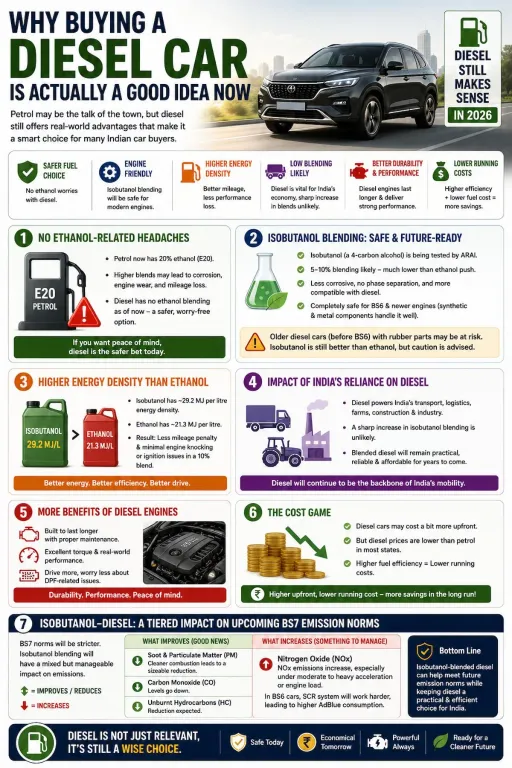
Diesel engines are also better for people who plan to keep their vehicles for long, as they typically last longer if maintained well. Even on the performance front, modern diesel engines leave no room for complaints- they are as fun to drive as petrol engines, if not better in some cases. If you are someone who drives a lot, you won’t have to worry about DPF-related issues either.
Diesel vehicles may have a higher upfront cost than petrol-equivalents. However, there is also a difference in fuel prices. Diesel engines typically return much higher fuel efficiency than petrol-powered ones. Meaning? Savings in the long run!
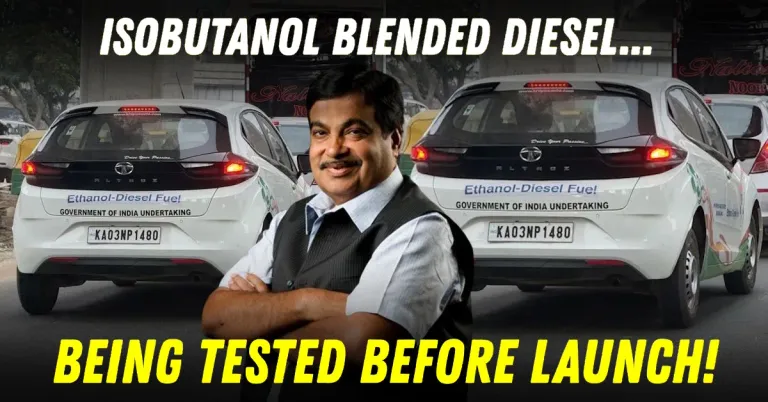
The only major concern in buying a diesel car today would be the upcoming BS7 emission norms, which are expected to be much stricter than the current ones. If the Isobutanol-blending program goes through, we will see a tiered impact on the emission compliance.
According to recent testing data from the Automotive Research Association of India (ARAI) and bioenergy companies like Praj Industries, lower blends of Isobutanol will lead to a sizeable drop in soot and particulate matter in the exhaust gasses. This is due to cleaner combustion. A reduction in Carbon Monoxide and hydrocarbons is also to be expected.
The Nitrogen Oxide emission, on the other hand, will increase with the use of blended diesel. The production of this will be high under moderate to heavy acceleration or engine load. In BS6 cars, this will cause the Selective Catalytic Reduction (SCR) to work harder and cause higher Adblue consumption.
Comments are closed.