

Every March, the global food world turns its gaze eastward. On 12 March 2026, the organisers behind Asia’s 50 Best Restaurants released the opening salvo of this year’s rankings, the extended 51–100 list, setting the stage for the highly anticipated top-50 ceremony scheduled for 25 March at Hong Kong’s Kerry Hotel. What emerged is perhaps the most geographically expansive edition ever assembled. With restaurants drawn from 27 different cities (up from 23 last year) and a dozen first-time entrants, the 2026 roster feels less like a conventional ranking and more like a redrawing of Asia’s gastronomic borders.
But statistics alone never tell the full story. Look closer and you find something far more compelling: a tiny counter restaurant in South Mumbai making its international debut, a Kuala Lumpur chef vindicated after years of foraging through Malaysian rainforests, and, perhaps most strikingly, four Indian restaurants staking their claim on a platform historically dominated by the culinary powerhouses of Northeast and Southeast Asia.
The New Arrivals That Matter

New entries on this list have always functioned as early warning signals, harbingers of talent the rest of the world is about to discover. The most commanding debut this year belongs to Beijing’s Chef 1996, which landed directly at No. 52, the loftiest position of any newcomer on the extended list. Operating exclusively through private dining rooms, it reflects the increasingly refined and confident direction of mainland Chinese gastronomy. Further south, Chengdu’s Co- (No. 69), a restaurant with just five tables and menus shaped by the chef’s extensive travels, has placed that Sichuan capital on the 50 Best map for the very first time.

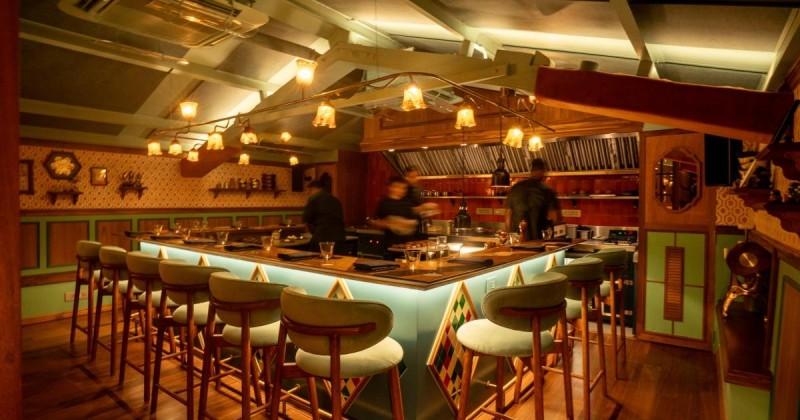
Yet it is the arrival of Mumbai’s Papa’s at No. 66 that feels most charged with meaning. Chef Hussain Shahzad, who trained under the legendary Floyd Cardoz and has earned recognition from Condé Nast Traveller India, runs what is essentially a 12-cover culinary theater from a compact counter in Bandra. His tasting menus are exercises in playful provocation: traditional Indian preparations deconstructed and reassembled with global technique, each course a small argument for why subcontinental flavors deserve a seat at the highest table. Already anointed by TIME magazine as one of the World’s Greatest Places in 2025, Papa’s entrance into the 50 Best universe now confirms Shahzad as one of the most inventive Indian chefs of his generation.
A Leap of Faith Rewarded
While debut entries capture the imagination, the year’s standout narrative of perseverance belongs to Kuala Lumpur’s Dewakan, which vaulted 22 positions to arrive at No. 62, the single largest ascent on the entire extended roster. Chef Darren Teoh has spent years on a deeply personal mission: scouring Malaysia’s indigenous pantry for forgotten roots, wild herbs, and native produce, then weaving them into contemporary menus that read like love letters to a landscape most urban diners never encounter. That this kind of radically local cooking is being recognised at the continental level, and with such dramatic upward momentum, suggests a growing appetite among international voters for cuisine that refuses to flatten itself into familiar European templates.
India’s Four: What the Numbers Really Mean
Four Indian restaurants now feature in the 51–100 ranking, representing Mumbai, New Delhi, and Bengaluru. In isolation, four may seem a modest figure. In context, it represents a paradigm shift. For years, Indian cuisine’s loudest ambassadors on international lists were chefs cooking abroad, Gaggan Anand in Bangkok, Himanshu Saini in Dubai. That the spotlight is now falling squarely on restaurants operating within India itself speaks to a new chapter: one in which the country’s own soil, kitchens, and dining rooms are generating world-class experiences without apology or approximation.

The range of philosophies here is what makes this quartet so noteworthy. Papa’s wages war on fine-dining pretension with irreverent wit. The Table has long championed a borderless culinary worldview. Inja attempts something genuinely unprecedented, a philosophical dialogue between two ancient food cultures separated by thousands of miles.

And Farmlore, which earned the American Express One To Watch Award in 2025, takes the farm-to-table ethos to its most literal extreme, operating from a functioning agricultural estate in rural Karnataka where diners eat within sight of the fields that feed them.

Three cities. Four restaurants. Four radically different visions. Together, they make an unmistakable case: Indian gastronomy has graduated from promising to formidable.
The Wider Continental Canvas
India’s emergence sits within a broader story of geographic democratisation. Seoul remains the most represented city on the 51–100 list, claiming seven spots, among them San (No. 54), this year’s One To Watch Award recipient. Bangkok, Singapore, and Hong Kong each maintain strong presences, underscoring their enduring status as Asia’s culinary nerve centres.
But the real intrigue lies at the margins. Four cities make their maiden appearances: Busan, Chengdu, Kanazawa, and Nishikawa. In Busan, Fiotto (No. 99), a modest Italian restaurant run by a married couple who grow their own organic produce, embodies a movement toward hyper-local, family-driven dining that prizes sincerity over spectacle. In Nishikawa, Dewaya (No. 93), a mountain ryokan that has been welcoming guests since 1929, now draws attention for chef Haruki Sato’s refined celebration of wild mountain vegetables and deep-forest ingredients. Japan, notably, now spreads its influence across Tokyo, Kanazawa, Nishikawa, Fukuoka, Wakayama, Kyoto, and Nanto proof that the country’s gastronomic genius extends far beyond its metropolitan hubs.
The Indian culinary footprint, too, extends well beyond national borders. Seven restaurants led by Indian-origin chefs feature on the extended list, including Thevar in Singapore (No. 58), where chef Mano Thevar draws on his Penang upbringing and Indian roots; Gaa in Bangkok (No. 95), helmed by Mumbai-born Garima Arora; and Haoma in Bangkok (No. 96), where chef Deepanker Khosla has built a zero-waste kitchen around an urban farming philosophy. The Indian culinary diaspora, it turns out, is every bit as consequential as the restaurants now rising at home.
All Eyes on Hong Kong
Everything announced so far is, of course, merely the overture. The continent now awaits the main performance: the unveiling of the 1–50 ranking on 25 March, at a ceremony hosted for the first time ever in Hong Kong, in collaboration with the Hong Kong Tourism Board. The event will stream live on 50 Best’s YouTube channel, and the question reverberating across every culinary capital from Tokyo to Mumbai is whether last year’s champion will hold its position or whether some new contender will seize the crown from this ever-expanding galaxy of extraordinary kitchens.
For India, the stakes are unusually high. With four restaurants already locked into the 51–100 bracket and established names like Mumbai’s Masque, a strong fixture in the 2025 top 50 list, expected to feature prominently in the upper echelon, the subcontinent’s overall representation could reach numbers never before seen in this competition.
What started as scattered sparks of ambition in repurposed lofts, agricultural estates, and minimalist dining rooms across India’s great cities has quietly caught fire. On the evening of 25 March, the world’s food establishment will take note. The question is no longer whether Indian cuisine belongs on the global stage. It is how high it will climb.

Comments are closed.