
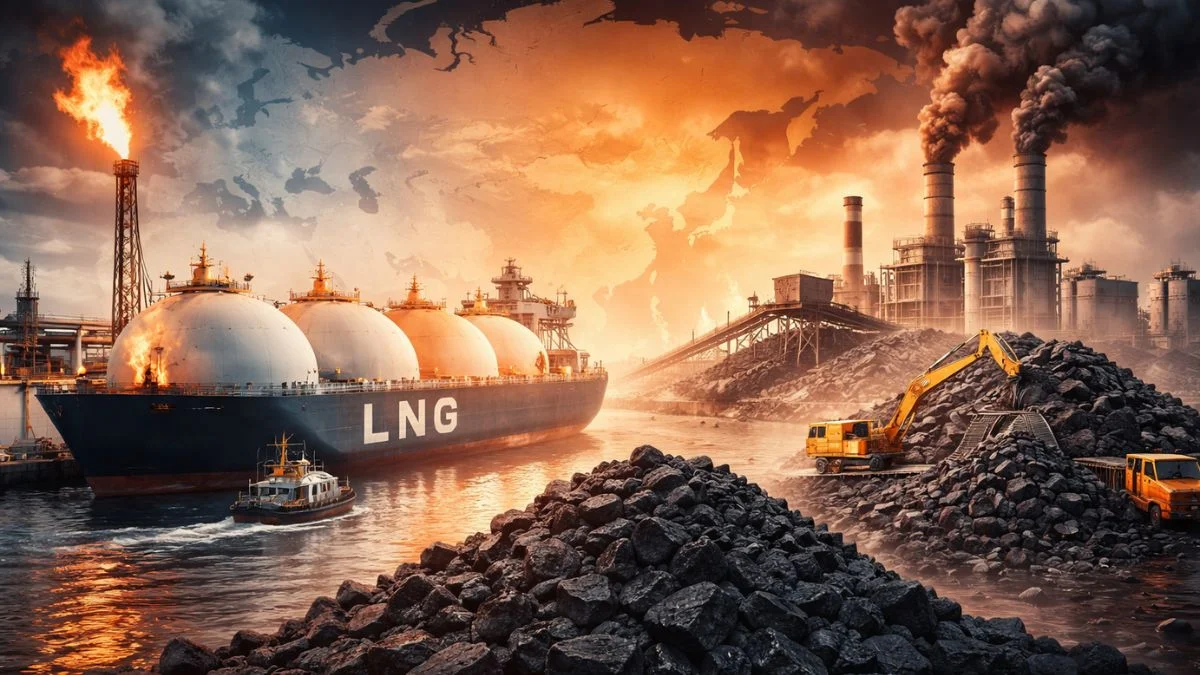

Asia’s accelerating pivot back to coal fired power generation, triggered by severe disruptions in liquefied natural gas supply, marks a defining moment in the region’s energy trajectory. As the ongoing U.S.–Israeli war on Iran constricts LNG flows through critical maritime chokepoints such as the Strait of Hormuz, governments across South and Southeast Asia are recalibrating their energy strategies in ways that expose deep tensions between economic survival, legal commitments, and climate ambitions. What is unfolding is not merely a short term fuel substitution. It is a structural stress test of Asia’s energy governance frameworks, revealing how external shocks can rapidly reorder policy priorities and legal obligations.
The immediate catalyst for this shift lies in the dramatic escalation of LNG prices, which have doubled to three year highs amid supply disruptions and the halt of shipments from major exporters. For energy import dependent economies, the price surge has rendered LNG economically untenable, particularly in price sensitive markets such as Bangladesh, Pakistan, and the Philippines.
In response, utilities are reverting to coal, a resource that, despite its environmental cost, offers price stability and supply reliability. Countries such as Thailand and Vietnam are increasing coal fired output, while South Korea and Japan are maintaining high utilisation rates of existing coal plants. This pivot reflects a fundamental principle of energy law and policy: in times of crisis, security of supply often overrides long term sustainability commitments.
The resurgence of coal raises critical questions regarding compliance with international climate obligations. Many Asian economies are signatories to the Paris Agreement, which imposes commitments to reduce greenhouse gas emissions and transition towards cleaner energy sources.
The increased reliance on coal appears, at least prima facie, to be in tension with these commitments. However, international climate law operates within a framework of nationally determined contributions, allowing states a degree of flexibility in response to exceptional circumstances. The present crisis may therefore be invoked as a justification for temporary deviations, particularly where energy security and economic stability are at risk. Yet, prolonged reliance on coal could expose states to reputational costs, investor scrutiny, and potential disputes under emerging climate accountability mechanisms.
One of the most significant long term implications of the current crisis lies in the potential erosion of confidence in LNG as a transition fuel. With approximately 107 billion dollars in LNG infrastructure investments at risk in South Asia, the economic and legal consequences could be substantial. Delays and cancellations of import terminals and regasification facilities raise issues of contractual liability, financing obligations, and regulatory approvals. Investors and developers may seek to invoke force majeure clauses or renegotiate terms in light of the unprecedented supply shock.
At the same time, governments may face legal exposure if policy shifts undermine previously approved projects or contractual guarantees. This creates a complex web of public and private law considerations, particularly in jurisdictions where energy projects are supported by sovereign assurances. Unlike LNG, which is heavily exposed to spot market volatility, coal procurement in Asia is often anchored in long term contracts and domestic production. Countries such as India and China benefit from substantial coal reserves, while others rely on established import arrangements.
This contractual stability provides a legal and economic buffer against external shocks. However, increased coal utilisation may also trigger regulatory responses, including emissions controls and environmental compliance requirements. Balancing these obligations with the need for uninterrupted power supply will test the adaptability of domestic legal frameworks. Paradoxically, the current crisis may accelerate the transition towards renewable energy. Analysts argue that repeated disruptions in fossil fuel supply chains undermine the case for import dependent energy systems and strengthen the rationale for domestic renewable capacity.
From a legal perspective, this shift aligns with evolving regulatory trends that prioritise sustainability, energy independence, and resilience. Governments may respond by revising policy incentives, streamlining approvals for renewable projects, and strengthening regulatory frameworks to attract investment. However, the transition is unlikely to be immediate. The capital intensity and infrastructure requirements of renewable energy mean that coal will continue to play a significant role in the near term, particularly in economies with limited alternatives.
The reluctance of utilities to pass on higher LNG costs to consumers highlights another critical dimension of the crisis. In many Asian economies, energy pricing is politically sensitive, with governments intervening to shield consumers from volatility.
Such interventions, while socially necessary, carry legal and fiscal implications. Subsidies, price controls, and tariff adjustments must be carefully structured to comply with domestic law and international trade obligations. Prolonged reliance on such measures risks distorting markets and straining public finances. Asia’s pivot back to coal in response to the LNG crisis is emblematic of a broader recalibration in global energy governance. It reflects the enduring primacy of energy security, even as states grapple with the legal and moral imperatives of climate change.
The current moment exposes the fragility of transition pathways that depend heavily on imported fuels and underscores the need for more resilient and diversified energy systems. For policymakers, the challenge lies in navigating a complex legal landscape where short term exigencies must be balanced against long term commitments. As the crisis unfolds, one reality becomes increasingly clear: the future of energy in Asia will be shaped not only by markets and technology, but by the ability of legal frameworks to adapt to a world defined by uncertainty, conflict, and competing priorities.

Comments are closed.