
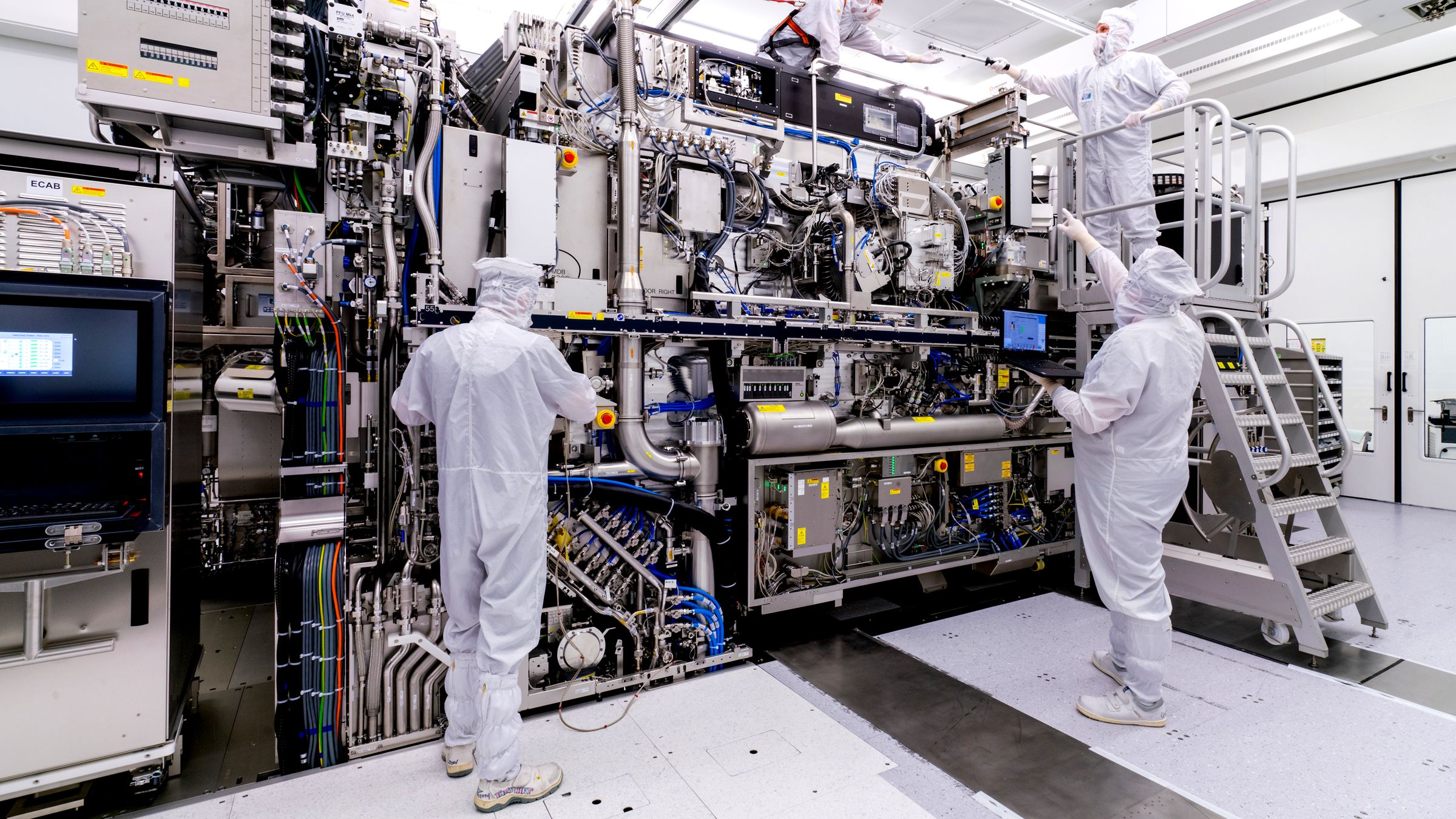
ASML Pushes EUV Technology Forward With Major Power Upgrade, Targeting Sharply Higher Chip Output

Dutch semiconductor equipment leader ASML Holding has revealed a significant advance in the performance of its extreme ultraviolet (EUV) lithography systems, a development that could substantially raise chip production capacity over the next several years. The company says it has succeeded in increasing the power of the EUV light source at the heart of its machines from 600 watts to 1,000 watts — a jump that may allow chipmakers to produce as much as 50% more chips per system by the end of the decade.
The breakthrough comes at a time when global competition in advanced semiconductor manufacturing equipment is intensifying. ASML remains the only company in the world capable of producing commercial EUV lithography machines, but rivals in the United States and China are investing heavily in efforts to build alternative technologies. By pushing the limits of its core system, ASML is seeking to reinforce its technological dominance in one of the most strategically important segments of the chip industry.
Why EUV Machines Matter So Much
EUV lithography tools are essential for manufacturing the world’s most advanced semiconductors — the chips that power artificial intelligence systems, high-performance computing platforms, smartphones, and data centers. Industry giants such as Taiwan Semiconductor Manufacturing Co and Intel rely on ASML’s EUV systems to etch extremely fine circuit patterns onto silicon wafers.
These machines use light with a wavelength of just 13.5 nanometers, enabling chipmakers to print features at extraordinarily small scales. In semiconductor fabrication, shorter wavelengths make it possible to create denser and more intricate transistor structures, which in turn allow chips to become more powerful and energy-efficient.
Because EUV technology is so critical to producing leading-edge chips, it has become a focal point of geopolitical tension. U.S. administrations have worked alongside Dutch authorities to restrict the export of advanced EUV systems to China, citing national security concerns. In response, China has ramped up domestic efforts to develop its own lithography capabilities.
Meanwhile, American startups including xLight and Substrate have raised large sums of capital to explore competing approaches to EUV light generation. xLight has received support from the administration of U.S. President Donald Trump, underscoring Washington’s push to strengthen domestic semiconductor supply chains.
Turning Up the Power: From 600 to 1,000 Watts
At the center of ASML’s announcement is a dramatic increase in the brightness of its EUV light source. Moving from 600 watts to 1,000 watts may sound incremental, but in chip manufacturing terms it represents a major step forward.
In lithography, chips are essentially “printed” onto silicon wafers in a process similar to photographic exposure. The wafer is coated with a light-sensitive chemical called photoresist. When EUV light shines through a patterned mask and onto the wafer, it transfers the circuit design onto the surface.
The brighter the light source, the shorter the exposure time required for each wafer. Reducing exposure time allows more wafers to pass through the system per hour, directly increasing overall production capacity. For chipmakers, this means lower manufacturing costs per chip and improved efficiency without needing to install additional machines.
Currently, ASML’s EUV systems can process around 220 wafers per hour. With the new 1,000-watt light source, the company expects that throughput could rise to roughly 330 wafers per hour by the end of the decade. Since each wafer can hold anywhere from dozens to thousands of chips depending on their size, even small gains in wafer processing speed can translate into substantial increases in total chip output.
Mastering an Extremely Complex Process
Generating EUV light is one of the most technically challenging tasks in modern engineering. ASML’s approach involves firing microscopic droplets of molten tin — about 100,000 every second — into a vacuum chamber. A high-powered carbon dioxide laser then strikes each droplet, heating it into an ultra-hot plasma state.
In this plasma form, the tin emits extreme ultraviolet light. The light is then collected and precisely guided using advanced optical systems produced by Germany’s Carl Zeiss AG before being directed onto the silicon wafer.
To reach 1,000 watts, ASML refined several elements of this already intricate process. Engineers doubled the number of tin droplets generated per second and introduced a two-step laser shaping method. Instead of relying on a single laser pulse to prepare the droplet for plasma formation, the upgraded system uses two smaller pulses to better shape and stabilize the droplet before the main laser impact.
This adjustment improves the efficiency with which laser energy is converted into EUV light while maintaining the precision and reliability required for round-the-clock chip production. Achieving higher output without sacrificing stability is crucial, as semiconductor fabrication plants operate continuously and demand consistent performance.
Looking Beyond 1,000 Watts
ASML’s ambitions do not stop at the 1,000-watt milestone. Company technologists believe the underlying improvements could pave the way for even more powerful EUV sources, potentially reaching 1,500 watts or even 2,000 watts in the longer term.
Further increases in power would allow additional gains in wafer throughput, helping chipmakers keep pace with the industry’s push toward smaller and more complex process nodes. As transistors shrink and designs become more intricate, maintaining high productivity in lithography will be essential to control manufacturing costs.

Comments are closed.