
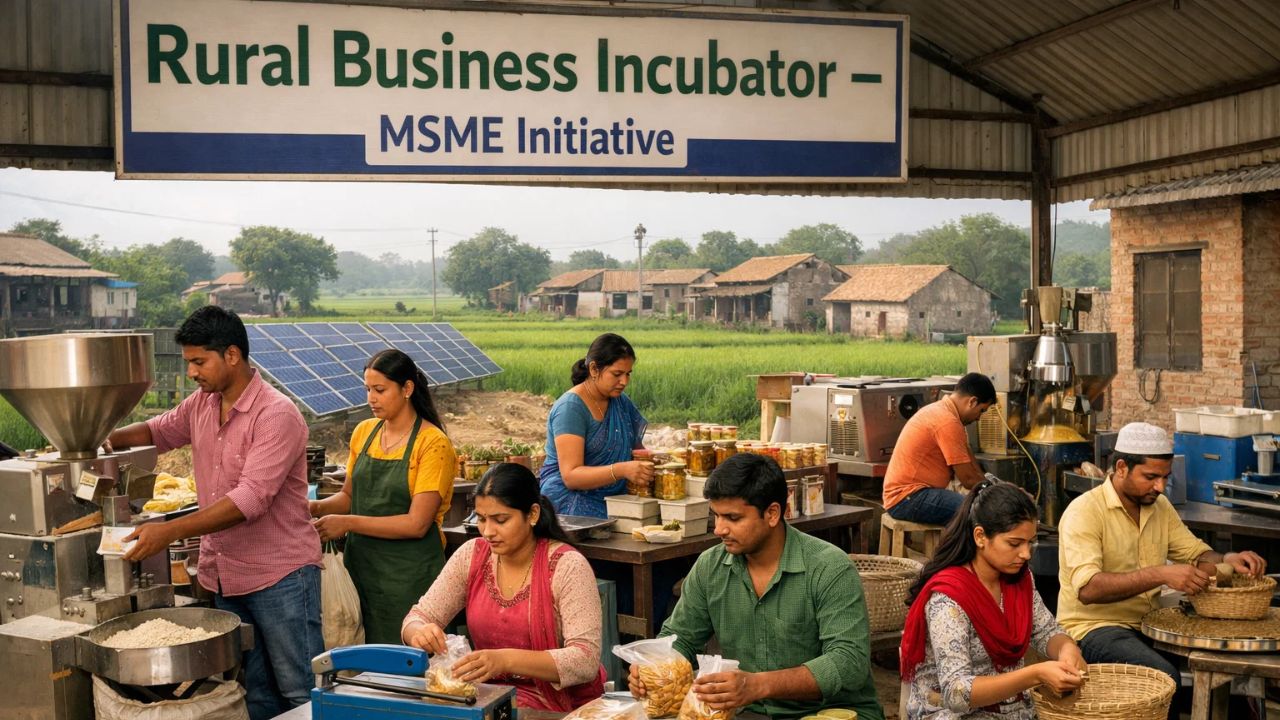

The role of rural areas and micro industries has always been important in the Indian economy, but due to lack of innovation, technology and capital, traditional and small scale industries of villages could not develop on a large scale. With the aim of bridging this gap, the Central Government started the ASPIRE scheme. This scheme not only encourages rural youth for entrepreneurship but also helps in creating agro-based industries, startups and employment. In the context of campaigns like Atmanirbhar Bharat and Vocal for Local, ASPIRE scheme is considered the backbone of rural industrialization.
ASPIRE (A Scheme for Promotion of Innovation, Rural Industry and Entrepreneurship) scheme has been implemented by the MSME Ministry. Its main objective is to promote innovation based industries, agri-startups, handicrafts, food processing and businesses based on local resources in rural and semi-urban areas. This scheme especially targets those youth who want to start their own enterprise instead of looking for a job.
How did it start?
The ASPIRE scheme was formally launched around 2015–16, when the government realized that schemes like PMEGP were promoting self-employment but lacked innovation and technology support. ASPIRE was brought to fill this gap, so that rural enterprises are not limited to small scale only, but can become scalable businesses in future.
The first objective of this scheme is to create employment opportunities in rural areas, so that migration can be stopped. The second major objective is to organize and modernize the agri-based industry. The third goal is to take the startup culture to villages, so that innovation is not limited to cities only. Apart from this, the ASPIRE scheme also aims to bring women, artisans and youth into the mainstream of entrepreneurship.
two way model
The ASPIRE scheme is primarily based on two institutional frameworks. The first is Livelihood Business Incubator (LBI) and the second is Technology Business Incubator (TBI). LBI aims to provide standard operating models, training and market links to traditional and rural businesses, while TBI promotes technology-based startups, innovation and research. Through these two, the government wants to create a complete business ecosystem in the villages.
LBI has been created for the enterprises that already exist in the villages, such as small scale industries related to incense sticks, fly ash bricks, dairy, food processing, handicrafts, khadi, bamboo products and construction materials. Through LBI, entrepreneurs are provided assistance in machinery, design support, skill training and marketing. This increases the productivity of traditional industries and reduces costs.
Whereas TBI focuses on new and technology-driven startups, especially in the fields of agriculture, food processing, renewable energy and rural services. Here work is done to connect the youth with prototype development, mentorship, research support and investment. Efforts are being made to promote startup culture in villages also through TBI.
Will get government grant
Under the ASPIRE scheme the government provides grants for setting up LBIs and TBIs. Typically, project support of up to several crore rupees is provided for an LBI, which covers infrastructure, training and operational expenses. This assistance is not given directly to the individual entrepreneur but is given through institutions, NGOs, educational institutions and government agencies, so that resources can be better utilized.
What is the eligibility?
ASPIRE scheme can be availed by those organizations which are working in the field of rural development, MSME or skill training. At the individual level, its indirect benefits accrue to rural youth, farmers, artisans, women groups and micro entrepreneurs. The special thing is that the scheme is focused on rural India, hence local needs are given priority compared to urban startups.
Emphasis on expanding business
ASPIRE scheme is combined with schemes like PMEGP, Mudra Yojana and CGTMSE. While PMEGP provides seed capital and subsidies, ASPIRE helps businesses become sustainable and innovative. In this way, this scheme is not limited to just ‘opening a shop’, but gives a strategy to take the business forward.
increase in employment
LBI established under ASPIRE in many states has linked local farmers to food processing. For example, by setting up pulses and spices processing units in a district, farmers’ produce was directly converted into value-added products. Due to this, farmers got better prices and local youth got employment. This model shows how ASPIRE connects agriculture and industry.
The biggest impact of the ASPIRE scheme has been seen in local employment generation. Not only direct employment was created through small industries, but opportunities were also created in sectors like transport, packaging and marketing. This increased cash flow in the rural economy and reduced migration.
What are the challenges?
Although the concept of ASPIRE scheme is strong, there are some challenges at the ground level. In many places, the problem of lack of awareness, lack of institutional capacity and lack of connection with the market comes to the fore. Additionally, the number of LBI and TBI is relatively low in some states, limiting the impact of the scheme.
If the ASPIRE scheme is better linked to state policies and district level plans, it can bring about an industrial revolution in rural India. By combining it with platforms like digital marketing, e-commerce and ONDC, rural enterprises can reach the national market.

Comments are closed.