
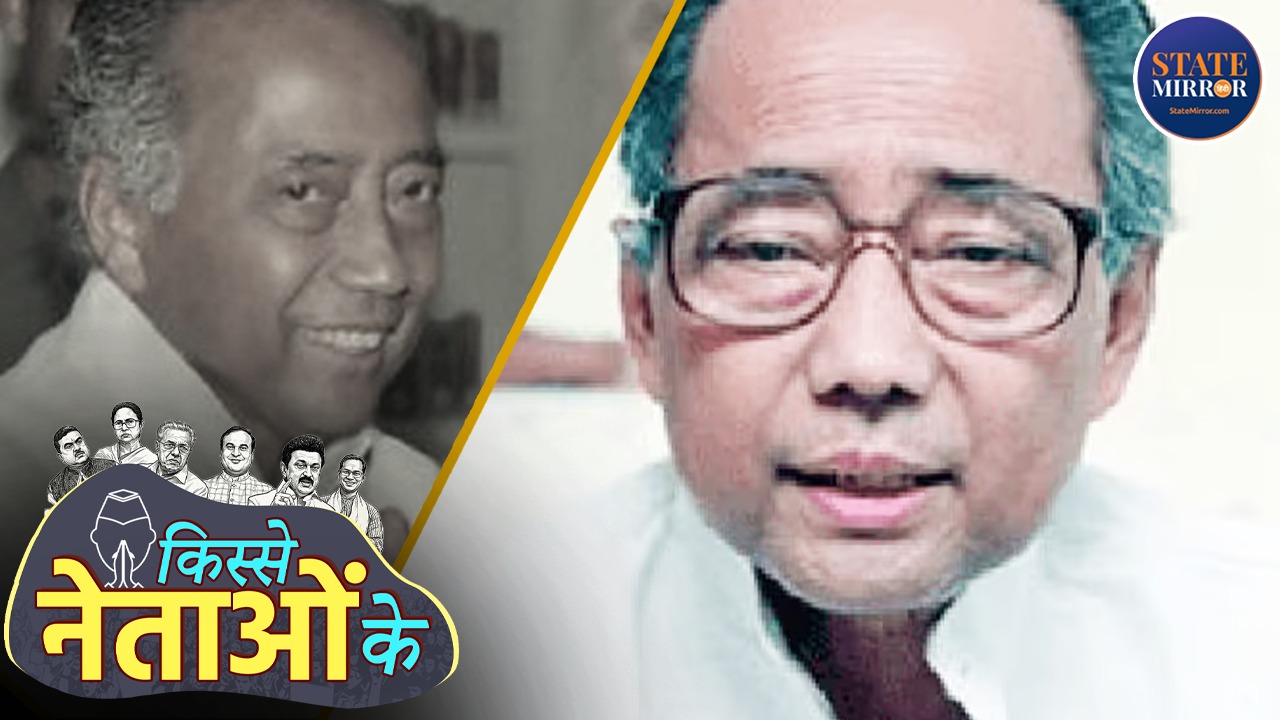
Crisis Manager or Controversial CM? The incomplete story of Hiteswar Saikia. Assam Politics Story

A period of Assam politics, when there was movement on the streets, there was a fight for identity and every day a new challenge arose before the government. At the same time a name emerges: Hiteswar Saikia. His life is not just the biography of a leader, but the story of Assam, which was going through turmoil, conflict and political change. Understanding Saikia means understanding that era, where every decision either saved the system or gave rise to controversy. Whether he was the crisis manager of Assam or the controversial CM is also a matter of debate. This has been discussed in many books including Rajeev Bhattacharya’s book ‘The Mirage of Dawn’. Know his complete story.
Did a normal childhood upbringing make them strong?
According to Rajiv Bhattacharya’s book ‘The Mirage of Dawn’ and Sanjib Barua’s book ‘India Against Itself: Assam and the Politics of Nationality’, Saikia, born on 12 April 1934 in Sivasagar district, had a very ordinary life. Growing up in a rural environment, Saikia adopted discipline and simplicity since childhood. He neither belonged to any big political family nor did he have any special resources. But this simple background became the strength of his personality. He gave priority to studies even with limited resources and established himself as a serious, thinking student.
From 1979 to 2000 and even after that, Assam was going through a period of chaotic social and political changes. In the same environment, Saikia started developing interest in public life. He was not someone who stood out in the crowd, but was a person who learned and understood silently.
Did his law studies make him an administrator?
former CM Hiteshwar Saikia Later he did BA and LL.B. Got the degree. During his law practice, he closely observed the ground reality of the system. The cases coming to the courts made him understand how difficult it is for the common man to get justice. This experience started developing administrative thinking within him. He became not just a reader of the law, but also a person who saw its implementation. This was the reason that when he came into politics, his vision was not just to give speeches but to improve the system.
Was his journey from law to politics smooth?
Joining Congress was the beginning of his political career. But this was not a fast climb. He gradually made his place in the organization. Saikia’s specialty was that he was not a leader who gathered crowds, but was a person who made strategies and implemented them. Within the party, he came to be seen as a trustworthy, disciplined and balanced leader. He stayed away from controversies, but whenever the party needed stable leadership in any crisis, his name came up.
Does the decade of the 1970s determine his political stature?
In the 1970s, Saikia started strengthening his hold in Assam politics. He became active at both the assembly and organizational levels. At the same time, issues like infiltration, identity and cultural insecurity started emerging in Assam.
This was the same period which later laid the foundation of the Assam Movement. During this time, Saikia established himself as a leader who could maintain balance even in difficult situations. He was neither in favor of radical politics nor completely passive, but was a leader who found a middle path. Ensured its reach from Guwahati to Delhi.
Assam movement became his turning point?
Assam movement started in 1979 under the leadership of All Assam Students Union. There was an atmosphere of protest, bandh and violence in the entire state on the issue of foreign nationals. During this period, Saikia supported the constitutional stand of the government. This decision was not easy, because on one hand there was public anger and on the other hand there was the responsibility of maintaining law and order. During this period, Saikia was among those Congress leaders who were in favor of maintaining the system at all costs. This time became the biggest phase of his political test.
Was becoming CM in 1983 the most difficult responsibility for him?
The 1983 elections were held under extremely controversial circumstances. Due to the agitation, All Assam Students Union boycotted the elections. There was violence at many places and the voting percentage was very low. In this environment, Congress government was formed and Hiteswar Saikia became the Chief Minister. This was certainly the pinnacle of power for him, but also the biggest challenge. His entire tenure was spent in handling law and order and dealing with the movement. Every decision was surrounded by controversies, every step was under criticism.
How did the Neely scandal affect his legacy?
The Nellie massacre of 1983 is considered the darkest chapter in the history of Assam. Thousands of people lost their lives in this incident and the entire country was shocked. After this incident, serious questions were raised on the Saikia government. Critics called it an administrative failure, while supporters said that the situation was already so bad that it was difficult for any government to control them. This incident became the most controversial part of his political legacy.
Did Assam Cord push his politics back?
In 1985, his efforts led to the Assam Accord, which opened the way for an agreement between the movement and the government. After this, Congress was out of power and a new government was formed under the leadership of 32 year old Prafulla Kumar Mahanta. That is, on whose request he implemented the Assam Accord, and after defeating him in the elections, he became the CM there.
This was definitely a setback for Saikia, but he did not consider it the end. He focused on strengthening the organization by remaining in the opposition. This was the same strategy which gave him the opportunity to return to power after a few years.
Did the experiences of the opposition make him stronger?
The period from 1985 to 1991 was a period of learning and strategy making for Saikia. He played an important role in re-establishing the Congress. He continued working on the ground and strengthening the organization. During this time, he understood that in politics, not only power but also patience and continuity is necessary. This was the reason why he was successful in returning to power again.
Defeat by a 32 year old young man – what does it indicate?
Despite long experience in politics and a strong image, Saikia had to face defeat by a younger leader in his later years. This defeat was not just an electoral defeat, but a sign of changing times. The new generation, new issues and new politics had posed new challenges to the old leaders. Saikia’s defeat shows that no one is permanent in politics, and it is necessary to change oneself in every phase.
Crisis Manager or Controversial CM?
Hiteshwar Saikia was one of those leaders of Assam politics, whose image is divided into two poles. ‘Crisis Manager and Controversial CM. On one hand, he is seen as a leader who took power during the very difficult period of Assam agitation, violence and law and order and tried to keep the state within the constitutional framework.
On the other hand, many serious questions also arise on his tenure, especially after incidents like the Nellie massacre of 1983, when there was sharp criticism on the role of the government. Supporters believe that the situation was already out of control, while critics call it an administrative failure. Hiteswar Saikia’s politics is understood in this contradiction, where he was both a strict crisis manager and also a controversial Chief Minister.
Is his story still relevant today?
The story of Hiteswar Saikia is a lesson not only for the past but also for the leaders of today. He showed how difficult it is to take decisions during a crisis, and every decision brings with it criticism. His legacy seems to be divided into two parts. On the one hand, a strict administrator, who stood by to maintain law and order; On the other hand, a controversial leader, during whose tenure the state saw its most difficult phase. Ultimately, Saikia’s story tells us that the real test in politics is not winning elections, but taking the right decisions in difficult times.

Comments are closed.