
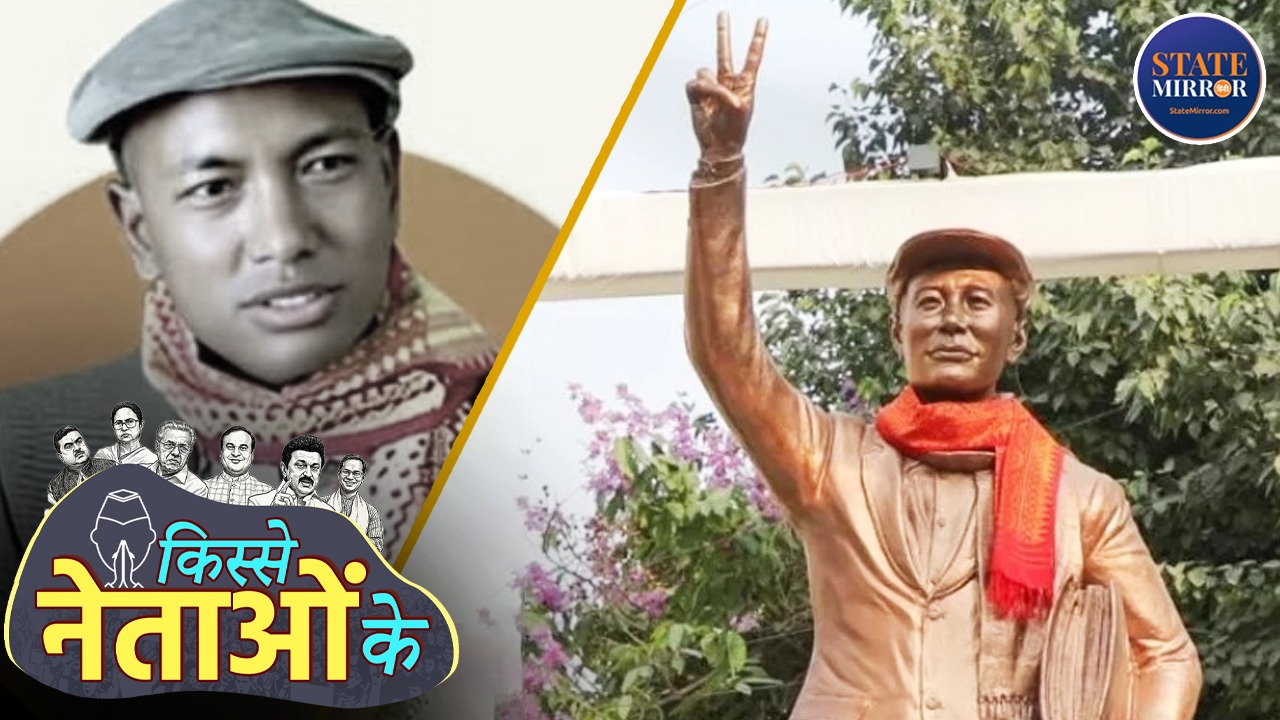
Stories of leaders: How did Upendranath Brahma become ‘Bodofa’? Kiss Netaon Ke: Upendranath Brahma Bodofa Story

If any region plays the role of “kingmaker” in the politics of Assam today, it is the Bodoland Territorial Region. But the story of this power did not happen suddenly. There is a movement behind this, which was given direction by an ordinary young man, whom the entire Bodo community today respects as “Bodofa” i.e. Father of Bodoland. that person’s name is Upendranath Brahma. Know his story amidst the preparations for Assam Assembly elections.
Udayon Misra, author of The Politics of Identity in Assam, has mentioned in detail about Upendranath Brahma in his book. Apart from this, there are many books in which there is mention about him. This book deeply explains the identity-based movements in the politics of Assam, such as the Assam movement, the Bodo movement and analyzes the changing nature of regional politics.
In which area of Assam was Brahma born?
Actually, Upendranath Brahma was born on 31 March 1956 in Kokrajhar region of Assam. He came from an ordinary farmer family. His childhood was spent amidst the problems of rural Bodo society such as poverty, lack of education and political neglect. Since childhood, he had an extraordinary question in his mind: “Why are our language and our identity not respected?” These questions that arose while sitting in the village school gradually became the purpose of his life.
When he left the village to study, he saw the world from a new perspective. He realized that only those communities which have their own strong identity and political voice move ahead. This realization created a resolve within him that if the Bodo community has to be saved, it will have to be organized. This idea later became the foundation of his struggle.
When he returned to his village, he saw the reality of his society more closely: poverty, illiteracy and political neglect. This situation shook him at an early age. After school education, Upendra Nath was not just a boy asking questions, but by the time he reached college, he had become a leader searching for answers. During this time, he joined All Bodo Students Union and from here his movement got direction. He did not allow this organization to be limited to just student politics, but transformed it into a broader social and political mission.
What was Upendranath’s thinking?
His thinking was clear, “The path of struggle is not violence, but organization and education.” He roamed from village to village, talking to people, connecting with the youth and making them understand the importance of their identity. Initially people were afraid that this movement would create conflict, but Upendra assured everyone that this fight is about rights and respect, not conflict.
In the 1980s, when Assam was going through many movements and instability, the demand of the Bodo community for its separate identity and political rights intensified. In this difficult time, the leadership of Upendranath Brahma emerged stronger. Despite political pressure, social opposition and unstable environment, he kept his movement away from violence. He believed that if the struggle loses its original identity, its purpose will also be lost.
When he died suddenly on May 4, 1990, the entire Bodo community fell apart. But this was not the end of him. From here a new era began. After his death his ideas became even more powerful. People started saying that Upendranath started calling Brahma. This gave rise to the popular belief that “Bodofa never dies,” because he was no longer a person but an idea.
How did Bodofa become?
He was called “Bodofa” i.e. Father of Bodoland because he not only led but also gave direction to a scattered society, organized it and taught it to stand up for its identity. Scholar Sanjib Baruah also believes that their movement was not just an ethnic struggle, but an “identity awakening”, where a community identified itself and turned it into a political force. “Bodofa” meaning “Father” was not an official title. This was the name of the trust that the public gave him.
Even today, his story is not just history but an inspiration, the story of a young man who started by asking questions and became the voice of an entire society. This is the reason why Upendranath Brahma is still alive today not just as a name but as “Bodofa” of the Bodo community.
After Brahma the movement did not stop but kept moving forward. On the basis of the consciousness he created in the Bodoland area, the movement for the Bodoland demand continued for decades. The result was that in 1993 the Central Government formed the Bodoland Autonomous Council. In 2003, Bodoland Territorial Council was formed and now it is recognized as Bodoland Territorial Region. There was only one thought behind all this, “Organized identity is the key to power.” Which was given to the people by Brahma.
Why is Bodoland the ‘kingmaker’ in Assam politics today?
Today Bodoland Territorial Region has become the decisive center of Assam politics. There is a direct impact on 15 to 20 assembly seats. Important role of BTC in coalition politics. In such a situation, BTC emerges as a force to form or bring down the government. Now no party can reach power in Assam by ignoring Bodoland.
What is the real legacy of Brahma?
Upendra Brahmanath did not just agitate, he gave a model. Make your identity your strength. Organize the society. Create democratic pressure and this model is keeping Bodoland strong even today.
After all, what does this story say?
This is not the story of just one leader. This is a story of complete political consciousness. It is the story of a fragmented society becoming a strong identity and that identity reaching power. Becoming the “Kingmaker” of Bodoland today is proof that Brahma’s idea was not a movement, but a permanent political revolution.
A year ago, the Municipal Corporation of Delhi (MCD) renamed a section of Lala Lajpat Rai Marg in South Delhi (near Kailash Colony metro station) as ‘Bodofa Upendranath Brahma Marg’. One of his statues was unveiled here by Union Home Minister Amit Shah.
Why is Bodoland important in Assam politics?
BTR region directly affects 12 assembly seats. These seats are spread in Kokrajhar, Chirang, Baksa and Udalguri districts. The total number of voters in this entire region is estimated to be between 30 to 35 lakh (3–3.5 million). The voting pattern here often decides the direction of the alliance. This is why BTR is called “Kingmaker”

Comments are closed.