
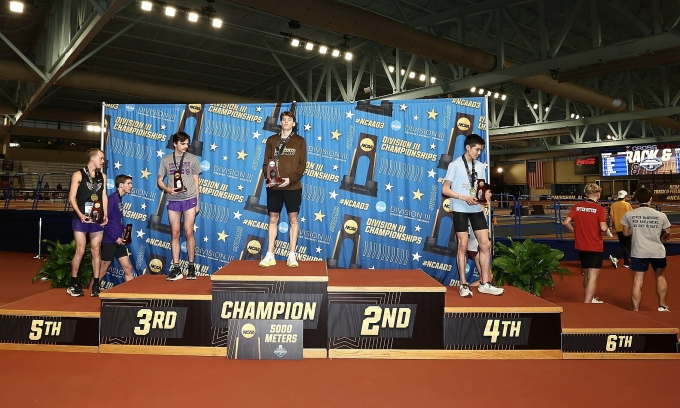

Athletes walk off the podium to avoid standing alongside the champion Seth Clevenger at the NCAA Division III Indoor Track and Field Championships on March 15, 2026. Photo taken from X |
During the national championships last weekend, Seth Clevenger of Rowan University won the men’s 5,000m final by nearly 30 seconds compared to the runner-up. However, his dominant performance was not met with support from his fellow competitors during the medal ceremony.
The athletes who finished second through eighth stepped off the podium shortly after receiving their medals. They refused to participate in the group photo with Clevenger, opting instead to take a separate picture together to protest his right to compete, Canadian Running Magazine reported.
After that, Clevenger went on to win the gold medal in the men’s 3,000m by more than 10 seconds. Once again, other athletes walked off the podium rather than standing beside the 22-year-old for a group photo.
The intense controversy surrounding Clevenger stems from his time at Division I Iowa State University. According to LetsRun.comtwo former teammates of Clevenger claimed that during the fall 2025 cross-country season, Clevenger admitted to using BPC-157, a substance that aids muscle recovery.
This confession reportedly led to his immediate suspension by the coaching staff, shortly after he achieved what was described as the “best race of his career”.
Another former teammate stated he had seen multiple packages labeled “EPO” in Clevenger’s refrigerator. Erythropoietin (EPO) is strictly banned by the World Anti-Doping Agency (WADA) because it unnaturally increases endurance by improving oxygen transport in the body.
During the 2024-2025 season, Clevenger only competed in one tournament before Iowa State University suspended several athletes for violating internal rules. While the university never publicly released the names or the specific reasons for the suspension, Clevenger’s sudden absence from all subsequent competitions suggested his involvement in the incident.
The U.S. Anti-Doping Agency (USADA) did open an inquiry into the matter, but lacked the jurisdiction over the case, noting that the NCAA operates outside of WADA’s authority.
Clevenger, through his attorney, has denied using any performance-enhancing drugs and noted he never failed an official NCAA drug test.
Because NCAA regulations dictate that internal university disciplinary actions do not automatically transfer to a new school, Clevenger faced no suspension. After transferring to Rowan University this year, he was immediately eligible to compete and quickly dominated Division III, which is open for universities that do not offer athletic scholarships, where students compete in sports while studying, with a high level of competition but without a professional standard.

Comments are closed.