
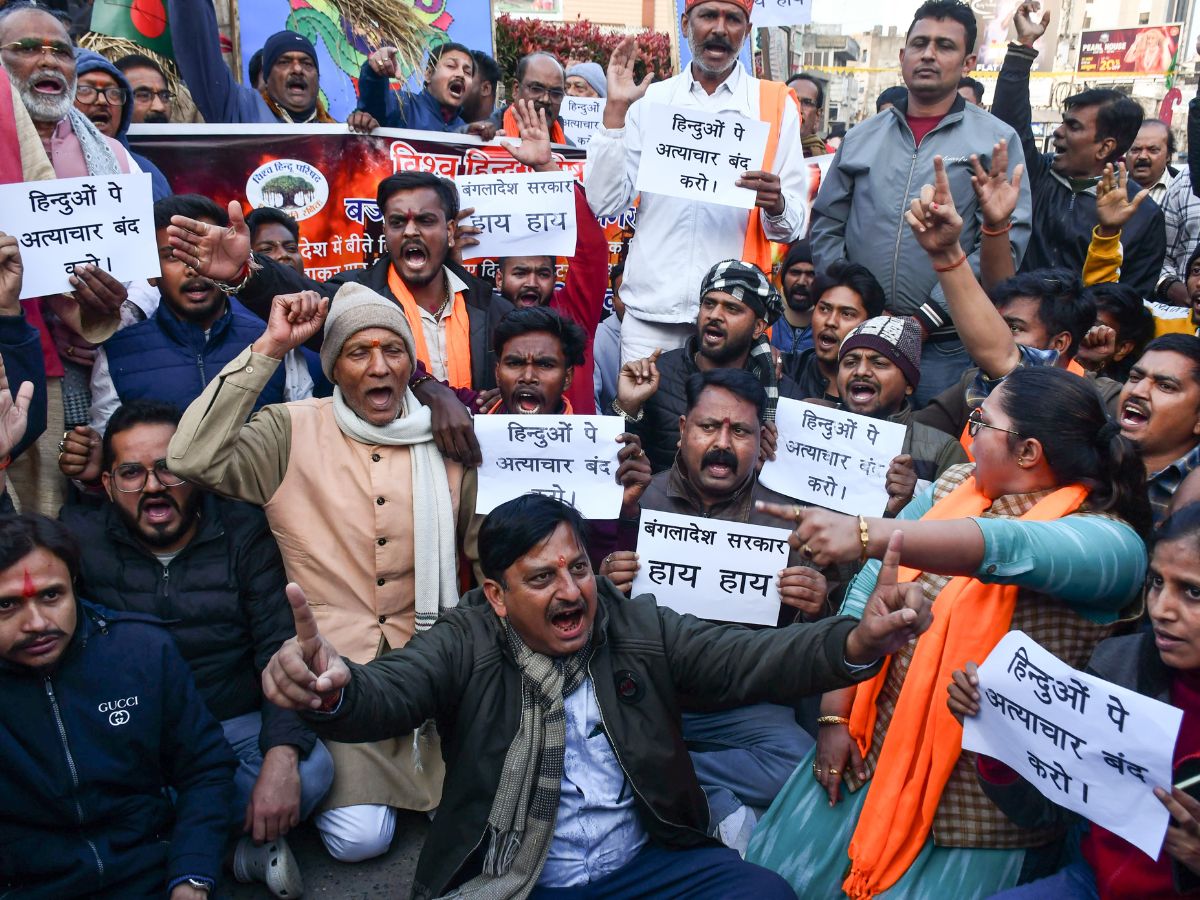
Attacks On Hindus Continue In Bangladesh As Politics Heats Up Ahead Of Contentious Feb polls

When Anil Sheel of Chhitagong’s Raozan realized that his house had been set on fire, he and his family members found the door of the house bolted from outside.
Sheel’s was one of the several houses in the area which had been set afire by unidentified miscreants on Tuesday night but his family had to cut through a fence of the house to save themselves.
BDNEWS24 reported that several houses of the minority Hindu community have been similarly set afire in the Raozon sub-district over the last weeks.
“After each fire, the police seized kerosene-soaked clothes and handwritten papers with the names and mobile numbers of various political leaders and senior administration officials,” the website reported.
It quoted the Raozon police station officer-in-charge Sajedul Islam as stating that the “previous houses were set on fire in the same manner as on Tuesday.”
In a video which captures the family members of one Hindu family attacked in Raozon, a woman can be heard wailing even as she says that everything belonging to them has been set on afire.
“Our house is gone,” she cries and tells mediapersons that someone had bolted the house from outside and set it on fire.
12 people including a child and a newly-wed couple nearly escaped death, C Plus TV reported.
Another woman whose house was targeted tells a mediaperson that their house had been bolted from outside and the miscreants behind the act doused it with kerosene before setting it on fire.
The woman says that they are shattered and are thinking what to do next as they sat outside their burnt down house.
Pictures of one of the banners that had been seized from the place where the fire was lit on Tuesday is in possession with The Sunday Guardian.
“Banner talked of plan to kill 2 lakh Hindus, Buddhists”
Speaking from Chhittagong over the phone, Kushal Barun Chakraborty, sahmukhpatra of the Bangladeshi Sammillitta Sanatani Jagran Jote told TSG that he visited the aggrieved Hindu families and they shared their ordeal with the Jote.
“The police took the banner with them. It read that: “On December 13, 2025, a plan was hatched and funding was provided to implement this plan. The said plan and funding were aimed at killing a total of two lakh followers of the Hindu and Buddhist communities in Raozan sub-district of Chittagong. No sign of the Hindu and Buddhist communities will be left in Raozan, they will not be allowed to remain.” Attacks on Hindus continue. First, Dipu Chandra Das was lynched in Mymensingh and now, another Hindu youngster Amrit Mondal has been killed. While the government and the police have termed him a criminal, the question is how can a Muslim man who got arrested with him remain alive while Mondal -a Hindu- was only killed?,” he questioned.
Chakraborty was mentioning the brutal lynching of 27-year-old Dipu Chandra Das who was set on fire after he was beaten to death by a mob and hanged on a tree in Mymensingh’ Bhaluka area in Bangladesh on December 18.
Eight days later, 29-year-old Amrit Mondal, alias Samrat, was killed by a group of locals at Hosaindanga Old Market in Pangsha subdistrict around 11 pm.
While the Mohammad Yunus-led government condemned the killing, it claimed that there was no communal angle involved to the violence and said that Mondal has two cases lodged against him including one of murder.
Bangladesh’s interim government said in a statement that the killing ensued after a violent situation stemming from extortion and criminal activities.
“The deceased, Amrit Mondal, alias Samrat, was a listed top criminal who had entered the area with the intent of collecting extortion money. At one stage, he lost his life during a clash with agitated residents,” the statement said.
However, Chakraborty questioned the government’s version of the sequence of events and said two persons were detained after the incident which included Mondal and a Muslim man named Selim.
“The government has said he was a criminal but how is it possible that only one of the two persons were killed. The Muslim man Selim survived and Mondal-a Hindu – has been killed,” he said.
In another incident, some youngsters entered Dhaka University’s iconic Madhur Canteen -named after a Hindu freedom fighter Madhur and a historic and symbolic space at the varsity,-and vandalised the setup, breaking its windows and furniture- an incident that sent shockwaves across the student and the Hindu community.
The word “boycott” was scribbled on the walls of the canteen which is widely regarded as the intellectual nerve centre of student politics in the varsity.
Attacks on minorities continued under BNP, Jatiya Party & even Awami League
Commenting on the incident, Chakraborty alleged that attacks on minorities have taken place under several governments including the BNP government and the regime of Lt Gen HM Ershad of the Jatiya Party.
Ershad regime had the Bangladeshi Constitution amended in June 1998 to declare that “the state religion of the Republic is Islam” in what some observers remarked was “the last nail in the coffin of secular ideals.”
Chakraborty said that several such incidents took place under the Sheikh Hasina government as well and no action would be taken against the perpetrators.
“Everyone is shocked when the fruits are ready, not realising that the seeds of this tree of radicalism had been sown long back. Hundreds of madrasas mushroomed under the Sheikh Hasina regime too and she even declared that the “Dawra-e-Hadith” degree of the Qawmi Madrasas (Islamic seminaries) of Bangladesh will be recognised as a master degree on Islamic Studies and Arabic,” he remarked.
Sheikh Hasina’s Awami League terms itself a party that follows secular ethos unlike the BNP which has, in the past, fought elections on the “need of defending Islam” from the “un-Islamic” political forces.
Before the 2001 general election, the BNP’s election manifesto proclaimed that the party, if voted to power, “will not enact any law contrary to Islam”.
Going a step further, Ershad’s Jatiya Party had declared ahead of that election that “Shariah laws will be followed, existing laws will be brought in line with the principles of the Quran and Sunnah and special laws will be made for punishing those making derogatory remarks against Allah, the prophet and Shariah” along with a promise of making religious education compulsory at all levels.
Jamaat-e-Islami announced that if voted to power, “it will convert the People’s Republic of Bangladesh into an Islamic Republic.”
While the BNP, Jamaat-e-Islaami and the Jatiya Party have been termed radical by observers, Hasina’s Awami League too has been criticised for being soft on Islamists during the attacks on Bengali Buddhist pagodas at Ramu and Hindu temples in Ukhia under Bangladesh’s Cox Bazar district in September 2012 to please her votebank.
However, former diplomats say that the Awami League would take action in some of the cases and note that radicalists have always existed in Bangladeshi society.
“It is true that radicalism has existed in Bangladesh and even in 1971, 20 per cent of people in the country were opposed to the Liberation war and were in fact, pro-Pakistan. Such elements have always tried to reassert themselves to negate the value of the Liberation war. In fact, for three months after Khaleda Zia was elected as the Bangladesh PM in 2001, such elements went on a rampage targeting Hindus and other minorities. This was till then the worse such instance since 1971. The situation that we are seeing today is much more serious ,” former Indian high commissioner to Bangladesh Veena Sikri told TSG.
Sikri pointed out that since July-August last year when Hasina was ousted from power after protests broke out in Bangladesh, the country has seen “the longest and most persistent attacks ever known in Bangladesh on Hindus, Buddhists, Sufis, Christians, Ahmaddiyas.” “There were attacks on minorities when Sheikh Hasina was PM too, but she always used to ensure that such elements were put down. Her regime would deal with such elements,” she said.
She remarked that Chinmoy Das -a Vaishnavite leader and one-time member of the International Society for Krishna Consciousness (ISKCON) -who was arrested by Mohammad Yunus interim government in November 2024 continues to be in jail without any FIR or charges framed against him.
“Religion has been central to people and political parties across South Asia but at the end of the day, Hasina believed that the best future of Bangladesh lay in its secular ethos,” she said.
With Bangladesh set to head for polls on February 12, Sikri said that the fact that the student-led NCP has tied with the Jamaat-e-Islami has proved that the events of July-August 2024 were not a student uprising but a regime change operation.
While noting that BNP matriarch Khaleda Zia’s son Tarique Rahman has returned to Bangladesh after 17 years, she “regretted” that he “has not condemned the violence against Hindus and other minorities.”
Rahman who is widely seen as the crown prince of Bangladesh returned to the country on December 25 after a 17-year-old exile and was extended a grand welcome across the country with party members, officials and the public coming out to welcome the BNP leader.
ALSO READ: 7.0-Magnitude Earthquake Jolts Taiwan Again, Second Strong Quake in Three Days
Sofia Babu Chacko is a journalist with over five years of experience covering Indian politics, crime, human rights, gender issues, and stories about marginalized communities. She believes that every voice matters, and journalism has a vital role to play in amplifying those voices. Sofia is committed to creating impact and shedding light on stories that truly matter. Beyond her work in the newsroom, she is also a music enthusiast who enjoys singing.
The post Attacks On Hindus Continue In Bangladesh As Politics Heats Up Ahead Of Contentious Feb polls appeared first on NewsX.

Comments are closed.