

Virendra Pandit
New Delhi: Gujarat-based Adani Group plans to invest Rs.1 lakh crore in its airports business over the next five years, betting on sustained growth in India’s aviation sector, which is expected to expand at 15-16 percent annually, the media reported on Friday.
“On the airport side, Rs. 1-lakh crore in the next five years,” Jeet Adani, Director of Adani Airports and younger son of billionaire Gautam Adani, was as saying by a news outlet, ahead of the start of commercial operations at Navi Mumbai International Airport next week.
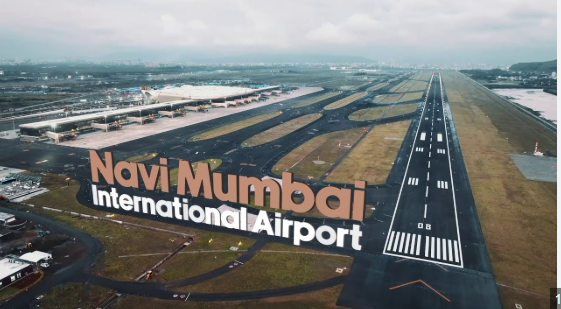
This airport will become the latest addition to the Adani Group’s expanding airport portfolio, further strengthening its presence in India’s aviation infrastructure.
The airport, being developed by the Navi Mumbai International Airport Ltd (NMIAL), in which the Adani Group holds a 74 percent stake, is scheduled to commence commercial operations on December 25.
Built at an initial cost of Rs. 19,650 crore, the first phase will have a capacity to handle 20 million passengers annually, with plans to scale it up to 90 million passengers over time, easing capacity constraints at Mumbai’s existing airport and supporting long-term growth in the region’s air traffic.
The Adani group had acquired the Mumbai airport from GVK Group.
Besides the two airports at Mumbai, the Group operates six other airports at Ahmedabad, Lucknow, Guwahati, Thiruvananthapuram, Jaipur, and Mangaluru.
This portfolio includes a mix of metro and regional airports, with the group also planning to bid aggressively for the next round of airport privatisations.
“As a staunch believer, bullish believer in this industry, we would be 100 percent very aggressive in the next round of bidding for all 11 (airports),” he said.
On investments in the maintenance-repairs-operations (MRO) and Flight Simulation Training Center (FSTC) verticals, Adani said, “It’s a little early to say because we are still in the process of finalizing a longer-term strategy and then putting a number to it.”
However, he added, “at the end of the day, we are deep into it and we want to keep growing our expertise and our depth.”
Adani said India’s aviation sector — encompassing airports and airlines — could sustain mid-teens growth for the next decade or more.
“The Indian aviation industry as a whole… can continuously grow at 15-16 percent, mid-teens, year-on-year, for the next 10-15 years,” he said, pointing to low per-capita air travel compared to China. “Even if we get to China, it means the whole sector has to grow by a multiple of cities.”
Calling the growth runway long-term, he said, “So that’s a very long growth pathway that we have. And all the signs show that it’s seemingly done.”
Highlighting capacity constraints at Mumbai’s Chhatrapati Shivaji Maharaj International Airport, Adani said, “(the) Mumbai Airport was supply constrained from 2016 onwards and wasn’t able to service the additional demand that was coming through,” adding that “with the start of the Navi Mumbai Airport, we will finally see some relaxation there.”
Terming the commissioning of Navi Mumbai International Airport a landmark moment, he said, “In terms of Indian aviation, this is an extremely important moment… firstly, we are seeing an asset of this size coming online and secondly, it’s not that it stops at this size. There is four times growth still left to do.”
The group, through its airport arm Adani Airport Holdings Ltd (AAHL), is India’s largest airport infrastructure operator. It controls a significant share of India’s air traffic, accounting for roughly 23 percent of passenger movements and about 33 percent of cargo traffic nationwide.
In parallel, AAHL is investing in capacity upgrades and phased expansions at existing facilities and scaling ancillary services such as non-aeronautical retail and city-side developments, reflecting its push to transform hard infrastructure into diversified revenue streams.
“We have separated the two businesses. One is the airport infrastructure and the other one is the aircraft services business. So that can include dual use, defense and civilian use,” Adani said.
In the previous round of privatization in 2019, Adani Group won six airports — Ahmedabad, Lucknow, Guwahati, Thiruvananthapuram, Jaipur and Mangaluru — and acquired Mumbai Airport from the GVK Group in 2021.
The Union Civil Aviation Ministry has identified 11 airports, including six smaller ones, for operations under the public-private partnership model, while the National Monetization Pipeline envisions leasing 25 Airports Authority of India-operated airports between 2022 and 2025.

Comments are closed.