

As Li Ning looked to capture the Indian badminton market share dominated by Yonex nearly a decade ago in 2017, the Chinese sports equipment manufacturer partnered with Baddyzone – an academy co-founded in 2015 by Mohit Kamat, former India No 2.
With the funds which flowed in, Kamat set up a talent acquisition programme, particularly targeting kids at the under-15 and under-13 levels, with an aim to train them for a year or two and provide them with a launch pad.
One of Kamat’s earliest recruits was Ayush Shetty – the now Asia Championships silver medallist and one of the fastest rising stars of Indian badminton.
Shetty, having already dominated the local badminton circuit in his hometown of Sanoor, was looking for a step up. He was already an age-group Karnataka state champion but was way down the national ladder, ranked No 27.
Shetty was into his final year in under-13 and there was nothing yet to concretely show he would turn into a world beater. His now-famed attacking game, which has proved to be a menace to the best in the world, was nonexistent.
Though Kamat had never closely analysed Shetty’s game, he had seen him in a few tournaments before the offer was extended.
“We just told them (Shetty and his parents) that you can come and train at our centres in Bengaluru for very little fee and we’ll give you the required performance support and monitoring,” recalled Kamat in a conversation with Read.
Cognitive ability and instinct
Within a week of Shetty joining, Kamat sat on the coaching chair on the sidelines as he competed in an all-India ranking tournament in the city. Three things stood out, and the coach was convinced.
“He had three existing skills, which I felt is good and convinced me that this is a level that can go to the highest level,” said Kamat. “First was his cognitive ability and problem-solving skills.
“He did not have a good attack then, but he had the sense to understand the opponent’s psychology and how they’re trying to play the game.
“You need to keep technique and everything aside. It can be taught. But knowing what the opponent will do and how they will use their strength is something instinctive or natural. I don’t think anyone has taught him that. He has developed it in his early days, and you need to thank his parents, who’ve done some good work in developing his cognitive intelligence,” he added.
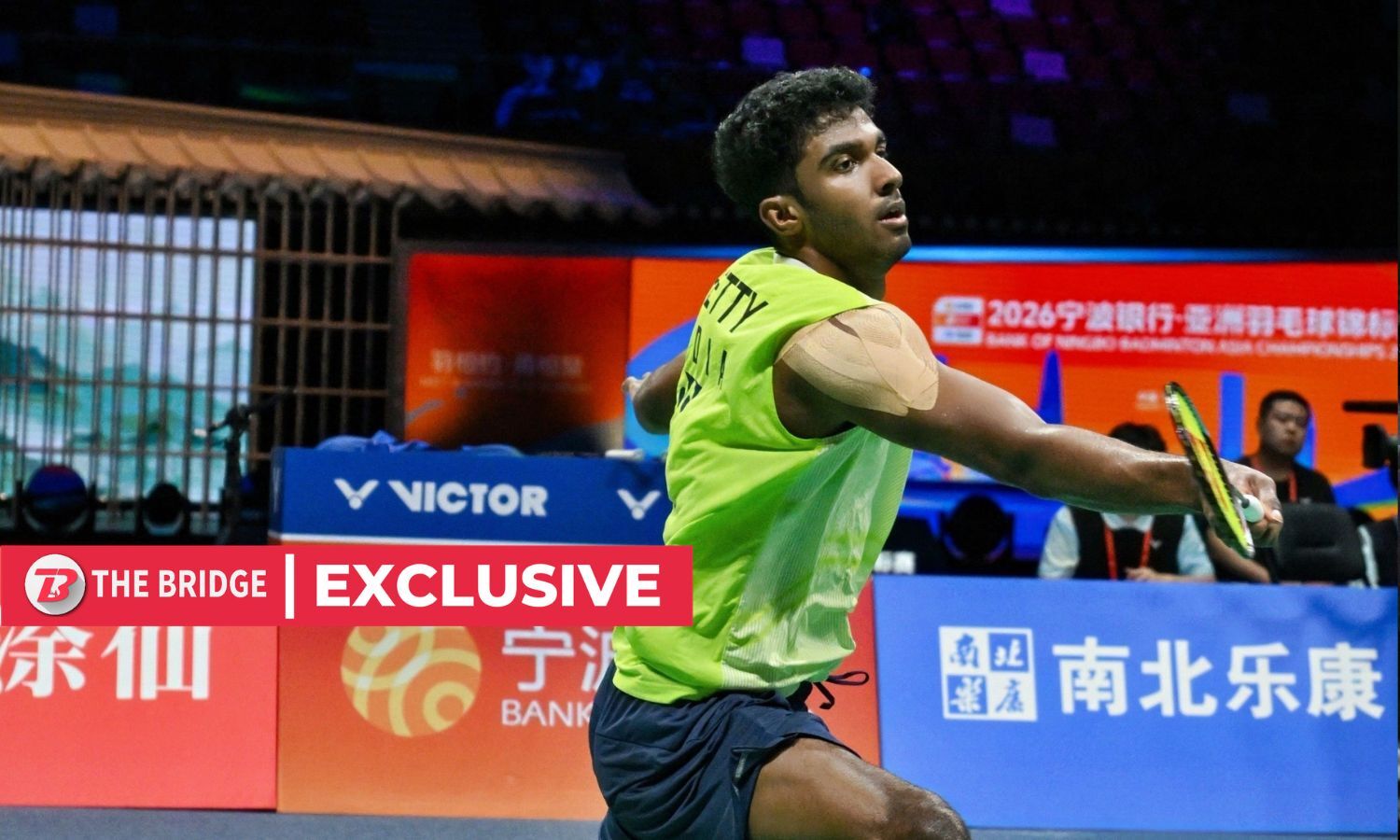
It was this cognitive intelligence and the ability to anticipate what his opponent would do next which shot Shetty to social media prominence in the early days of the 2026 Badminton Asia Championships.
In the first round clash against Li Shi Feng, Shetty hung his racquet at the net for a few seconds after lifting the shuttle from the front court. The Chinese shuttler smashed it right into the middle of his racquet, helping him get the point and online virality.
“He was anticipating shots before they were playing, and he was in a position to finish more often than not,” noted Kamat.
“He knows it by default. You can’t teach this instinct,” the coach added.
Shetty himself attributed that shot to just pure instinct.
“It was just instinct. I knew I couldn’t take it from behind. So, I just tried my luck and placed my racquet. It was a special one,” said Shetty in a media interaction.
Instincts aside, Kamat also notes Shetty to be a quick learner.
“Suppose we have programs A, B, C in a week and we completed module A on Monday or Tuesday, then there was never a need to repeat those modules because he had already mastered it,” he explained.
Apart from the cognitive ability, the other two aspects which also impressed Kamat in a 13-year-old Shetty were his endurance and his sharp serves.
“He would return the shuttle, no matter how it came, because of his endurance. That positive return of the shuttle, which he was doing right, is very hard to find at that age,” he shared.
“Thirdly, there used to be no weak rallies in his game. He had a simple service which was not heading straight to the opponent’s hands, and he had a good toss.
“These are basic things which will put any opponent in a dire situation, and he had these three qualities naturally,” Kamat added.
Calmness and physicality
After that first all-India tournament in Bengaluru, Kamat and Shetty spent the next few months fine-tuning his explosiveness on court and his attacking game with an aim to break into the top-10 of the U13 national rankings.
“The first focus was on explosive moments, which would have allowed him to move quicker and have a good jump from the rear end of the court,” Kamat revealed. “We developed it via an extensive focus on strength and conditioning.
“Secondly, we relentlessly focused on the art of attacking. Attacking in the sense of the downward strokes,” he added.
It paid dividends as Shetty won a few national tournaments and rose to become India No 1 in U13 within a few months.
It helped him establish himself in the circuit, and soon after that, Shetty switched to the famed Prakash Padukone Badminton Academy (PPBA) – a place where he continues to train even today.
Ayush Shetty celebrates after becoming the first Indian in 61 years to reach men’s singles final at 2026 Badminton Asia Championships (Photo credit: Badminton Asia Championships)
It is at the PPBA, with the right guidance and nutrition, that Shetty morphed into the now 6’4″ giant.
“When he joined (Baddyzone) he had an ectomorphic body frame – naturally lean, slender frame, and good metabolism,” noted Kamat.
“What I mean when I use the term “natural talent” is the three things I mentioned earlier. It must only be after he joined PPBA and had proper guidance and nutrition that he grew. Again, you also need to note that 6’4″ height can’t be tailored for anyone,” he added.
It is this physicality for Shetty which has often drawn constant comparisons with Viktor Axelsen, a modern-day great and his own idol.
While he has grown multi-fold in size and his game has elevated to the elite level since they last worked together, one thing Kamat notes hasn’t changed is his calmness.
“There are many players who are extremely good with skills but can’t deliver under pressure,” said Kamat.
“Shetty, on the contrary, has always been calm and composed under pressure. He continues to be so,” he added.
An association which started only because a Chinese corporate entity wanted to capture market share might just have given India Ayush Shetty – its next big superstar.

Comments are closed.