
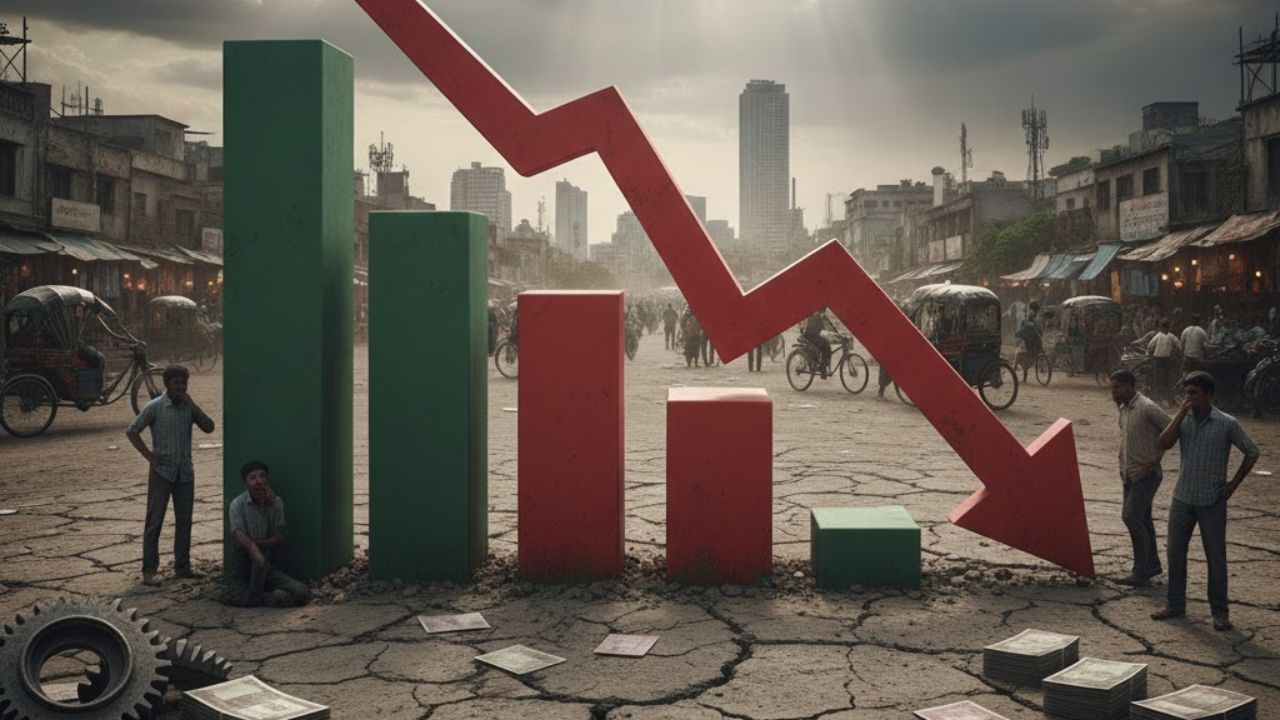
Bangladesh’s economy has fallen flat; unemployment at its peak, it is very difficult for people to survive.

Bangladesh Economy Crisis: Bangladesh is going through its most difficult economic phase. Promises of stability and reform have quickly evaporated with the interim government. Due to this the country’s economy has come to a standstill. People are starting to get disappointed. With each passing day, there are new stories of families struggling to make ends meet, workers losing jobs and small businesses closing down. The country is on the verge of a serious economic crisis due to political instability and increasing violence. The government treasury has become empty due to decline in income and less investment. Many industrial companies are leaving the country.
The International Monetary Fund (IMF) team led by Chris Papageorgiou visited Dhaka from 29 October to 13 November. According to the documents revealed after this, Bangladesh’s GDP growth in FY 25 has decreased from 4.2 percent in FY 24 to 3.7 percent. This reflects production delays, tight policy mix and increased uncertainty during the popular uprising. Inflation fell by double digits at the beginning of FY2025, but remained at 8.2 percent in October. Whereas GDP had registered a growth of 3.5 percent in 2020, 6.9 percent in 2021 and 7.1 percent in 2022.
Dangerous increase in non-performing loans
Concerns over non-performing loans and private sector credit provide yet another revelation. There has been an alarming increase in non-performing loans. ADB’s estimates range from 20% more to more than 35% under the central bank’s revised classification rules. This is the result of a long overdue commitment to honest accounting.
banking sector bad
For years, the previous government reportedly put pressure on regulators to hide defaults, relax classification standards and extend loan re-scheduling indefinitely. The result was that the banking sector looked healthy on the outside but was deteriorating on the inside.
Decline in private credit growth
The rise in non-performing loans is the system’s price for confronting the real state of affairs. The deceleration in private credit growth, which fell to 6.29% by the end of 2025, must be understood in context. Previous double-digit credit growth was fueled by massive, politically connected borrowing, which produced little actual economic return. Eventually this turned into a growing non-performing loan crisis. Many of these loans were never given with the intention of repaying them. It is alleged that these were sent to real estate or offshore accounts abroad. On the contrary, today banks are more cautious. Credit is going to sectors where the risk of default is low.
Foreign direct investment surprised
Foreign Direct Investment (FDI) also tells a surprising story. Contrary to popular belief, political turmoil deters investors. FDI in Bangladesh increased by 20% in the 2024-25 financial year. By the way, for the first time in recent records, net FDI flow from the US turned negative, mainly due to disinvestment in the energy sector following political uncertainty. This led to a sharp decline in American investment.
Elections are to be held on 12th February
Elections are scheduled for February 12. This, along with the possibility of a fully elected government returning to Bangladesh in the next two and a half months, has improved the sentiment among some global investors. Who were waiting.
increase in unemployment rate
According to the latest quarterly labor force survey of Bangladesh Bureau of Statistics (BBS), the unemployment rate in the country stood at 4.63 percent in the October-December quarter of the current financial year as per the standards of the 19th International Conference of Labor Statisticians (ICLS). This is more than 3.95 percent recorded in the same period last year.
Also read: Bangladesh on the path of Pakistan! Foreign debt increased by 42% during Yunus era, alarm bells on the economy
Food items became expensive
Continuous inflation is reducing the purchasing power of the people. Due to this, domestic demand is weakening and the recovery story is becoming more difficult. Private sector investment has also slowed down rapidly. Imports of capital machinery have fallen by 25 per cent in FY 24-25 compared to the previous year. A similar decline has been recorded in letters of credit for such machinery. Before the turmoil, Bangladesh’s economy had shown strong headline growth rates. Averaged 6-7 per cent annually over the past decade, but this masked structural weaknesses, including low revenue generation and a large current account deficit. There were also several regulatory hurdles, which reduced investor confidence.
Is the economy collapsing?
After a sharp decline following the political earthquake in the financial year 2024-25, Bangladesh avoided economic recession, but joined the list of low-growth countries. IMF has estimated 4.9 percent GDP growth for the current financial year, which is lower than earlier estimates.

Comments are closed.